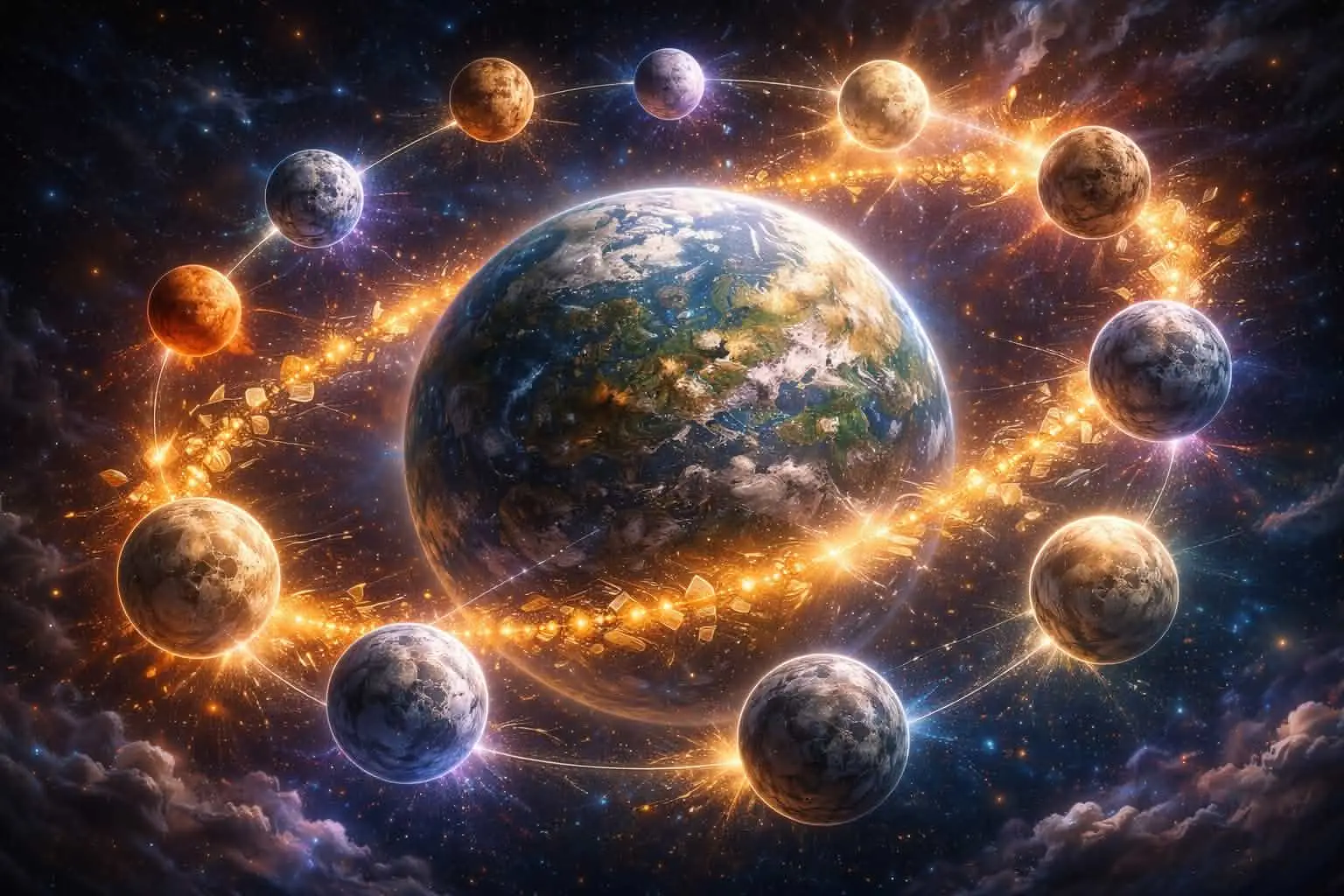
Cosmology of Eberron
The system that holds reality together
LECTURE NOTES — INTRODUCTION TO PLANAR THEORY, MORGRAVE UNIVERSITY, 998 YK
Before we begin: you are sitting in a manifest zone. Sharn exists because of a permanent connection to the plane of Syrania, the Azure Sky, which empowers flight magic and enables these towers to reach heights that would be structurally impossible anywhere else on the continent. The skycoach that brought you to campus this morning flew because of that connection. The bridges you crossed hold because of it. The fact that you are sitting in a chair seven hundred feet above the ground and not thinking about it is itself a product of the cosmological system we are about to study.
Eberron sits at the centre of its own cosmological system — a closed arrangement of thirteen planes orbiting a single Material Plane, sealed from the wider multiverse by the Ring of Siberys. The three Progenitor Wyrms created Eberron and its planes as a new cosmic system, recreating the races found elsewhere in the multiverse and placing them in a world beyond the reach of Gruumsh, Corellon, Lolth, and other influences for good and ill. Whether the barrier will hold forever is another question, and one that certain scholars at the Arcane Congress find increasingly urgent.
This cosmology is not a curiosity. It shapes daily life. Manifest zones mark places where a plane's influence is permanently strong — Sharn's towers reach into the sky because of Syrania, the greatest farms and vineyards in Khorvaire grow in Lamannian zones that promote fertility, and the prison-fortress of Dreadhold is built in a zone where Lamannian primordial matter produces preternaturally durable stone. Coterminous periods amplify those zones and extend planar effects across the world. Remote periods weaken them. People in the Five Nations understand planar cycles the way they understand weather and tides — not as philosophy but as operating conditions that can be planned around, profited from, and occasionally survived.
The Progenitors
Every child in Khorvaire knows the story, though few agree on what it means.
Three cosmic beings — Siberys, Eberron, and Khyber — created the thirteen planes, then used those planes' concepts as the foundation of the Material Plane: a realm that could know war and peace, life and death, order and chaos. The Progenitors worked together at first, but rifts formed as they shaped reality. Dark Khyber grew greedy and Siberys responded by becoming more forceful, each seeking greater influence in the work. Daanvi, Fernia, and Irian bear the prevailing mark of Siberys. Kythri, Mabar, and Xoriat show the dominant touch of Khyber. Eberron sought to mediate but could not bridge the divide.
When it came time to create the final, central plane, the tensions could not be contained. Khyber struck Siberys without warning and tore him apart, scattering his scales across the sky. Eberron could not defeat Khyber with claw and tooth. Instead, she embraced her, calling on the powers of life to give birth to soil, tree, and ocean, transforming herself into a living prison that Khyber could never escape. Siberys's remains became the ring around the world; his scattered scales became the stars. Khyber remains trapped within — the Dragon Below, the Mother of Monsters, the source of all darkness — forever struggling to break free.
Almost every culture across Khorvaire, Sarlona, and Xen'drik shares some version of this story. Whether the Progenitors were literal cosmic dragons, symbolic forces, or something the mortal mind cannot properly categorise is a matter of ongoing debate. In the Five Nations, most consider it a simple metaphor for sky, earth, and the monsters that lurk below. Even those who consider it literally true — as do many druids, particularly of the Gatekeeper tradition — do not worship the Progenitors the way they might the Sovereign Host. Siberys is dead. Eberron is the world itself; she is the source of all life, but does not actively intervene. A few cults, notably among the kobolds of Khorvaire, worship the Progenitors directly, but this is not mainstream practice.
What is not disputed is the structure they left behind:
Siberys, the Dragon Above. Shattered Siberys became the Ring of Siberys — a brilliant equatorial band of golden light that dominates the sky. Siberys dragonshards fall from it. The Siberyan Theory, as taught at Arcanix and the Arcane Congress, postulates that all arcane magic manipulates energy that radiates from the Ring. Magic itself, in this view, is the Blood of Siberys.
Eberron, the Dragon Between. The world. Soil, stone, living things, and the Eberron dragonshards found within it. The stabilising medium between extremes — the fulcrum where all planar forces exist in balance.
Khyber, the Dragon Below. Go below the surface and you find not a molten core but the demiplanes of Khyber — an endless array of pocket realities, each stranger than the last. Some are inhabited by fiends. Some by aberrations. Some by things that predate any classification. Khyber dragonshards form in these depths, associated with binding, containment, and corruption. The deepest reaches hold imprisoned overlords — archfiends bound since the Age of Demons — and planar boundaries that were never meant to be tested. A chasm in Breland might lead to a labyrinth of demons; a passage in the Mror Holds might open into a realm consisting of the guts of a colossal living creature. Anything is possible in Khyber, and the demiplanes are not concretely tied to the world above.
CHILDREN'S RHYME — COMMON ACROSS THE FIVE NATIONS
Golden Siberys, bright and high, Shattered scales across the sky.
Gentle Eberron, strong and deep, Wrapped the world in living sleep.
Dark Khyber, bound below, Dreams of breaking what we know.
Three made one, and one made three — That's the world, and that is we.
The Skies of Eberron
From the surface, Eberron looks much like our own world — soil below your feet, moons and stars above. But Eberron is not what it appears to be. As far as anyone has determined, it is the sole planet in its Material Plane and the fulcrum where the thirteen planes come together. What hangs in the sky is not what it seems.
The Ring of Siberys. A brilliant band of golden light wrapping the equator, visible from every point on the surface. Its colour suggests the entire ring may be comprised of Siberys dragonshards — the same crystals that fall to the surface and serve as vital components in dragonmark focus items, elemental binding, and high-end artifice. The Ring is not merely decorative; the Siberyan Theory holds it as the source of all arcane energy, and Xen'drik's position along the equator — directly beneath the Ring's densest passage — explains why the continent's Siberys shard fields are far richer than Khorvaire's.
The Sun. Called Arrah. In the Progenitor myth, the three created the sun after creating the planes, much as mortals might kindle a campfire. The fire remained even after their battle. In the Sovereign Host, Dol Arrah is the Sovereign of Sun and Sacrifice — her name is, essentially, "Warrior Sun."
The Stars. There are stars in the sky, but they are not distant suns. There are limits to the Material Plane, and the stars mark those limits — glittering points in what amounts to a crystal sphere. The common constellations are figures of ancient dragons: Io, Tiamat, Chronepsis. Most people could not say where these names come from; it is generally assumed they were handed down from an ancient kingdom of Sarlona or established by the ancestors of the Aereni. In fact, the names derive from a tradition spread by the sages of Argonnessen — the dragon continent — though very few mortals know this.
The Moons. Twelve orbiting moons are visible from Eberron. A thirteenth, Crya, has not been seen since ancient times, when tales say the empire of the giants destroyed it — severing the connection to Dal Quor, the Region of Dreams, and making that plane permanently remote. Each moon goes through standard lunar phases, but during the month that shares its name, it enters an ascendant phase and shines brighter than usual. Each moon is also tied to a specific plane: when that plane is coterminous, the moon enters an additional ascendant phase; when the plane is remote, the moon grows unusually dim. It is possible — though uncommon — for two or three moons to be ascendant simultaneously if multiple coterminous periods converge, a conjunction that characters proficient in Arcana can usually anticipate.
No one from Eberron has visited the moons. Some sages believe they are habitable planetoids. Others believe they are not physical bodies at all but rather planar gateways — that an airship flying high enough would pass not into empty space but into the sky of the associated plane. Determining the truth would require an expedition beyond anything yet attempted.
ANNUAL REPORT — ARCHIVIST YENNA COPPERDALE, AUNDAIR ROYAL OBSERVATORY
I have spent thirty years mapping the Ring's shard-fall patterns by season, latitude, and planar conjunction. My best model predicts impact sites with an accuracy of roughly four miles. Cannith considers this impressive. I consider it a reminder that I am modelling something I do not fundamentally understand.
Moon | Plane | Colour |
|---|---|---|
Zarantyr, the Storm | Kythri | Pearly white |
Olarune, the Sentinel | Lamannia | Pale orange |
Therendor, the Healer | Syrania | Blue-grey |
Eyre, the Anvil | Fernia | Silver |
Dravago, the Herder | Risia | Lavender |
Nymm, the Crown | Daanvi | Yellow-gold |
Lharvion, the Eye | Xoriat | Dull white with large black chasm |
Barrakas, the Lantern | Irian | Bright grey |
Rhaan, the Book | Thelanis | Pale blue |
Sypheros, the Shadow | Mabar | Smoky grey |
Aryth, the Gateway | Dolurrh | Orange-red |
Vult, the Warder | Shavarath | Pockmarked steel-grey |
Crya (destroyed) | Dal Quor | Not visible; impossibly black |
The Thirteen Planes
Eberron is enfolded by thirteen planes of existence, each governed by a distinct set of metaphysical principles — war, dreams, decay, light, madness, order, nature, fire, ice, twilight, and more. Many have aspects of both Outer Planes and Inner Planes. All overlap with Eberron in some way, and they influence and are influenced by the Material Plane.
The planes are not moral destinations. They are not heavens or hells arranged around divine judgement. They are adjacent states of reality whose proximity to the material world waxes and wanes in cycles. When a plane draws close — coterminous — its influence strengthens across all of Eberron and amplifies existing manifest zones. When it recedes — remote — the influence fades, and the absence impacts the world as strongly as the presence did. Life blossoms when Irian the Eternal Dawn is coterminous; colours seem to fade when it is remote. Undead grow stronger when Mabar the Endless Night draws close. The wild magic of Kythri becomes unpredictable and strange when that chaotic plane waxes. Thelanis, the Faerie Court, becomes coterminous for seven years at a stretch every 225 years, and when it does, new gateways spring up across the world and mischievous fey cross over — though you must generally break some superstition or taboo to be pulled through.
Each plane is composed of layers — distinct regions within the plane, each reflecting a different facet of its core concept. The layers of Shavarath, the Battleground, each contain a different kind of war: a bitter siege, a bloody melee, a lingering guerrilla conflict. The layers of Lamannia, the Twilight Forest, range from the Endless Ocean to the First Storm to the Rot, a swamp of natural decay where megafauna corpses feed giant scavengers. Travel between layers varies by plane: in some, you walk through a massive door; in Thelanis, you travel to a new layer by acting out the elements of a new story.
Manifest zones are places where a plane's influence is permanently felt on the Material Plane. Each is tied to a specific physical location on both sides — a manifest zone to Thelanis always connects to a particular region of that plane, not to Thelanis in general. Manifest zones often exhibit one or more of a plane's universal properties. The city of Sharn sits in a Syranian zone that empowers flight and keeps its towers reaching toward the sky. Lamannian zones enhance fertility and are prized by farmers, vintners, and House Vadalis enclaves. Irian zones sustain positive energy and often serve as the foundations of Jorasco healing houses; the City of the Dead in Aerenal, which sustains the deathless councilors of the Undying Court, is built on a powerful Irian zone. Manifest zones tied to Daanvi, the Perfect Order, are used as courtrooms — their Plane of Truth property makes deception difficult. Intelligence agencies are always searching for zones with detection properties. Zilargo has a number of valuable Lamannian zones with elemental power, which both House Cannith and the Twelve are eager to exploit — though elementals sometimes spontaneously manifest in such places, and bound elementals in airships can break free if the vessel passes too close to certain Lamannian zones.
Some manifest zones serve as direct portals between Eberron and another plane, though travel is blocked to Dal Quor and Xoriat. Most portals only open under certain conditions — often when the associated plane is coterminous, when the relevant moon is full, or both. Gateways to Thelanis often require that you follow ghostly music or chase a silvery deer off the path; if you stay on the path, you will not stumble through. Gateways to Lamannia and Fernia can be more abrupt.
The Age of Demons
The cosmology is not merely a system of planes and cycles. It has a history — and the deepest stratum of that history still shapes the present.
In the first days of the world, the children of Khyber — fiends, aberrations, and monsters — rose from the darkness and claimed dominion. The greatest among them were the overlords, immortal archfiends who each embodied a specific evil that plagues mortals: tyranny, cruelty, war, deception, fear. Each overlord shaped the world to match their whims, and no civilisation could challenge them. This was the Age of Demons, and it lasted for untold millennia.
The Age ended after an extended war between the overlords and a legendary group of champions — now known to followers of the Sovereign Host as the Sovereigns and the Six. Whether these champions were gods, dragons, or something else entirely depends on which tradition you consult. The Sovereign Host's adherents believe they were the Nine and Six. Many scholars assert the myths are based on the deeds of heroic dragons — that the tales of Aureon, for instance, may be inspired by a dragon named Ourelonastrix. The truth remains undetermined, and it is possible for adventurers to find sites or relics from this age that hold power regardless of which interpretation is correct.
The overlords could not be destroyed. Countless couatl — celestial serpents said to embody the last light of Siberys — sacrificed themselves, their spirits combining into a prison of pure celestial energy. This force is the Silver Flame. Even today, the overlords remain bound and the world protected from apocalyptic evil by its power. Each overlord is sealed in a Khyber dragonshard and held by the Flame. Though bound, an overlord can influence the region around its prison — and there is no official, complete list of all overlords or where they are bound.
The Lords of Dust — the rakshasa and other fiends who once served the overlords — still work to free their masters, reading the Draconic Prophecy for the conditions that will weaken the seals. The dragons of Argonnessen — through their secret network known as the Chamber — still watch for signs of the overlords' return. This is not ancient history in the usual sense. It is an ongoing containment operation, and the front lines are invisible.
Faith and the Divine
The gods of Eberron do not manifest physically. No deity is known to issue commands, perform miracles before reliable witnesses, or sit on a throne in an identifiable plane. The Sovereigns do not dwell in the planes, and the people of Eberron do not expect them to. Vassals of the Sovereign Host believe the Sovereigns are everywhere at once — Onatar is not working at a forge in Fernia; he is with every smith at every forge.
Some immortals in the planes honour the Sovereigns. A platoon of angels in Shavarath may carry the banner of Dol Arrah. A squad of demons may howl praise to the Mockery. The Librarian of Dolurrh may mention the time Aureon came to borrow a book — but that was almost a hundred thousand years ago. These acknowledgments confirm the most basic myths of the Sovereign Host: that in the first age of the world, a band of champions defeated the overlords. It is possible that they ascended and became the omnipresent entities many believe them to be. But that is the part that even angels must take on faith.
Divine magic is real. It requires two things: absolute faith and a connection to a divine power source. Whether a paladin of Dol Arrah draws power from an actual goddess or from a well of collective faith in the unconscious of tens of thousands of believers is a question no one has answered. In a practical sense, the truth is irrelevant — the power exists. But the question of why one templar becomes a paladin and another of equal devotion does not is one that no school of magic or theology has resolved. People of faith say the templar was chosen. Maybe that is true. Maybe it is all just luck.
The Silver Flame is not a god. It is a force created during the Age of Demons to bind the overlords. It has a concrete purpose: it is the cage that keeps apocalyptic evil at bay. Those who seek to protect the innocent from supernatural evil can draw on its power. Noble souls strengthen the Flame after death. The Church of the Silver Flame is a practical, pragmatic faith — at the end of the day, the templar is not there to tell you how to live your life. They are there to make sure you can live your life, to protect you from the monsters and fiends that could appear at any moment.
The Blood of Vol is a grim but practical faith that believes there is no afterlife, the gods are cruel, and all we have is each other. Seekers believe that all mortals have a spark of divinity within their blood, and their clerics and paladins draw divine power from their own souls.
None of these traditions can point to a plane and say "our god lives there." All of them produce real, functional divine magic. The cosmology accommodates faith without confirming it, which is — depending on your temperament — either its greatest strength or its most frustrating feature.
RESEARCH NOTES — PROVOST DAELYS IR'RHAAN, MORGRAVE UNIVERSITY
I have interviewed a planetar, a pit fiend, an Aereni elder, and the high priest of a cult dedicated to the Keeper. Not one of them could tell me definitively whether the Sovereigns or the Six exist as discrete entities. What they could all tell me is that something answered when the faithful prayed. What that something is, and whether it has opinions, remains an open question.
Magic and the Cosmological System
Magic in Eberron is understood as a form of science. Arcane magic is widely believed to manipulate energy that radiates from the Ring of Siberys — the Siberyan Theory, Arcanix's dominant framework. Anyone with the aptitude can train at a house trade school to become a magewright or learn to be a wandslinger. There is nothing strange about seeing an airship in the sky or sending a message through a speaking stone.
Planar proximity affects how magic works. Spells aligned with a coterminous plane are stronger. Spells opposed to a remote plane may weaken. Manifest zones create local conditions where specific kinds of magic are enhanced or suppressed. Arcane institutions account for this the way marine engineers account for tidal variation — not as interference, but as operating conditions that inform scheduling, construction, and pricing.
Khorvaire possesses "wide magic, not high magic." The speaking stone lets you send messages between two stone stations, but sending is a rarer service that fewer people can afford. Lesser restoration is available at any good Jorasco healing house, but raise dead is not trivial. People in the Five Nations are accustomed to tools and services that function at the level of cantrips and 1st- or 2nd-level spells. They are familiar with 3rd-level magic — fireballs on the battlefield, aristocrats using Sivis sending services — but these things are expensive. Anything beyond that is rare, powerful, and often the province of the dragonmarked houses, the Arcane Congress, or individuals of exceptional ability.
Dragonshards serve as the interfaces that make most of this infrastructure possible. Siberys shards power dragonmark focus items and high-end enchantment. Eberron shards serve as all-purpose components — dragonshard dust substitutes for any costly spell component at equivalent market value. Khyber shards bind elementals and contain dangerous forces. An artificer binding an elemental into an airship's ring is not performing a miracle. They are exploiting a well-documented interaction between Khyber shards, elemental entities, and containment geometry. The process is taught in schools.
What No One Can Explain
The cosmology is a system. Systems can be studied, modelled, and exploited. Khorvaire has done all three. But the system has gaps that no institution has closed.
No one knows what lies beyond the Ring of Siberys in cosmological terms — whether the barrier is permanent, degrading, or already breached. No one knows what the moons truly are. No one can explain why divine magic works, only that it does. No one knows what caused the Mourning — whether it was a planar event, an arcane catastrophe, or something outside any existing model. No one has a complete list of the bound overlords or their prisons. The seals of the Gatekeepers that hold the daelkyr in Khyber and keep Xoriat from becoming coterminous are maintained by a dwindling sect of druids whose numbers may not be sufficient to the task. Dal Quor, the Region of Dreams, has been permanently remote since the giants shattered the moon Crya — and yet every mortal who sleeps still travels there, which means the barrier is not as absolute as scholars assume.
The cosmology of Eberron is a system that can be studied. It is not a system that has been fully understood. The difference between those two things is where most of the interesting problems live.
ADDRESS TO THE POST-MOURNING SYMPOSIUM, 995 YK — ARCH-ARCANIST HAELORN DUSKMANTLE, ARCANE CONGRESS
The Mourning is the best evidence we have that our model of the cosmological system is incomplete. Something happened that our entire collective tradition of arcane theory, planar scholarship, and theological study did not predict and cannot currently explain. That is not a failure of one discipline. That is an indication that everyone, everywhere, is missing something foundational. I find my colleagues are not as troubled by this as they should be.