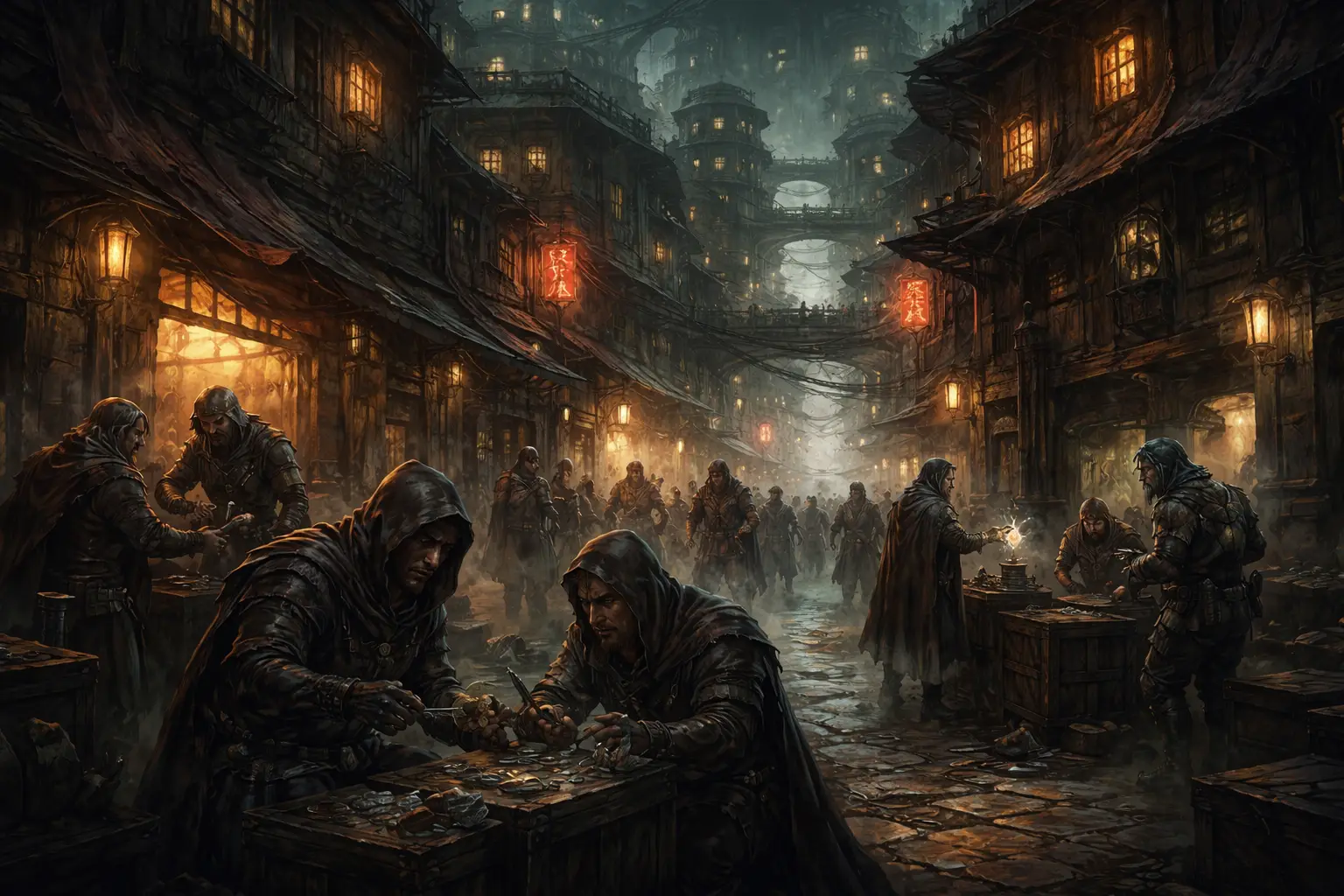
Lower Dura
"Lower Dura is where Sharn's promises stop, and its reality begins."
Lower Dura is the bottom end of Dura's vertical gradient: a place of collapsed prestige, entrenched poverty, and tolerated predation. It was once the heart of Sharn — the original city, back when the first towers rose from the ruins of Shaarat, and Callestan served as the center of commerce for the entire settlement. The ward still bears the architecture of that past, in the form of manors converted to tenements, temples converted to squatter camps, and a theater built to entertain nobles that now hosts dreamlily dens and crooked card games behind its cracked façade.
What happened to Lower Dura is not complicated: money moved upward, and when it left, it took the Watch with it. The district is defined not by active destruction but by the city's decision to stop paying attention. The exceptions are narrow and economic. Precarious is the only district in the ward with a meaningful Watch presence, because Precarious handles cargo that the city above cannot afford to lose. Everything else has been abandoned to whoever can hold it.
The council seat for Lower Dura belongs to Ilyra Boromar — the Boromar Clan's personal representative, reporting directly to Saidan Boromar, the most ruthless figure on Sharn's city council, and a woman whose record on the council includes the suspicious deaths of several opponents. Her position has recently grown complicated. Daask has spent two years raiding Boromar holdings throughout the ward, and the council majority has refused to direct Watch resources against them. The Boromar Clan, once thought omnipotent, is visibly losing ground.
Lower Dura is the most densely populated ward in Sharn and among its most impoverished. The ward shows its age in every surface: cracked and worn streets, walls covered in mildew and graffiti, everbright lanterns replaced by everburning torches — and in the worst neighborhoods, the torches shattered or stolen. Residents are shielded from the worst of the violence by gang allegiances, criminal ties, or the simple fact of having nothing worth taking. Visitors with obvious wealth are advised to keep weapons to hand.
A Ward Abandoned
Lower Dura's decline is centuries in the making. As Sharn grew and its institutions moved into newly built towers at higher elevations, the old ward was left behind. The garrison relocated. The noble families followed the money upward. The temples moved their relics to Sovereign Towers and left their shells to be converted into worker housing. What remained was an increasingly hollow city-within-a-city: buildings that looked like Sharn's past, inhabited by the people the new Sharn had no use for.
The final formal blow came on 9 Olarune 918 YK, when Aundairian saboteurs destroyed the enchantments supporting the Glass Tower. The citadel broke apart as it fell, most of it landing in the Dagger River, but its spires struck the temple district then called Godsgate, shattering buildings and killing hundreds. The city council declined to fund reconstruction. Within a year the district had a new name — Fallen — and has been shunned by most of Sharn ever since.
The Two Economies
Lower Dura runs on two economies with almost no overlap between them.
The legitimate logistics economy is centered in Precarious and The Stores. Cargo rises from Cliffside through the skydocks — arcane cranes and levitation rigs operated by an army of stevedores, teamsters, and lift crews — and is staged in warehouses before being forwarded into the city's markets and manufactories. The Boromar Clan owns many of these warehouses and holds interests in the shipping trade that flows through them. The Watch presence here is real and consistent, because disrupting the skydocks would immediately affect the economies of every ward above.
The shadow economy defines everything else. With the Watch absent, criminal organizations provide the functional replacement for civic order: protection, dispute resolution, territory enforcement, and access to work that is only "illegal" when it inconveniences someone with power. Fences, bookies, dreamlily brokers, and illicit contractors operate openly enough that locals treat them as standard commerce. The four major criminal powers of Sharn — the Boromar Clan, Daask, House Tarkanan, and the Tyrants — all maintain significant presences in the ward, with Callestan serving as their shared nexus.
The Boromar-Daask War
The most consequential current development in Lower Dura is a slow-burning territorial conflict between the Boromar Clan and Daask that has been intensifying for two years. Daask's elite Droaamite soldiers — gnolls, ogres, minotaurs, medusas, trolls, and various other monstrous combatants operating under guerrilla tactics — have been systematically raiding Boromar holdings throughout the ward. The Boromars, whose operational model depends on controlling territory and maintaining an aura of omnipotence, have struggled to respond effectively. They have hired Deneith mercenaries to protect specific holdings, but these guards cannot be everywhere at once, and they are ill-equipped for opponents like trolls and medusas.
Daask has taken over criminal control of the Cogs outright and is gaining ground in the lower levels of the city. The Boromar Clan still dominates the middle and upper wards, but the credibility damage is real: the other criminal organizations — Tarkanan and the Tyrants — have taken advantage of the chaos to expand their own operations in Callestan, filling the gaps the Boromars can no longer fully cover.
Districts
Callestan (Inn district) — When Sharn first rose from the ruins of Shaarat, Callestan was the center of commerce. Today it is the city's most concentrated nexus of criminal activity, where all four major criminal organizations maintain holdings and negotiate boundaries. House Tarkanan handles assassination and theft; the Tyrants run forgery, deception, and prostitution; the Boromar Clan controls smuggling, gambling, and illegal goods; Daask operates as a violent wildcard. The Silvermist dream parlor — a Boromar-owned dreamlily den that fronts as an illusion entertainment venue — and the Cracked Mirror — a changeling-run tavern rumored to connect to the Tyrants — are among its more notable establishments.
Fallen (Slum/ruin) — Once Godsgate, Sharn's first temple district. After being struck by the falling Glass Tower in 918 YK and subsequently abandoned by the city council, it became Fallen: a ruin field inhabited by ravers — feral, bloodthirsty figures of uncertain origin whose nature is debated but whose lethality is not — and the restless spirits of those killed in the disaster. The city council uses Fallen as an informal asylum, depositing the criminally insane into the district where they either join the ravers or quickly die. The only functioning institution is Blackstone Church, where a single priest named Faela provides nonmagical healing and conflict mediation to those desperate enough to live there.
Gate of Gold (Tenement district) — The gate from which this district takes its name had its gilt plating stripped off centuries ago, which tells you most of what you need to know. Once home to founding families of Sharn, the district is now wretched tenement housing in decaying manors and converted towers. Small and dangerous, it offers no services worth naming.
Malleon's Gate (Goblinoid slum) — The oldest continuously inhabited goblin district in Sharn, with roots predating the human city itself. Goblin families have lived here for over a thousand years; recent decades have brought a significant wave of monstrous immigrants from Droaam and Darguun, many affiliated with Daask. The district is especially hostile territory for halflings or anyone with visible Boromar ties. It contains an old temple to the Sovereign Host where the nine sovereigns are depicted as idealized goblinoids, and a shrine to the Mockery established by the medusa Gasslak. Malleon's Gate is essentially Daask-controlled territory at ground level.
Oldkeep (Apartment townhomes) — The old City Watch headquarters, sold to landbarons after the Watch relocated upward and converted into apartment housing. Most residents work in Precarious, The Stores, or Middle Dura, and many have ties — knowing or not — to the Boromar Clan. Daask has been running surgical strikes here: operatives hit Boromar-linked targets and vanish into the Cogs before the hired Deneith guards can respond.
Precarious (Warehouse district) — The ward's economic anchor and its only properly policed district, Precarious physically projects out over the cliff's edge, built around the skydocks that move cargo between the Dagger River port and the city above. The arcane cranes and levitation rigs here are infrastructure the city cannot afford to lose, which is why the Watch maintains a presence nowhere else in the ward but maintains one here. A small Sarlonan immigrant community lives within the district alongside the warehouses, flophouses, and workhouses that have grown up around the dock labor economy.
The Stores (Warehouse district) — Similar in function to Precarious, The Stores handles overflow warehouse capacity and goods moving through the lower port economy. Unlike Precarious, it receives less Watch attention, making it somewhat more dangerous and a preferred location for smugglers hiding contraband among legitimate cargo. A significant halfling community lives here, and the district is a Boromar stronghold — the clan owns many of the warehouses and the Glidewing, the Race of Eight Winds mount that represents Gate of Gold and The Stores, is widely believed to be funded by Boromar money.