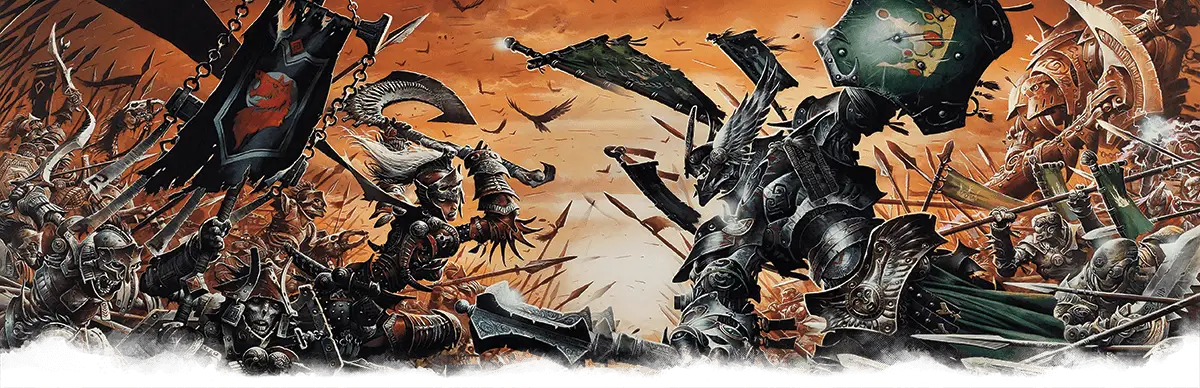
The Day of Mourning
FROM THE KORRANBERG CHRONICLE — Special Edition, 21 Olarune 994 YK:
CATACLYSM IN CYRE!
A magical catastrophe of unknown origin engulfed the nation of Cyre yesterday, bringing a century of war to an explosive climax. Surely when the children of King Jarot began their squabbles over succession a hundred years ago, they could not have foreseen the horror that would engulf the home of Queen Mishann. Our reporters are still sifting through accounts of what has happened, but it is clear at this point that beautiful Cyre, the jewel of Galifar's vast holdings, has disappeared behind a churning cloud of dead-gray mist.
On 20 Olarune, 994 YK, the nation of Cyre ceased to exist.
No declaration preceded it. No warning was issued. Cyre had been battered by a century of war — it had lost the eastern territories of Valenar to the Tairnadal and the southern territories of Darguun to the hobgoblins — but it still stood. Cyran soldiers had recently driven deep into Karrnathi territory and were holding their lines against the combined forces of Breland and Thrane. Tens of thousands of Karrnathi troops were in Cyran territory on that day, preparing a staging ground for a deeper push into Breland; they died alongside the Cyrans. The war, brutal as it was, appeared to be continuing as it always had.
And then the mist came.
Accounts of where it began differ sharply and have never been reconciled. Some survivors swear the dead-grey mist rose from the royal Vermishards of Metrol — the seven towering columns of rock that bore the palaces of the Cyran crown — spilling first from the royal palaces themselves. Others insist the disaster originated in Making, the great Cannith stronghold in southern Cyre — the region around the city was consumed by enormous tremors, the lightning rails and other roads connecting it to the rest of the continent were annihilated, and the city was isolated so completely that almost no one credibly believed to have been inside escaped. Still others describe a blinding light near the Saerun Road before the mist arrived from over the horizon. House Medani attempted to find answers by examining the bodies left behind in Metrol, but found evidence just as conflicting as people's stories — many had fled in different directions, while others appeared to have died with no awareness of what was happening.
By the end of the day, the mist had engulfed the entirety of Cyre's borders. Over a million people died. Those who survived were soldiers already fighting beyond Cyre's borders when the Mourning struck, residents of the borderlands who heard warnings in time to flee — some by sending stone, some simply by seeing the mist approach on the horizon and running — and a small number who escaped by magical means from deeper inside the country. At Dollen on the River, one of the last cities consumed, residents fled across the Cyre River, only to be swiftly captured by the Karrnathi military and held as prisoners of war. At the coastal town of Seaside, the smaller military presence meant no organised evacuation — boat owners took on only close friends and family, conscientious captains made agonising choices to cut people off lest overcrowding sink their vessels, and far too many people never made it onto a ship at all.
The mist halted its advance as it spread outward, slowing at the borders with uncanny precision; it stopped within feet of the camps of Cyran soldiers holding sections of the Brelish front. It did not cross. It still has not.
A few thousand people survived from within the mist itself. Most have no clear memory of the event and no explanation for why they were spared when those around them were not. Some in Khorvaire call these survivors cursed — touched by something that left its mark.
LETTER — recovered from a Cyran soldier's body, Brelish front, 20 Olarune 994 YK: "Dalla — the mist is on the horizon. It is coming from the east. I can see it from where I stand. The officers say it is Karrnathi weather magic. I do not think it is weather. I do not think it is magic. I think it is the end of something. If you receive this letter and I do not come home, know that I was looking east when it came, and I was thinking of you." — Unsigned. The letter was found in the soldier's hand. The soldier was alive. He does not remember writing it.
The Mournland
What the dead-grey mist surrounds is now called the Mournland. It is not simply a ruined country. It is a wound — a dungeon the size of a nation, filled with dangers and treasures, and nothing about it is predictable.
The border of the Mournland is defined by a wall of grey mist that rises thousands of feet into the air, forming a canopy that conceals the interior even from above. The mist ranges from a few hundred feet to several miles in depth at its thickest. Travellers who linger in it report a growing sense of claustrophobia and despair; it is easy to become disoriented, to walk in circles until supplies run out or something in the mist finds you first. The DC for Wisdom (Survival) checks to avoid getting lost in the mists is 15. Patches of lighter fog dot the interior, but the worst of it is concentrated at the border — a threshold between Khorvaire and whatever the Mournland has become.
Past the mist wall, the land is transformed in ways that defy consistent description. In some places, the earth has been fused into jagged glass. In others, it is cracked, burned, or reduced to a grey sludge that does not behave like ordinary ground. Trees turned to crystalline onyx. Flowers that begin buzzing when a breeze touches them. The Glowing Chasm — a vast crack in the northern Mournland — emits a cold purple light from depths that have never been measured; the mutated creatures that roam the Mournland are drawn to it, and those that linger near it mutate further, becoming more twisted and misshapen than before. In the east, where the Rushing River once ran south to Kraken Bay, the riverbed is dry and dead. Where its source spring once was, there is now the Crimson Water — a stagnant lake the colour of old blood, its shores littered with the bones of animals and travellers who sought to drink from it. At the lake bottom lies the ruined resort town of Eastwood Springs, and no one has been brave or foolish enough to search for lost treasures in its depths.
There are rules in the Mournland, but they are not the rules of the world outside. Wounds sustained within its borders do not heal on their own. The thousands of bodies that litter its battlefields — soldiers from every nation that fought on Cyran soil — do not decompose. They simply remain, preserved in the postures of their deaths, neither rotting nor rising. Existing undead were unaffected by the Mourning, and new undead came into being when the cataclysm struck. Ghosts and specters linger near the sites of their deaths. Battlefields stir when living creatures approach, their fallen soldiers rising once more to fight whatever war they remember.
Most extraordinary are the living spells — war magic that has taken on a physical existence, becoming something neither spell nor creature but sharing qualities of both. Arcane fires crawl through the streets of ruined cities, cling to lampposts, and flee from strangers. Living cloudkills drift across open ground searching for new victims. In the ruins of Eston, one of House Cannith's great foundry-cities — once renowned for its clockwork menagerie and its steel gardens, now overrun by living spells and constructs twisted by the Mourning into deadly monsters — reports speak of something stranger still: a living spell that has begun absorbing others, amalgamating into an arcane maelstrom of growing intelligence. Salvage reports suggest it answers questions in riddles and appears to understand the questions it is asked.
In Metrol, the old capital, buildings and entire city blocks have been relocated without apparent pattern — maps made before the Mourning are useless. Several of the Vermishards appear to have been exchanged with each other. The days are quiet. The nights bring a cacophony of chaos and violence as misshapen monsters emerge from their lairs to prowl and hunt through the rearranged streets. Warforged colossus WX-5, called Norr — the most humanoid of the colossi, built to inspire as well as guard — lies slumped against one of the vermishards, a mountain of darkened metal and shattered purpose.
Almost nothing in the Mournland can be predicted. Magic is unreliable, especially near Making and the Glass Plateau — an enormous expanse of fused obsidian that the cataclysm created around the city, mostly smooth and flat but jutting with jagged spikes and spires. The central portion is dark obsidian with bursts of fiery light visible in its depths. Toward the edges, the glass becomes lighter and more transparent, almost pale white along the jagged cliffs at the plateau's rim. New fissures continue to open, with strange magma flowing outward to expand the plateau's margins slowly but steadily. An enormous pillar of glass — the Crystal Spire — juts from an arbitrary point within the ruins, reaching an impossible height into the sky, crackling with volatile arcane energies. The fabric of reality is thin there. Navigation magic fails. Dangerous magical phenomena are especially common. And somewhere beneath the obsidian, buried in Making's subterranean depths, secret Cannith laboratories hold whatever they held on the day everything stopped.
Constructs and warforged were largely unaffected by the Mourning, which is why the warforged who follow the Lord of Blades have been able to establish a presence within the Mournland that no organic faction can match. For reasons unknown, the Kolyarut — the ineffable central intelligence that enforces the laws of the plane of Daanvi — has taken a special interest in the city of Making, sending a single agent to delve the ruins and replacing it almost immediately when destroyed. The agent does not hesitate to use violence against those who interfere with its duties. What it is looking for, no one has been able to determine.
The ruins of Cyre are, in a grim sense, the warforged's now.
"It's dangerous. It's mysterious. But it's also a dungeon the size of a nation, with opportunities for those brave enough to enter the mists." — Eberron: Rising from the Last War
Competing Theories
The cause of the Mourning is unknown. This is not a matter of contested interpretation — it is a genuine absence of consensus, a question that the best arcane minds of Khorvaire have spent four years failing to answer. A DM should consider whether the mystery can be solved in their campaign and what the consequences would be. Right now, fear of the Mourning holds war at bay. If it is confirmed that the Mourning is no longer a threat — or if one nation manages to harness its power — war could begin again.
Several theories circulate. None are proven.
The Weapon Theory. The most widely held view is that the Mourning resulted from an experimental weapon — either Cannith-made, state-commissioned, or developed in one of Cannith's secret research facilities in Making — that went catastrophically wrong. The particular devastation around Making supports this view: the Glass Plateau, the Crystal Spire, the sealed subterranean laboratories. So does the fact that House Cannith lost its leadership and the majority of its operations on the Day of Mourning. Whether this constitutes evidence of guilt or simply of proximity is a question that different investigators answer differently. The canonical formulation: "The secrets can be found in a Cannith research facility within the Mournland. If this knowledge could be recovered and refined, it could produce a terrifying weapon."
The War Magic Theory. A related view holds that the Mourning was not a single weapon but the cumulative consequence of a century of extensive magical warfare — that the arcane fabric of the region, stressed by a hundred years of siege staff bombardment, blast disk detonation, and sustained ward magic, finally ruptured. If the nations continue to use such magic, the Mourning could expand. This theory is the one that frightens warmongers most, because it implies that the power to destroy nations is not something any faction controls — it is something the war itself produced, and it could happen again anywhere the conditions are replicated.
The Overlord Theory. The Mourning was triggered by the release of an ancient demon overlord, a fiend imprisoned since the dawn of time. This mighty entity lurks in the Mournland, building its power, and soon it will be ready to act. The whirlwind of stone and sand that at least one Mournland explorer has reported — and that a rakshasa is said to be working to reach — may be connected.
The Divine Judgment Theory. Religious communities across Khorvaire have interpreted the Mourning through their own theological frameworks. In Thrane, some Silver Flame theologians frame Cyre's destruction as a consequence of its moral failures — arrogance, arcane excess, material pride. In Karrnath, Blood of Vol preachers offer darker readings. These interpretations are not universally accepted even within their own traditions, and many faithful have reacted to the Mourning not with theological certainty but with crisis.
The Planar Rupture Theory. Arcane scholars have proposed that a century of intensive magical warfare destabilised one or more of Cyre's manifest zones, producing a catastrophic interaction with an adjacent plane. The Glowing Chasm's cold purple light and its mutagenic effects suggest ongoing planar contamination. The Glass Plateau's expanding margins and the Crystal Spire's volatile energies are consistent with a site where something fundamental broke.
The Deliberate Attack Theory. Some investigators believe the Mourning was not an accident but a targeted strike. If so, every surviving nation is a suspect. No nation has admitted involvement. No faction has claimed credit.
The Sealed Testbed Theory. Among the most unsettling fringe interpretations is the suggestion that the Mourning was not a failure but a success — that someone created the Mournland deliberately, as a sealed environment for research that required conditions impossible to produce elsewhere. The arcane maelstrom in Making's ruins, the strange intelligence of certain living spells, the preservation of the dead: these are not consistent with a weapon that misfired. They are consistent with a weapon that worked.
The most honest answer is that no one knows. The mist remains. The dead do not decay. The living spells hunt. And inside the Glass Plateau, something the size of a city sits beneath fused obsidian, cracking with volatile energy, with the ruins of Cyre's greatest Cannith stronghold buried somewhere in its depths — waiting, like all the Mournland, for someone to find it.
"Everyone has a theory. The theories are not comforting. The absence of a theory is worse." — Morgrave University lecturer, speaking to students before a Mournland field expedition briefing
Political Consequences
The Mourning ended the Last War. Not through resolution, not through victory, but through terror. If that could be done to Cyre — to the heart of old Galifar, to a nation with armies in the field and a queen on her throne — it could be done to anyone. Within two years of the Day of Mourning, the Treaty of Thronehold was signed.
Valenar and Darguun, which had each seized Cyran territory during the war, refused to return what they held. The Treaty ratified their claims, leaving the surviving Cyran government with no recognised homeland. Prince Oargev ir'Wynarn, last surviving child of Queen Dannel, presides over New Cyre — a refugee settlement in eastern Breland that ranges from a roughly hewn downtown to an outlying tent city, more camp than capital. He was serving as Cyre's ambassador to Breland on the Day of Mourning, and the treaty was signed without him. He holds court, dispatches diplomats, and funds expeditions into the Mournland hoping to uncover the truth of what destroyed his nation. Publicly, he praises Breland's hospitality. Privately, he is consumed by anger and the need for vengeance — and the question of whether the Mourning was an accident or an attack is not, for him, an academic exercise.
The Cyran diaspora has scattered across every corner of Khorvaire. Former nobles in threadbare clothes attend social functions in borrowed enclave space. Veterans who were fighting in enemy territory when the Mourning struck came home to find there was no home. Breland, alone among the Five Nations, offered land without condition — but the King's Dark Lanterns maintain surveillance on the refugee community as routine, and no serious effort has been made to integrate Cyrans into Brelish civic life. In Q'barra, refugees built the region called Hope almost from scratch, finding themselves culturally at odds with the New Galifarans who had left Cyre generations earlier. In Karrnath, refugees were initially treated as prisoners of war. In Zilargo, they were admitted quietly and placed under continuous Trust observation.
The question of whether New Cyre might eventually seek to become an independent nation — and whether Breland would permit it — has never been openly answered.
"My students ask me when the Last War ended. I tell them: I will let them know." — Arcanix instructor, contemporary history
The Mournland's Inhabitants
The Mournland is not empty. It is dangerous and largely inhospitable to organic life, but it is inhabited.
The warforged appear immune to most of the Mournland's environmental effects — they do not heal within its borders, but they do not suffer the ongoing corruption that afflicts flesh. The Lord of Blades has used this advantage to establish a presence within the dead nation that no other faction can match. His followers — the Blades — salvage resources from the ruins, collect weapons and magical research from destroyed facilities, and build what they describe as the foundation of a warforged nation. They launch periodic raids against targets in the bordering Five Nations and have destroyed Cannith workshops across Khorvaire. They do not negotiate. The Blades are certain their leader possesses a creation forge and that he swells his following with new warforged, though no one outside the inner circle has confirmed this.
Beyond the Blades, the Mournland is inhabited by mutated creatures of every kind — some recognisable variants of creatures known elsewhere, others apparently new forms that emerged from the Mourning itself. Ghosts fight battles that ended four years ago. In Metrol, the nights belong to misshapen things that emerge from wherever they shelter and hunt each other through the rearranged streets. Ikar's Salvagers — the most well-known salvage operation, led by a Karrnathi half-orc with a wicked scar — send expeditions in for the considerable wealth that was left behind when a nation vanished in a day. Few return complete, and none return unchanged.
House Orien wants to restore the lightning rail line that crosses the Mournland, reconnecting the western and eastern halves of Khorvaire. House Cannith wants to recover trade secrets, experimental artefacts, and magic items from the creation forges, foundries, and secret laboratories it lost on the Day of Mourning. Prince Oargev funds expeditions hoping to recover the lost regalia of the Cyran crown. A Gatekeeper druid wants a rock sample from the Glass Plateau. A young Cyran paladin wants to retrieve her father's sword. An elderly knight is strapping on his armour one last time so he can ride into the Mournland and die on the battlefield where his companions perished and "where I should have been."
Everyone wants something from the Mournland. The Mournland gives back only what it chooses.
POSTED NOTICE — Ikar's Salvagers recruitment office, Vathirond: "EXPERIENCED ADVENTURERS WANTED for Mournland expedition. Hazard pay: 50 gp/day plus 10% salvage share. Requirements: combat proficiency, arcane resistance, willingness to sign death waiver. Previous Mournland experience preferred but not required. Apply in person. Do not send familiars."
Cultural Trauma
The Mourning inflicted a wound on Khorvaire that the Treaty of Thronehold did not address, because no treaty could. For the survivors of Cyre, it was not merely the loss of a homeland. It was the erasure of an entire civilisation in hours: noble lines, regional dialects, artistic traditions, archives, temples, and a million people. The Cyran community observes the Day of Mourning — 20 Olarune — as a day of grief, marked by the black Mourningwear that has become the most visible symbol of their collective loss: clothing cut in the traditional Cyran style, drained of all colour. Some tell stories of the dead. Others teach the history of the nation to the young. Others perform traditional Cyran songs and dances. Others remember only the war, cursing the other nations for refusing to acknowledge Mishann's claim and for starting the conflict that led to this.
In Sharn, where one of the largest Cyran refugee communities lives in High Walls, the Day of Mourning draws crowds from across the city — and Cyran ice sculptors gather in Sunset Park in Ocean View for the annual Long Shadows festival, carving intricate scenes from Cyran history and then watching as they melt, creating something beautiful and unforgettable and then witnessing its destruction. Some call this morbid. For most participants, it is a way to remember what was lost.
For those outside Cyre, the Mourning became something different: a limit marker, the moment the war revealed what it was capable of. Children across Khorvaire grew up with it as the central fact of their world. Playwrights and preachers reached for it as metaphor. Arcane researchers face heightened public suspicion that was unimaginable before 994 YK. In every nation, the first response to any new magical catastrophe — any unexplained arcane event — is the same unspoken question: is it happening again?
The Mourning stands as the clearest evidence that the Last War was capable of something worse than any crown intended. Whether it was a weapon, a failure, a judgement, or something without a name, it ended the war without answering any of the questions that caused it. That uncertainty is part of its weight. Most nations officially deny responsibility while quietly investigating. Most individuals in Khorvaire have an opinion on the cause that is not really an opinion — it is a fear, dressed as an explanation, hoping to feel like knowledge.
INSCRIPTION — carved into the base of the Sharn War Memorial, 997 YK: "To the fallen of Cyre. To all who were lost on the twentieth of Olarune. We do not know why. We remember."
ADDED BENEATH, in a different hand: "We do not know why. We do not accept that we will never know."