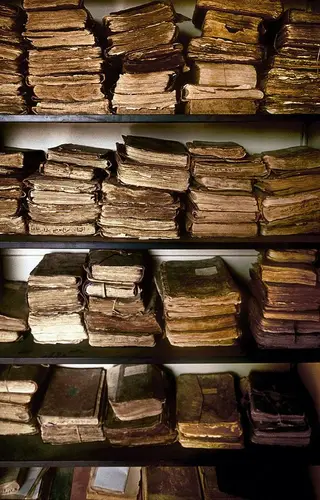
The Journals of Tariq Rassam
In Ashurian Aramaic.
These bound folios are diaries documenting Tariq
Rassam’s decades-long struggle against the unnatural.
There is at least one volume for every year between
1943 and 2016. Rassam kept vast notes on his work
against the unnatural, including the rituals he mastered
and critical lost historical details regarding Delta
Green’s operations in the Middle East. The journals
are hand-written in Ashurian Aramaic, an extinct language
that served as a kind of lingua franca in Mesopotamia
during the fifth through ninth centuries CE.
The Throne of Blood, the Father of War
In 1983, a close friend from the University of Baghdad’s Department of Archaeology asked Rassam to consult on a troubling case. It regarded an ancient Assyrian bronze amphora that had been unearthed in the deserts of the sparely inhabited Al-Muthanna Province. Strange and bloody nightmares had haunted the team while they excavated the object and transported it to the University of Baghdad. A university janitor murdered his family after sleeping in a storeroom with the amphora. The friend needed help, and Rassam had established himself as someone whom clear-eyed materialists could consult once it became impossible to deny the supernatural.
Rassam’s translation of the ancient Sumerian, Akkadian and Aramaic scratched into the amphora’s surface worried him from the start. He soon deduced that he and two fellows who had been exposed to
the unnatural before seemed immune to the amphora’s influence. Its visions of blood seemed only to affect the dreams of those more innocent. Rassam grew convinced that what was sealed inside the strange vessel should stay there.
At that time, Iraq was controlled by Saddam Hussein and the nation was deeply engaged in the Iran-Iraq War. As much as Rassam wanted the dangerous artifact out of the country, he feared the Iraqi security state was too well organized to permit it. Rassam was also unsure how he could prevent the amphora being seized as contraband or opened by curious customs agents. He had no more contacts in Delta Green and he thought British intelligence wouldn’t understand what was at stake.
So, at age sixty, Rassam hid the amphora under his home, in a vault that had been built as an air-raid shelter. He did his best to lie low and confine his life to the management of the family business, his study and teaching of Mesopotamian archeology, the occasional trade in black-market artifacts (so the Ba’athists wouldn’t suspect him of being too straight-arrow), and producing regular payoffs to the right Ba’ath Party officials. He bided his time and waited for a chance to remove the vile amphora from his homeland.
Over his years of research, Rassam learned the amphora was called “The Throne of Blood” and that it was supposedly occupied by a previously unknown Assyrian god or demon called “The Father of War.”
Hiding the Throne of Blood
When the Gulf War broke out in 1991, Rassam was horrified by the sheer amount of firepower the American- led forces poured onto Iraq from the sky. The Americans’ refusal to support the Shia and others who rose up against Hussein after the war soured him even further. Rassam retired from the University of Mosul in 1997. He figured that it was his fate to grow old and die, alone and childless, as the custodian of the Father of War.
In 2003, the Americans invaded Iraq despite the obvious fact that its enemy, Al-Qaeda, was in Saudi Arabia, Afghanistan, and Pakistan. Rassam tried to stay out of the way of the Americans and the guerilla forces operating in the country. Many members of his extended family died at the hands of the American invaders, Sunni resistance, and foreign jihadis who turned his country into a battlefield. Rassam did his best to get his family out of Iraq and did some business with Kurdish smugglers along the northern border. He also kept engaged with the black market for antiquities, taking pains to recover items lost during the looting of the Iraq
Museum in Bagdad. Sometimes Rassam wondered whether all the war he had seen could be evidence of the influence of the Father of War. Could there ever be peace in the Middle East before this demonic prisoner was removed from the land? He vacillated between smuggling the amphora out of the country and filling the entire vault with concrete to entomb it forever.
Then came ISIL. When Rassam saw their destruction of archeological sites and ancient artifacts, he determined to get the Throne of Blood out of Iraq at whatever cost. He feared it would be discovered and opened by foolish iconoclasts. Rassam could not know for sure what would happen when the Father of War was released. He knew only that things would get even worse. After thousands of years of imprisonment, the Father of War would be very hungry for blood.
The very last journal says that Rassam planned to look once more for his old contact in Delta Green and ask their help smuggling the Throne of Blood out of Iraq.