Character creation will take place during session 0 (or on the Discord for late additions).
As a new player to an ongoing campaign, you start with XP equal to 80% of the party’s average XP. You may then invest that XP into a new character who starts with a random roll on Treasure Type V.
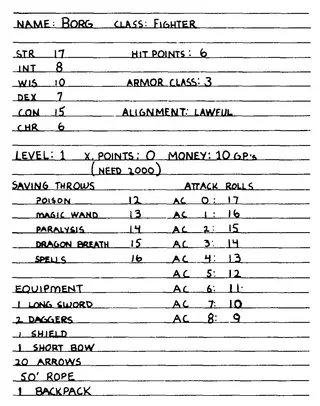
For a character record sheet, you can use whatever works best for you. I suggest either this classic sheet (if you want a printed sheet), this Old-School Essentials sheet (if you want a form-fillable PDF), a copy of this Google sheet (if you prefer to go digital), or just use a piece of lined paper (if you want to go really old-school).
Character creation will proceed as outlined in the Old-School Essentials Classic Fantasy system reference document with the following exceptions:
Roll Ability Scores
Instead of rolling, you may start with a standard array of 15, 14, 13, 12, 10, 8 and assign them to your abilities as you see fit.
Choose a Class
You are encouraged to choose one of the base classes from B/X D&D: Cleric, Dwarf, Elf, Fighter, Halfling, Magic-User, or Thief (which can be found here). Optionally, you may choose a class from Old-School Essentials: Advanced Fantasy and from any issue of Carcass Crawler (links can be found in the Discord).
When choosing a class, keep the following house rules in mind:
Elf and Magic-User (and any other Arcane Spell Caster)
Arcane spell casters begin play with a number of additional spells in their spell book as follows: one if their Intelligence modifier is +1, two if +2, or three if +3.
In addition, arcane spell casters begin play with Read Magic in their spell book for free.
Over time, they may add as many spells in their spell book as they would like.
Copying spells into their spell book from a scroll or other caster’s spell book may be attempted as a downtime action.
May use a staff as a weapon, in addition to a dagger.
May construct a tower starting at level 9.
Thief
Thieves use x-in-6 skills (instead of percentile skills).
They start with 1-in-6 for each skill: climb sheer surfaces, find/remove treasure traps, hear noise, hide in shadows, move silently, open locks, and pick pockets.
They begin with 4 skill points to be allocated to their skills.
Each allocated skill point increases the skill’s chance of success by 1-in-6.
They gain 2 additional skill points at each level thereafter.
The chance of pick pocketing success is reduced by 1-in-6 per three levels of the victim.
Thieves gain additional skills starting at 1-in-6 at appropriate levels.
Adjust Ability Scores
You may raise and lower any ability, 1 up for 2 down (may be spread between two scores).
This replaces the more restrictive rule-as-written.
Roll Hit Points
Instead of rolling, you may start with hit points equal to the highest face of your hit die, +/- your Constitution modifier.
Buy Equipment
Instead of rolling for gold, you may start with 105 gold pieces.
Instead of buying equipment, you may start with one of the following gear sets.
Cleric
Mace (1d6 damage), Plate Mail (AC 3), Shield (AC -1); and a Backpack containing Iron Rations (2), Waterskin, Lantern, Oil (1), Tinder Box, Rope (100'), and 2 gold and 7 silver pieces.
Fighter
Sword (1d8 damage), Plate Mail (AC 3), Shield (-1 AC); and a Backpack containing Iron Rations (2), Waterskin, Torches (6), Tinder Box, Hammer, Iron Spikes (12), Rope (100'), and 5 gold and 7 silver pieces.
Magic-User
Dagger (1d4 damage); and a Backpack containing Spellbook, Iron Rations (7), Waterskin, Torches (3), Tinder Box, Hammer, Iron Spikes (6), Mirror, Rope (100'), and 46 gold pieces.
Thief
Dagger (1d4 damage), Leather Armor (AC 7); and a Backpack containing Thieves' Tools, Iron Rations (7), Waterskin, Torches (6), Oil (3), Lantern, Tinder Box, Rope (50'), Pole (10'), Hammer, Iron Spikes (12), and 1 gold piece.
Elf, Dwarf, Halfling, and Other Classes
Elves, Dwarves, and Halflings start with the Fighter gear set. Elves also receive a spellbook.
Gear sets for other classes will be provided as needed.
Assign Skill Points
At first level, you start with a number of skill points equal to your Intelligence modifier (if positive), to a minimum of one. You may assign these points to increase the likelihood of success on a skill. Each point increases success by 1-in-6.
See B/X House Rules for more information on skills.
Character Portrait
Optionally, find or make a character portrait.
There are many ways to find a picture to use as a character’s portrait. It is recommended to search on Pintrest. Start by searching for “dnd character portrait” and refine the search as needed, such as by adding class and gender.
Once you find something you like, share it with @cobbland on Discord, and it will be made into a token for session play.