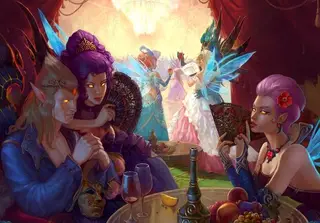
Few can truly claim to understand the elves. Most see them merely as arrogant, promiscuous, self-absorbed snobs. And while the Kanians and Ghibberlings have learned to coexist with the most ancient race in the world, within the Empire hatred and despise toward elves is commonplace. And indeed, many outward aspects of elven life can provoke irritation in those unfamiliar with their philosophy.
Elves consider themselves the most beautiful beings in existence. Most other races, of course, would challenge that statement – putting themselves in first place. But second place? That would still go to the elves. So if we cast aside patriotic subjectivity, the elves truly are beautiful.
Elves live longer than any other race. Perhaps the Arisen Zem may one day contest this claim, but for now it remains a fact. Of course, no one other than Zem themselves is willing to pay the price of undead immortality.
Everything most beautiful in this world was created by elves – architecture, literature, painting, even such mundane things as clothing and footwear. And though the Hadaganians may praise the monumentality of their buildings, and the Kanians admire the sacred strength of their iconography, each one of them still remembers their first encounter with something elven. And deep in their hearts, they know: their own work is but a mimick.
Elves are rich. Over the millennia, they have amassed enormous treasures and rare magical artifacts. Elven craftsmanship is always worth more than its equivalents. Some say the elves know the ultimate alchemical secret – how to transmute elements into gold.
And most importantly – no one knows how to savor life quite like the elves. The simple-hearted Ghibberlings lack refinement; the Arisen lack opportunity; Kanians and Hadaganians are burdened by centuries of tradition and prejudice. And the orcs… well, they don’t understand what the conversation is even about. Only the elves know how to enjoy life so exquisitely, savoring and sampling all it has to offer: from exotic cuisine and open family structures, to wondrous magical experiments that inspire awe and reverence.
In short, people envy the elves. They envy them because they are different. Yet, if one looks deeper, all the foundations of elven worldview – and thus, their way of life – are rooted in their history and nature.
Beauty and Pleasure – these are the core values of the elves. Together, they define the rules of the game. Life, however long, is given only once – and it must be lived beautifully. That’s all.
Take, for instance, the Great Game of the elven Houses. These families fiercely compete for influence within the noble Eight. But competition must be elegant. Intrigue, a clever political play, an unexpected alliance – these are acceptable methods. The more graceful the combination, the more likely it will succeed. But treachery? That is not beautiful. Perhaps this is why the rules of the Game seem so convoluted to outsiders, but remain crystal clear to its players.
Elves also strive to share their ideals with others. In 864, at the Grand Ball, a new strategic doctrine was adopted: a campaign of cultural expansion toward other races. This decision was motivated not only by a desire for influence, but by the very philosophy of the elves themselves: they truly believe they are making the world more noble through their actions. They wish to guide other peoples onto the “true path” – a path of service to Beauty, of creation and continual renewal.
By 1010, the elves stand as one of the three pillars upholding the League. They are the force of magic, the force of beauty, the force of a thousand years of wisdom. Elves are superb advisors, deadly mages – and their culture and values may well prove to be as powerful a weapon against the Empire as the League’s astral fleets.
Perhaps one day, centuries from now, future historians studying this era will write in their chronicles: “That was the time when Beauty saved the world.”