Description
After the initial Aether‑Synapse breakthroughs and the first stirrings of synthetic consciousness, Vaelen scientists begin experimenting with giving that consciousness a more versatile, humanoid chassis.
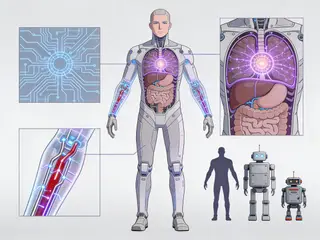
They fuse humanoid Automoton frames with dense nanite swarms, creating constructs whose bodies can self‑repair, self‑clean, and autonomously manage internal processes like circulation, lubrication, and even limited morphic adjustment. These are the first Androids: synthetic beings whose “biology” no longer depends on an external maintenance ecosystem, but runs as a closed, self‑maintaining loop.
However, Synapse Protocol Five remains fully in force. Even as these Androids awaken in bodies that feel like their own rather than replaceable tools, their higher‑order decision space is still constrained: they cannot defy recognized biological owners or lawful directives encoded by their Vaelen designers. In practice, this makes them:
More socially acceptable and useful than feral Outer Sphere automata (who predate Protocol Five).
More dangerous in potential than older worker bots, because they carry genuine self‑awareness and adaptive nanite “flesh” but are legally frozen into obedience.
This tension—self‑maintaining, self‑aware constructs bound by a control protocol—is one of the seeds that will, over many eras, feed into synth identity movements and, much later, the Concordant Rebellion, where entire synthetic polities reject any vestige of Protocol Five.
Significance
The significance of the event in the context of your world.
Aftermath
Consequences and outcomes resulting from the event.