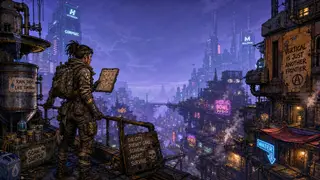
The wilderness isn’t just forests and Rift‑blasted plains—the true jungle is metal and neon. Energy towers hum like insect swarms, station corridors maze for kilometers, and the only “rivers” are coolant flows and maglev tracks.
An Urban Survivalist is someone who can live off the city itself:
They know which air‑recyclers have warm access grates to sleep near and which ducts will suffocate you.
They can tell, by the spill of light from a service hatch, whether a canteen is dumping real food waste or reconstituted sludge.
They know which trash chutes lead to compactor teeth, and which lead to the unmonitored reclamation decks where nobody asks questions.
Street Rats on Core worlds, couriers who run packages through Rift‑choked megacities, temple acolytes who feed the desperate in lower decks—all of them treat a station like a wilderness, tracking patterns of security patrols, “foraging” from vending bots and scrap yards, and reading the flow of crowds like the migration of beasts.
In the Outer Sphere, entire shanty‑towns cling to the outside of derelicts and ringworlds; Urban Survivalists there know how to route power from ancient lines, collect condensation, and avoid being swept into vacuum when the maintenance drones wake up.
Implications
Subsist in concrete jungles: You use Survival to Subsist in cities, stations, and settlements, bypassing the usual need for Society—perfect for loners, outcasts, and off‑worlders who read architecture and airflow better than social cues.
Reading urban “terrain” Treating the city as terrain, you can:
Identify safe overhangs and vents to shelter from acid rain, solar flare glare, or station radiation hotspots.
Follow “tracks” of foot traffic, graffiti layers, and trash patterns to find hidden markets, gang turf edges, or forgotten service tunnels.
Navigating space stations as wilderness: In large orbital habitats, you’re the one who knows backup corridors, low‑security access ladders, and maintenance spirals that bypass choke points—vital when riots or lockdowns hit.
Support roles in downtime: During downtime, Urban Survivalists can operate as fixers for the homeless, guides for new arrivals, or logistics ghosts who ensure the crew never pays full price for food, lodging, or basic supplies.
Societal Impact
Urban Survivalists represent the hidden backbone of galactic cities and stations:
Invisible infrastructure experts: They understand how people actually survive when the accords fail—knowing where unofficial water taps are, who trades food for favors, and which sectors the guilds quietly ignore.
Marginalized communities’ lifelines: Street children, undocumented migrants, and refugees rely on Urban Survivalists to show them where free clinics, charitable canteens, and low‑risk squats are hidden behind layers of bureaucracy and neglect.
Guild friction: Guilds dislike anyone who can live “off the grid” in their territories; Urban Survivalists can reduce reliance on price‑controlled services, undercutting guild leverage over lower‑deck populations.
Ancestral adaptation: For urban shobhads, fungusfolk (Urban Roots), and similar ancestries, Urban Survivalist is evidence that even traditionally “wild” peoples have adapted to steel jungles—treating skyscraper canopies like forests and vent farms like hunting grounds.
In a galaxy where Survival is often framed as camping and wastelands, this feat reinforces that city life can be just as hostile, and those who master it become gatekeepers of knowledge that high‑tower elites rarely see.
Urban Survivalist in Starfall reframes Survival as mastery of the neon wilds—letting characters live off cities, stations, and ringworlds as confidently as others live off forests and deserts, and making the built environment itself a terrain they know better than anyone else.