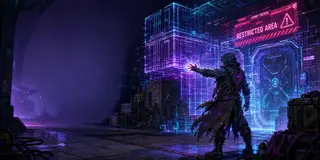
Illusory Object in the Starfall Galaxy is the go‑to “holo‑conjurer” spell: you project a convincing, stationary fake object or terrain feature that can mislead eyes, brains, and even some sensors depending on how high you cast it.
holo‑lies in the Starfall Galaxy
On Starfall’s stations, freighters, and city‑planets, Illusory Object is the spell everyone suspects but nobody can quite prove—the favorite of con artists, security architects, guerrilla tacticians, and any caster who wants the environment itself to lie
You see it in fake bulkheads that hide smuggling alcoves, bogus cargo pallets that never existed on the manifest, and “temporary” hazard signs that funnel crowds exactly where a fixer needs them.
At 1st rank, Illusory Object feels like a cheap holo projector: perfectly convincing at a glance, but quiet and scentless—good enough to redirect a patrol or make a hallway look blocked.
At 2nd rank and above, it graduates to premium neuro‑holography: the brain hears the clank of metal cases, smells coolant or incense, and even feels the fake railing when a guard leans on it.
By 5th rank, the spell becomes infrastructure. Asterays and similar beings spin up permanent‑feeling constructs, using Illusory Object to paint sensor‑only decoys in the void or create mirage installations that lure hostile fleets into empty space.
In crowded hubs like Rift‑scarred megastations, locals half‑joke that you should never trust any door, crate, or walkway you haven’t physically kicked twice—and even that might just be your nervous system lying to you.
Devotion and mana themes
In Starfall’s color framework, Illusory Object is primarily Blue–Black:
Blue Devotion : It’s about controlling information and perception, not brute force—shaping what people think they see, guiding decisions by editing reality’s user interface.
Black Devotion: It leans into deception, misdirection, and self‑serving trickery: false vaults, fake airlocks, decoy weapon racks, and “emergency exits” that don’t actually exist.
Implications
Crowd routing and safety theater: Station authorities use Illusory Object to create convincing bollards, barriers, and “maintenance walls” to redirect foot traffic, even when the barrier is literally empty air.
Corporate doublespeak: Corps dress up secure areas with illusory decor—fake windows with serene vistas, “ornamental” armories that are just pretty light, or hidden doors masked as blank walls until the right clearance ping is sent.
Art, religion, and protest: Street artists and cult preachers conjure massive light‑sculptures, transient shrines, or “monuments” to vanished causes that can dominate a plaza for an hour—then vanish as if they never were.
At 5th rank, entire illusory plazas or monuments can become long‑term fixtures, especially on poorer worlds that can’t afford real architecture but still want symbols of identity and hope.
Societal impact
Illusory Object erodes the basic trust that “if you can see and touch it, it exists.” At high enough ranks, the spell can trick not only organics but many classes of visual and basic EM sensors, especially when paired with specialized variants like the asteray’s sensor‑only false image ability.
This forces serious organizations—militaries, guilds, and megacorps—to invest in counter‑illusion tech (filtered scanners, aura readers, trained Seek protocols) and policies like “never trust a new wall on an old ship.”
Religions and data cults split: some embrace Illusory Object as a parable about the unreliability of the senses, others ban its use in sacred architecture, insisting all altars be verifiably physical.
Meanwhile, black‑market architects quietly sell “illusion‑ready” floor plans—designed so fake bulkheads and phantom cargo rows slot perfectly into the layout for when a client needs to disappear evidence on short notice.
Illusory Object is Starfall’s quintessential environment‑hack spell: it doesn’t blast or bind, it rewrites the story your senses tell you about what’s in front of you—and in a galaxy of drifting hulks and neon haze, that can be more dangerous than any gun.