Source Gamemastery Guide pg. 130
From the inside, “nation” is just whatever banner your passport, guild token, or embedded exocortex claims.
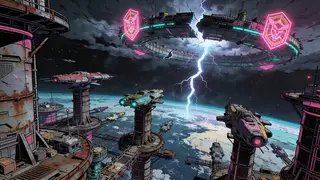
On core worlds, that might still mean a flag and a hymn played before holo‑parliament sessions. On the rim, it looks more like a stacked scrapyard‑city welded along a forgotten ring station, a convoy of patched‑together haulers following a trusted navigator’s Rift instincts, or a megacorp whose shareholder registry matters more than any planet’s soil.
Borders aren’t fence lines so much as:
Which patrol transponders answer your hail.
Whose tariffs get auto‑debited the moment your ship pings a beaconsphere.
How often Rift storms cut you off from the rest of charted space.
Ask anyone in the modules clinging to the outside of an orbital nation: it’s not laws that define a country, it’s whose debt you’re born into and whose anthem booms from the emergency speakers when the Rift screams.
Starfall Nation‑Building
Use this as a GM tool for creating any large-scale power in Starfall (planetary governments, megacorps, guild city‑states, nomad flotillas, AI dominions).
Step 1 – Core Concept & Role
Define the one‑sentence pitch and what this polity does in your campaign.
Concept: “What is this nation at a glance?”
Examples: “Guild‑run scrap monarchy on a Rift‑scarred moon,” “Chronologist protectorate guarding a Metronome array,” “Nomad flotilla turned pilgrimage state.”
Role in play: Is it home base, antagonist state, neutral marketplace, or warzone?
Mechanical hook: Assign a basic “Nation Level” to match the party’s tier and how dangerous or resource‑rich interaction with it should feel .
Step 2 – Location, Size, and Population
Adapt the original guidance on geography and population: borders follow natural and logistical constraints; scale and demographics drive story.
In Starfall, think in terms of:
Spatial footprint:
Single world or continent.
Multi‑system trade compact.
Orbital ring-city and its tethered habitats.
Migratory nation (caravan fleets, station‑hopping cults, Rift‑tide surfers).
Borders:
Jump lanes, wormhole choke points, Rift exclusion zones, patrol radius of defense grids.
Population:
Rough magnitude (thousands, millions, billions).
Mix of ancestries, uplifted species, synths, and modified humans.
Key split: citizens vs clients vs exploited underclass—who counts, who doesn’t?
Mechanically, record:
Scope tag: Local / Regional / Sector‑Scale.
Population tag: Sparse / Dense / Overcrowded.
Travel friction: Easy (open lanes), Moderate (tolls, paperwork), Hard (blockades, Rift storms).
Step 3 – Cultural Profile
Define:
Core aesthetic and vibe:
Rust‑baroque shrine‑world, neon‑drenched guild megacity, brutalist corporate hive, bio‑organic reef culture, etc.
Everyday tech attitude:
“Every kid mods their own drone,” “Exocortexes are taboo,” “Rift‑touch is sacred disease.”
Social fabric:
Is this a face‑to‑face bazaar culture, a bureaucratic maze, a hyper‑networked swarm, a clan web tied by ship crests and shared hulls?
Mechanically, give the polity 2–4 Culture Tags, e.g.:
Ascetic, Hedonistic, Militarized, Pilgrim, Data‑Obsessed, Wreck‑Diver, Rift‑Cult, Anti‑Synth, Guild‑Feudal, Chronometer‑Lawful.
Use those tags to justify circumstance bonuses/penalties on social checks, downtime actions, and how NPCs respond.
Step 4 – History and Scars
The source guidance emphasizes origin, major upheavals, and how people adapted to them. lean into:
Origin:
Survivor state of a shattered empire, corporate secession, Rift cult uprising, guild charter gone feral.
Founding trauma:
A botched Metronome experiment, pirate occupation, AI revolt, failed terraforming.
Recent shifts:
Loss of a key jump gate, Rift storms cutting off trade, Chronologist intervention, guild coup.
Mechanically, pick 2–3 Historical Scars that explain current problems and hooks:
“Lost Homeworld,” “Recent Coup,” “Collapsed Trade Spine,” “Rift Quarantine,” “AI Amnesty,” etc.
These automatically generate plot seeds (refugees, truth‑seekers, revanchists, war relics).
Step 5 – Economy and Power Structures
Economic engines:
Rift‑reactive alloys, Metronome maintenance, water and atmosphere contracts, shipyards, data crypts, biotech farms, salvage rights.
Resource constraints:
Fuel poor but metal rich; tech rich but food insecure; dependent on one unstable Rift corridor.
Power architecture:
Guild council, dynastic megacorp board, AI triumvirate, charismatic theocracy, warlord coalition.
Shadow power:
Smugglers’ rings, data cults, mercenary leagues, foreign guild “advisors.”
Mechanically, note:
Primary commodities (what this polity exports/imports).
Power center tags: Guild‑Council, Corp‑State, Rift‑Theocracy, AI‑Curia, Warlord Bloc.
A simple “Stability” rating: Fragile / Stable / Authoritarian, affecting the DC of checks to incite, reform, or leverage the system.
Step 6 – External Relations and Posture
Define:
Official stance:
Expansionist, Isolationist, Opportunistic, Protector, Buffer State.
Key relationships:
Principal rival, main trade partner, external patron (off‑map guild, distant empire, Metronome overseers).
Public vs private:
“Publicly neutral, secretly arming both sides,” “Officially pious, quietly hosting data cult black markets.”
Mechanically, create 3–5 Relationship Notes:
“[Polity] and [Neighbor] are in cold war over a Rift corridor.”
“[Polity] relies on Chronologists for Metronome upkeep but resents their oversight.”
You can treat each as a latent “clock” the PCs can advance or defuse via subsystems like Influence, Reputation, or custom Victory Point arcs .
Implications
Diplomatic Campaign Frames: Use these polities as clients, patrons, and obstacles in political thrillers—negotiations over docking rights, guild charters, or Metronome leases.
Downtime & Infrastructure: Let players invest downtime to nudge Nation Dials (Stability, Reach, Rift Exposure), tying crafting, research, and influence to visible changes in the setting.
Logistics & Access: Gate access to gear, services, and information by nation traits: a High‑Tech, Data‑Obsessed state might make rare augmentations common, while a Rift‑Theocracy hoards miracles and bans cybernetics.
Social Impact
Treating nations as structured polities rather than vague backdrops makes the galaxy feel interconnected and reactive, just like the original GM guidance intends for fantasy settings.
Trade routes exist because someone’s navy (or guild militia) keeps them open.
Refugees, mercenaries, and smugglers have clear home flags—and grudges.
Chronologist interventions, Rift storms, and guild wars visibly redraw jump maps and political maps at the same time.
When you update a nation’s stat block—after a civil war, a Rift catastrophe, or a successful PC revolution—you’re also updating the tone of entire sectors: where famine breaks out, which ports glow neon all night, and where a party’s colors earn them a free drink or a knife in the back.