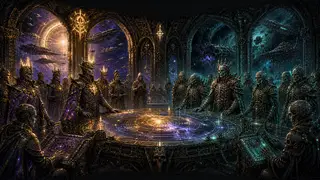
Event Type: Diplomatic / Legal Treaty – Containment of an Undead Power
By early Vaelen Ascendancy, the Inner Sphere was still pretending at unity under the Phoenix Throne: a constellation of Vaelen void‑princes who ruled star‑systems as personal principalities while convening, when forced, as a Parliament of Princes. On their charts, the Noāxol Corpse Empire around Paxima was a “contained aberration” on the Wraith‑scarred fringe—disturbing, but distant.
The reality was uglier. Corpse‑fleets under Babluse necrovite admirals had begun ranging well beyond Paxima’s orbit, probing trade lanes and Rift‑gates near the Wraith‑touched margins of the Inner Sphere. Slaver‑merchants and panicked magistrates reported incidents of “soul‑harvesting” in failing colonies: mass Quietus conscriptions offered—or forced—on dying worlds, with the resulting corpsefolk conscripted into Noāxol fleets and labor cadres.
Several Vaelen princes argued for a holy war of purgation. Others, fresh from the last cycle of Rift disasters and rebellions, understood the ledger:
The Ascendancy could not afford a full crusade on the fringe.
The Noāxol already controlled local Rift‑gates, Quietus protocols, and hard‑to‑replace engineers.
Every annihilated corpse‑fleet meant wreckage drifting in Rift‑space, feeding new Wraith storms.
So, instead of a crusade, they convened a parley in the dark.
On GD‑28.4.34, aboard a neutral Vaelen void‑station hanging above a quiet Rift‑gate, a coalition of Vaelen void‑princes and Babluse necrovites negotiated what became known as the Pact of the Two Lights. The “two lights” were the symbols invoked in the treaty preamble: the warm starlight of living empires and the cold necromantic glow of second life, promised to shine side‑by‑side rather than burn each other out.
Terms of the Pact
Surviving fragments of the Pact—preserved in Vaelen legal codices and Noāxol ossuary‑archives—outline a careful, brittle compromise:
Corpse‑Fleet Containment:
Noāxol fleets would confine regular patrols, soul‑harvesting, and large‑scale Quietus “recruitment” to a mapped belt of Wraith‑touched systems along the Inner Sphere’s margins.
Any Noāxol operation deeper into the core required formal Vaelen authorization or a writ of mutual defense (e.g., purging Wraith outbreaks).
Rift‑Gate Access and Trade:
In return, the Ascendancy granted the Noāxol limited but legal access to specific Rift‑gates, establishing sanctioned routes for corpsefolk envoys, Navigators, and merchant flotillas.
Babluse necrovites gained the right to participate in regulated trade, including licensed sale of necro‑tech, Quietus derivatives, and corpsefolk labor contracts—within strict corridor systems and under Vaelen customs oversight.
Status of the Dead:
Within Pact‑aligned systems, self‑willed corpsefolk were recognized as persons of “second estate” with the right to sign treaties, represent the Noāxol, and command ships.
Mindless or illegally controlled undead remained contraband, and both sides pledged to destroy rogue necromantic actors who violated the Pact’s consent standards.
Enforcement was always shaky. Outlying princes ignored provisions when it suited them; Noāxol captains tested the edges of the Wraith‑touched map whenever they thought no one was watching. But the Pact shifted undeath from an unacknowledged horror to a negotiated category of international law, at least for a few luminous decades.
Corpses in Court: A Brief Normalization
For a short window of history, the Pact of the Two Lights made something previously unthinkable seem almost mundane:
Babluse corpsefolk diplomats appeared in Inner Sphere courts—skeletal or desiccated, draped in grave‑silks and necro‑sigils, speaking flawless court Vaelen.
Quietus‑born Navigators were hired to guide multi‑faction convoys along risky Wraith‑margin lanes, their deathless calm prized in regions where living minds frayed under constant haunt.
Inner Sphere merchants began to treat regulated corpsefolk labor as just another entry in risk‑weighted ledgers, provided contracts were stamped “Pact‑compliant.”
This uneasy normalization never reached all regions, and fanatical blocs within the Ascendancy denounced the Pact as a betrayal. Still, modern Babluse activists point back to GD‑28.4.34 as proof that undeath can be regulated rather than purged, that a galaxy can draw lines around corpse empires instead of defaulting to extermination.
-
Primary Functions in Campaigns:
A legal precedent for when corpsefolk are recognized as people vs. abominations.
A reason that Noāxol fleets can appear at the edge of the map without triggering automatic war—“they’re operating within Pact limits.”
A narrative lever for Babluse or Noāxol PCs to demand rights: “we have treaty‑backed standing in this court.”
-
Significance
Treaty Lawyering: PCs help interpret whether a new Noāxol operation near a Rift‑gate violates the original language. Is it “defensive patrol,” “mutual Wraith suppression,” or a quiet land grab?
Diplomatic Escort: Parties may be hired to escort corpsefolk envoys through Pact‑aligned routes, dealing more with prejudice, propaganda, and legal technicalities than with open combat.
Historical Investigation: In a later era, the original Pact tablets or encrypted data‑stacks are scattered; PCs are sent to recover or authenticate texts that could decide whether a modern undeath‑regulating bill passes or fails.
Aftermath
The Pact’s legacy is deeply contested.
For many Vaelen historians, it marks the height of Ascendant realpolitik: a moment of pragmatic containment that bought decades of relative stability on the Wraith fringe. To hardline purists and some modern Celestial Accord blocs, it is a shameful stain—a time when living empires “sold border worlds to the dead” in exchange for calm lanes and cheap necro‑labor.
For Babluse corpsefolk and Noāxol loyalists, the Pact is remembered as validation: a signed admission that their empire was a legitimate actor, not just a plague. Banners in some Noāxol enclaves still depict the two stylized lights—golden star and teal lantern—crossed over a Rift‑gate, commemorating the idea that living and dead could share the sky, however briefly.
Modern activist circles in the Inner Sphere, especially those pushing for regulated Quietus access in disaster‑prone regions, invoke the Pact whenever calls rise to “purge the undead.” Their argument: if the Vaelen could negotiate boundaries for corpse‑fleets and soul‑harvesting at the height of the Corpse Empire, then modern regimes can draft enforceable safeguards rather than defaulting to genocide. Opponents counter with records of Pact violations, arguing that “you cannot fence in hunger,” whether that hunger is for souls, power, or eternal tenure.
The Chronologists Guild mostly treats the Pact as a cautionary footnote: any treaty that ties Rift‑gate access to such volatile actors is something to monitor very closely on the timeline.
The Pact of the Two Lights is Starfall’s answer to the question, “What if we tried to manage the dead instead of just fearing them?”—a fragile, flickering moment when two kinds of starlight shared the same table and wrote rules neither side ever fully kept.
GD‑28.4.34 Beacon 3