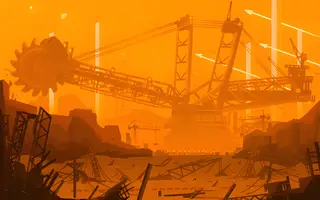
Superheavy industrialization married to colossal swathes of poorly-inhabited desert; Kitezh is one of the few places in the Solar System that can offer any measure of true 'freedom' for those willing to risk it.

The red planet, and humanity's most long-running stellar partner. While Yulin was always the object of primary attention, Kitezh could never truly escape the zeitgeist of desire. When the Grand Empress emerged, it was Kitezh that she first put her foot towards, and it was Kitezh that became the first planet of the Eusan Empire.
It was never to be the capital, no... but it let the planet thrive. Mass volumes of industry funneled off of Vineta and transferred over, with more then constructed on-planet. It was Kitezh that the first Klimate Engines were built on, and it was Kitezh that was the first site of non-Vinetan birth.
As the Empire secured itself upon Buyan, Svarog, and Heimat, Kitezh maintained its mass-industrialization quietly and religiously... but it also developed something strange; the 'Kitezhyaka.' The 'natives.' Everybody born on Kitezh is native-born, obviously, but they are a very separate being from a Kitezhyaka.
To be a Kitezhyaka is to be one willing to undergo great hardship for the sake of ones' freedom. They are those outside the cities and the factories and the borders, who took it upon themselves to develop their own farms, their own villages, their own 'way of doing things.' A Kitezhyaka is, often, barely any more a member of the Empire than they are of the Nation. Some of them don't even know there's a war on.
This is not to say they are looked down on; they are instead viewed, almost, as a romantic ideal, a means of taking control of ones' life and living for yourself. They take up the danger of Kitezh's wilds with only their own support nets to catch them; Imperial society is very aware of the risks and hardship, and so it remains largely just that. An ideal. A mainstay trope of Imperial romantic literature is a factory worker running off with a burly and tanned Kitezhyaka; something that also appeals quite heavily to your average Rotfronter factory worker, and so such novels can be highly sought-after contraband items.
Through the Kitezhyaka's work, a Kitezhi worker can acquire fresh produce of all kinds depending on whereabouts they live and what the environment is like, as they deliver to small pop-up markets. Some of these homesteader-esque Kitezhyaka villages can, over the decades, grow big enough to become more fully incorporated in to the Empire proper; returning them to technology and modern society, while retaining several odd idiosyncracies.
The rest of Kitezh, meanwhile, is much-similar to Rotfront, though with far more pleasing architecture thanks to its accommodating environment and weather. Religion is almost universal, though compared to Buyan holds a far smaller place in people's daily lives. One offers their due prayers, does not take the Empress' name in vain, and ensures they work admirably and resolutely. In exchange, the many holy of Kitezh provide them spiritual balms and soothings, while protecting them from malfeasance and corruption.
The War of Revolt, as it is referred to by the natives of Kitezh, has had little true effect on most. The Revolution itself did not last long, nor cause much catastrophic damage compared to on Buyan, while it did not see great battles like Vineta.
It is only more-recently, with the invasion by the Nation, that many have seen things escalate. A general sense of danger; of continuous watching and listening-to of the news for updates. Sometimes, a sense of despair. More often, a sense of righteous fury. A desire to see the invader crushed beneath the might of Kitezhi industry.
Red: Imperial Control
Orange: Nation Control
Purple: Contested Location
Tan: Poorly-inhabited Steppe / Desert
White: Ice sheet