The Wardens are an elite international law-enforcement and space-safety service of the Interstellar Community of Sovereign States (ICSS). They form a permanent ICSS department with police powers to enforce its laws. Their duties include regulatory enforcement, criminal investigation, patrol, search and rescue, and protection of non-spacefaring peoples.
Wardens serve at ports and stations, aboard patrol vessels, and in teams deployed across multiple star systems.
History
The Wardens were founded on stardate 9890.188, 3,587 Cycles ago, following the Giza Conventions of Cycle 9876.
Mandate and Jurisdiction
The Wardens derive their authority from ICSS law. The ICSS claims jurisdiction over every sovereign state with a practical means of faster-than-light travel between star systems, classified as Tier 2 or higher. Under ICSS law, that jurisdiction applies regardless of whether a state recognizes the organization's authority.
Wardens work with local police, customs services, and port authorities on investigations and enforcement actions. In cases involving several jurisdictions, investigators share records and arrange the transfer of evidence and detainees to the responsible authorities.
Responsibilities
Space Safety and Rescue
The Wardens respond to distress calls, search for missing vessels, and rescue people aboard damaged ships and stations. Rescue teams assess structural and environmental hazards, treat casualties, evacuate survivors, and stabilize vessels for recovery. Aerospace craft, sensors, and drones support searches and inspections of areas unsafe for crews to enter.
The service enforces spaceflight safety standards and investigates accidents. It maintains or oversees navigation beacons and hazard markers and issues traffic advisories. Inspection records and accident investigations help identify recurring equipment failures and unsafe practices.
Trade Security and Criminal Investigation
Patrols protect ports and trade routes against piracy and smuggling. Wardens board suspect vessels, inspect cargo and ship documentation, and investigate offences involving carriers, shipowners, brokers, suppliers, and buyers.
Investigators secure crime scenes, interview witnesses, recover records, preserve evidence, and take suspects into custody. Investigations can extend across several star systems as they trace the movement of people, vessels, and cargo.
Migrant Interdiction
The Wardens intercept vessels carrying people in breach of ICSS migration law. Boarding teams check passengers' identities and travel circumstances, inspect conditions aboard the vessel, and investigate suspected smuggling or trafficking. They provide rescue and medical care when passengers have been abandoned, injured, or confined in unsafe compartments.
Defence Readiness and Conflict Response
The Wardens deploy armed patrol vessels and personnel to ICSS security operations. During border skirmishes, they can separate opposing forces, monitor fighting, protect civilian traffic, and assist evacuations and relief efforts.
Protection of Non-Spacefaring Peoples
The Wardens enforce the Giza Conventions, which protect Tier 0 and Tier 1 populations from exploitation by spacefaring powers. They investigate abduction, unauthorized resource extraction, coercive settlement, and forced subordination. These protections cover populations of both indigenous and offworld ancestry.
Wardens monitor traffic near protected worlds, intercept suspected offenders, trace offences to their offworld organizers, and remove unauthorized installations and personnel. These duties are subject to the Conventions' restrictions on contact and interference. Covert observers must remain undetected by the protected population.
Organization
The Wardens are headquartered on Munoro IV in the Munoro System. The service has 5,588,000 active duty personnel and 350,000 reserve personnel.
The service is organized into the Prevention Directorate, the Response Directorate, and Specialized Tactical Units.
Prevention Directorate
The Prevention Directorate enforces ICSS ship codes, issues pilot licences, and inspects vessels and cargo documentation. Its offices handle the routine regulatory business of ship operators, carriers, port administrators, and commercial agents. It is the branch most commonly encountered by law-abiding residents and businesses.
Inspectors examine records and equipment, record deficiencies, and check that they have been corrected. Concealed cargo, falsified documents, and deliberate safety violations can lead to a criminal investigation or the interception of a vessel. Records from separate inspections can reveal links between vessels, shipments, and criminal organizations.
Response Directorate
The Response Directorate conducts patrols, deep-space search and rescue, interdiction, and criminal investigations. It responds to distressed vessels, threatened stations, reported crimes, and border skirmishes. Long-endurance patrol ships carry its teams into remote systems and support prolonged assignments away from Warden facilities.
Specialized Tactical Units
Specialized Tactical Units are elite task forces that investigate and dismantle criminal syndicates operating across several jurisdictions. They pursue these organizations through frontier regions where local system police lack authority.
Teams combine investigators and intelligence specialists with personnel trained for high-risk boarding and arrests. Inspection records from Prevention and cases investigated by Response help them trace syndicates' personnel, ships, finances, and supply networks.
Selection and Training
Admission to the Wardens is highly competitive. Hundreds of thousands of applicants seek entry each Cycle, and approximately two thousand are accepted. Selection is demanding, assessing academic ability, physical conditioning, practical judgment, and performance under sustained pressure.
Initial Training
Members who pass training selection enter as Warden Recruits and undertake two Cycles of intensive initial training. Academic study covers ICSS law, the laws, traditions, and customs of member factions, use of force, criminal investigation, regulatory enforcement, rescue, space safety, and the protection of non-spacefaring peoples.
Recruits receive physical training and instruction in equipment handling, emergency response, team coordination, and zero-gravity operations and combat. Practical exercises test their ability to apply legal and technical knowledge under pressure. Operations trainees also learn to pilot mechs.
Field Training and Assignment
After the initial two-Cycle programme, Warden Apprentices entering Fleet and specialist trades continue occupational training in field assignments. Qualification for independent duties leads to Warden I; subsequent advancement depends on the responsibilities and proficiency required for the next rank.
Operations Apprentices complete a further two to four Cycles of supervised field training. They learn mission planning, investigation, rescue, apprehension and tactical procedures from experienced Operators. Qualification for independent operational duties leads to Warden I. Initial and field training together last four to six Cycles; Warden II marks advancement into regular supervision.
Ranks
Fleet, Operations and shoreside personnel share one rank structure. Branch and occupation remain separate service-record fields. Candidates awaiting selection are applicants, rather than serving ranks. The Wardens have no warrant-officer grades.
Rank is displayed as a cluster of dots on the standing collar. The number of dots equals the numeric rank: W.01 wears one dot, through W.16 with sixteen. Warden Recruits (W.R) and Warden Apprentices (W.A) wear no collar rank insignia. Spoken nicknames run from Ones through Sixes for Warden I–VI.
Rank | Code and Collar Insignia | Responsibilities |
Warden Recruit (WR) | W.R; No insignia | Recruits enter the Wardens through foundational training. They learn service discipline, teamwork, law, safety and the practical skills required before taking up an operational post. |
Warden Apprentice (WA) | W.A; No insignia | Apprentices learn their occupation under supervision while contributing to the work of their command. Routine duties and practical instruction develop the competence needed for independent service. |
Warden I (W1) | W.01; 1 dot | Known as Ones, these Wardens are qualified to perform their normal operational duties independently. They are responsible for the quality of their work, their equipment and their conduct, and begin preparing to supervise others. |
Warden II (W2) | W.02; 2 dots | Twos take their first regular supervisory assignments. They direct junior personnel, pass on specialist knowledge and turn a team's orders into practical tasks. |
Warden III (W3) | W.03; 3 dots | Threes run work centres and serve as experienced technical authorities. They train their people, resolve difficult problems and keep the personnel and equipment under their care ready for duty. |
Warden IV (W4) | W.04; 4 dots | Fours coordinate larger teams or several related work centres. They allocate people and equipment, organize the work ahead and prepare promising junior leaders for greater responsibility. |
Warden V (W5) | W.05; 5 dots | Fives are established departmental experts and senior leaders. They supervise subordinate Wardens, develop junior supervisors and give commanders practical advice grounded in extensive field experience. The rank recognizes sustained professional and technical achievement. |
Warden VI (W6) | W.06; 6 dots | Sixes hold the service's senior enlisted appointments, overseeing large teams, departmental programmes and training. They advise command on personnel and readiness, develop the next generation of senior Wardens and help maintain effective working standards throughout a command. |
Ensign (ENS) | W.07; 7 dots | Ensign is the first commissioned rank. Ensigns complete one Cycle at Warden Officer School (WOS), then gain field experience directing personnel and managing daily work under more experienced officers. |
Lieutenant (LT) | W.08; 8 dots | Lieutenants lead divisions, departmental watches and critical operational functions. They coordinate skilled personnel, exercise delegated command and guide junior officers through increasingly demanding assignments. |
Lieutenant Commander (LCDR) | W.09; 9 dots | Lieutenant Commanders lead departments and coordinate substantial operations aboard ships, at stations and land commands, or within aerospace and special-operations units. They turn command priorities into workable plans and supervise their execution. |
Commander (CDR) | W.10; 10 dots | Commanders lead major departments, aerospace squadrons, stations, destroyers and land activities according to their appointment. They answer for their command's performance, readiness and personnel development. |
Captain (CAPT) | W.11; 11 dots | Captains command major vessels, aerospace wings, stations, land installations and other large organizations. Their responsibilities include current operations, sustained readiness and the longer-term development of the command. |
Rear Admiral (RADM) | W.12; 12 dots | Rear Admirals direct major operational formations and organizations. They set priorities across several commands, allocate resources and supervise senior leaders carrying out complex assignments. |
Vice Admiral (VADM) | W.13; 13 dots | Vice Admirals oversee major commands and shape service policy. They coordinate broad operational commitments with the ICSS's stability and defence priorities and prepare the service for future demands. |
Admiral (ADM) | W.14; 14 dots | Admirals hold the highest field-service rank. They direct major fleets, combatant commands and service-wide organizations, with responsibility for operational strategy and the Wardens' future capabilities. |
Commissioner (CMS) | W.15; 15 dots | The High Commissioner appoints Commissioners to lead sector-level Warden organizations. Commissioners connect civilian leadership with field command and oversee the service's work across their sectors. |
High Commissioner (HCOM) | W.16; 16 dots | Appointed by the ICSS Directorate, the High Commissioner holds the Wardens' highest rank and leads the service. |
Service Records and Seniority
A dossier records rank code and completed Cycles of Warden service as W.RR.S, with branch recorded separately. For example, W.08.6 identifies a Lieutenant with six completed Cycles of service. Recruits and Apprentices use W.R.S and W.A.S. The service count includes initial training and carries forward through rank changes; collar insignia shows rank only.
Rank establishes precedence between grades. Command and watch appointments identify who exercises authority within an assignment, including between officers of the same grade. A longer service count does not itself transfer an appointed command.
Pay
All branches use the same base pay. Recruits and Apprentices receive ¢750 per Phase; each numbered rank receives ¢1,000 multiplied by its rank number. W.01 therefore receives ¢1,000 and W.16 receives ¢16,000 before the service supplement.
A Phase, also called a Tenth, is one tenth of a Cycle: 100 mils or ten Spans. Pay is issued on the first mil of each Phase, at stardates ending .000, .100, .200, .300, .400, .500, .600, .700, .800 and .900. There are ten payments per Cycle.
Each completed Cycle of service adds 2.5% of the member's current rank's base pay. The supplement is recalculated from the new base pay whenever rank changes.
Phase pay = current rank's base pay × (1 + 0.025 × completed Cycles of service).
A Warden IV recorded as W.04.8 receives ¢4,000 × 1.20 = ¢4,800 per Phase.
Rank Code | Base Pay per Phase |
W.R | ¢750 |
W.A | ¢750 |
W.01 | ¢1,000 |
W.02 | ¢2,000 |
W.03 | ¢3,000 |
W.04 | ¢4,000 |
W.05 | ¢5,000 |
W.06 | ¢6,000 |
W.07 | ¢7,000 |
W.08 | ¢8,000 |
W.09 | ¢9,000 |
W.10 | ¢10,000 |
W.11 | ¢11,000 |
W.12 | ¢12,000 |
W.13 | ¢13,000 |
W.14 | ¢14,000 |
W.15 | ¢15,000 |
W.16 | ¢16,000 |
Shipboard Organization
Warden patrol ships bring together Fleet personnel, who crew and operate the vessel, and an Operations contingent, whose members conduct deployed missions.
Fleet Personnel
Fleet personnel crew the bridge, navigate the ship, operate its weapons, and launch and recover aerospace craft and drones. Engineering staff maintain propulsion, power, life support, and automated systems. Medical staff care for the crew and patients brought aboard, while command staff direct the vessel and its personnel.
During missions, the ship transports deployed teams and provides communications, surveillance, and fire support.
Operations Contingent
Operators board vessels, investigate crimes, conduct rescues, and apprehend suspects. A patrol frigate typically carries between four and twelve Operators, supported by Security, Medical, Science/Research, and Maintenance departments. Mission teams comprise Operators and the support specialists needed for the assignment.
Operators maintain exceptional strength, speed, and endurance through regular physical training. Team exercises continue throughout long patrols.
Support Departments
Security guards personnel and facilities, assists with arrests, and supervises detainees.
Medical provides treatment for deployed personnel and casualties encountered during missions.
Science/Research conducts forensic examinations, scientific analysis, and surveys, and advises teams on unfamiliar environments and materials.
Maintenance prepares, services, and repairs the contingent's mission equipment.
Patrol Fleet
The Wardens operate vessels suited to port security, patrols around orbital stations, local traffic enforcement, and extended assignments across multiple systems.
Vigilance-Class Patrol Frigate
The Vigilance-class is the Wardens' most common patrol vessel. This 300-metre frigate carries a crew of 300 and is built for long missions in deep space. It is jump-equipped and stealth-capable.
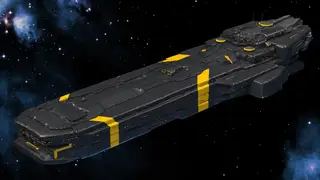
Vigilance-class patrol frigate in Warden near-black and gold livery.
Embarked Assets and Facilities
The frigate carries aerospace craft, drones, and mechs, with launch and recovery facilities, maintenance spaces, and a large armoury. Aerospace craft transport personnel and casualties between the ship, stations, and planetary surfaces. Drones conduct reconnaissance and inspect places unsafe or inaccessible to crew. Mechs provide protected mobility, armed support, and the ability to move heavy loads.
The ship's advanced medical facilities provide diagnostics, surgery, and trauma care for personnel and rescued casualties. A large brig holds detainees pending investigation or transfer. Training facilities accommodate physical conditioning, weapons practice, simulations, and team exercises.
Stealth and Endurance
Tier 3 optical camouflage reproduces the scene behind the hull, making the ship difficult to see. Observers may still distinguish the vessel at close range. Its heat and propulsion emissions can still reveal its presence to sensors.
The frigate uses its jump drive to travel between star systems. Patrol routes account for drive range, recharge time, jump positions outside major gravity wells, and resupply.
Identity
The Wardens are known as “The Watch” and “Black Shirts”. Their motto is “Ever Vigilant”. The service colours are Wardens Black, Wardens Gold, and Wardens White.
Uniforms and Personal Equipment
Fleet Uniforms
Fleet dress uniforms use the same tailored standing-collar tunic, asymmetric front closure, and skirt or trouser design as Operations dress uniforms, in white with black trim. Fleet personnel wear a black belt and black shoes; the women's skirt uniform includes black tights. The rank-dot pin is worn on the standing collar.
Operations and Support Dress Uniforms
Operations and its support departments wear black dress uniforms consisting of a tailored tunic with a standing collar, asymmetric front closure, and black waist belt with a plain rectangular buckle. Occupational colours appear in the collar, wrist and closure trim, buckle accents, and right-shoulder symbol.
The skirt variant has a fitted skirt that follows the hips and thighs and ends above the knee, worn with black tights and modest heels. The trouser variant pairs the tunic with black trousers and boots.
Trim and embroidered symbols have matching, subdued colours. Black embroidery on the Maintenance uniform is distinguished by its texture and stitching.
Shoulder Insignia
The wearer's left shoulder carries the common white-on-black circular Wardens patch: an eye within concentric rings, the ICSS name around the upper ring, and WARDENS below. The right shoulder carries the occupational symbol in the trim colour. The occupational symbol is no larger than the Wardens patch. Rank is shown separately by a dot-cluster pin on the standing collar: one dot per rank number, from one for W.01 to sixteen for W.16. Recruits and Apprentices wear no collar rank insignia.
Occupational Colours and Symbols
Occupational Division | Base Uniform Color | Trim and Symbol Colour | Right-Shoulder Symbol |
|---|---|---|---|
Operations (Operators) | Black | Muted gold | Lightning bolt |
Security | Black | Gray | Dagger |
Medical | Black | Muted red | EKG waveform |
Science / research | Black | Muted blue | Microscope |
Maintenance / mechanical | Black | Black | Wrench |
Fleet | White | Black | N/A |
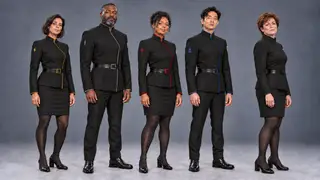
From left to right: Operations, Security, Medical, Science/Research, and Maintenance dress uniforms.
Operator Physical-Training Uniforms
Operators wear black tank tops, athletic shorts, socks, and training sneakers. Male and female versions share the same colours and insignia placement. The tank tops end at the waist, and the shorts are cut to allow unrestricted movement.
Muted gold trim follows the tank necklines and armholes and the shorts' side seams and hems. Black socks carry a narrow gold band, and black sneakers have restrained gold accents. The garments use matte athletic fabric with subdued gold stitching.
The tank carries a small gold Operator lightning bolt on the wearer's right upper chest and a small white Wardens eye emblem on the left. The lightning bolt is no larger than the Wardens emblem. Training uniforms carry no rank insignia.

Warden Operators in physical-training uniforms.
Tactical and Mission Equipment
The standard tactical uniform is durable working clothing for armed patrol, boarding, and field missions. It is worn with armour, load-bearing equipment, communications equipment, and the tools needed for an assignment. EVA suits provide pressure protection and life support for work in vacuum.
Mech-Pilot Equipment
Operators assigned to symbiotic mechs use the Tier 3 Mech Pilot Suit, which combines a neural body glove, interface helmet, and articulated armour. The suit connects the pilot to the mech's controls and protects them during a cockpit breach or ejection.
The Warden version has near-black matte armour with muted-gold markings. Shoulder markings follow the service pattern: the white-on-black Wardens eye-and-rings insignia on the left and a muted-gold Operator lightning bolt on the right.
See Also
ICSS · Giza Conventions · Mechs · Mech Pilot Interfaces · FTL