Mornaich
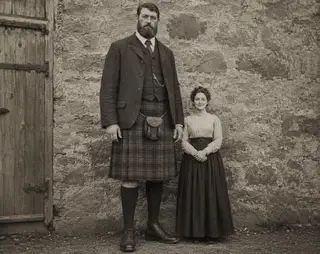
The Mornaich are a rare species of enormous humanoids native to the Seleric Range and the highest reaches of the surrounding Seleric Highlands. Humans commonly call them giants, mountain giants, or Seleric giants, though Mornaich is their proper name.
Adults average approximately four metres in height and commonly weigh close to a tonne. Despite their size, they closely resemble humans in their faces, body plan, expressions, sexuality, and social behaviour. They do not possess horns, tusks, claws, strange eyes, or other obviously monstrous features.
The Mornaich are not enlarged humans. They are a native Veyrathian species with their own evolutionary history, physical adaptations, and ancient claim upon the Seleric mountains.
They are also exceptionally scarce. Their total population is believed to number between eight and twelve thousand, with more than nine in ten remaining inside the Seleric Range. Only a few hundred are thought to live permanently beyond the broader Seleric region. Most people in Veyrath will never see one.
Within their homeland, the Mornaich are not legendary beings or isolated primitives. They are herders, farmers, hunters, craftspeople, miners, soldiers, landholders, judges, and merchants. They speak Seleric languages and belong to the wider Seleric ethnoculture. Their history has been intertwined with that of Seleric humanity for thousands of Cycles.
Names and Usage
Species name: Mornaich
Singular: Mornach
Adjective: Mornaic
Common foreign names: giant, mountain giant, Seleric giant
Average height: approximately 4 metres
Average weight: approximately 750 to 1,150 kilograms
Average lifespan: approximately 150 Cycles (about 219.1 Veyrathian years)
Sexual maturity: approximately 25 Cycles (about 36.5 Veyrathian years)
Estimated population: 8,000 to 12,000
Homeland: the Seleric Range and Seleric Highlands
The name Mornaich is Seleric. Its oldest known forms appear in mountain boundary records and legal compacts predating the modern Kingdom of Cerathene. Scholars have connected it to archaic words for height, greatness, or an elder kindred, though the original meaning remains uncertain.
The foreign term giant is not necessarily insulting, but it is imprecise and carries associations with folktale monsters. A Mornach is a person, not a category of creature.
Physical Description
Women commonly stand between 3.7 and 4.1 metres, while men more often stand between 3.9 and 4.4 metres. Adults outside these ranges occur, but individuals below 3.5 metres or above 4.6 metres are unusual.
Their proportions remain recognizably human, though their bodies are adapted to bear immense weight. Mornaich have broad, thickly cushioned feet, reinforced spines and pelvises, massive joints, dense connective tissues, and long bones with heavy internal bracing. Their chests are deep enough to contain enlarged hearts and lungs, while their necks and lower legs are slightly shorter in proportion than those of humans.
Mornaich appearances overlap strongly with those of Seleric humans. Broad brows, strong noses, pronounced cheekbones, square jaws, and deep-set eyes are common. Hair ranges from black and brown through auburn, copper, red, and fair shades. Grey, green, hazel, and brown eyes predominate. Pale skin, freckling, wind-reddened cheeks, rough hands, and other signs of mountain weather are widespread.
Men commonly grow heavy beards. Both sexes often wear their hair braided, bound, or cut in practical styles suitable for wind, snow, machinery, and outdoor work.
At a distance, a Mornach may resemble an impossibly large Seleric human. At close range, the scale of the hands, joints, voice, breathing, and footfalls makes the difference impossible to ignore.
Strength and Movement
Mornaich possess immense absolute strength, but they are not proportionally as strong as their size might suggest. Much of their power is required simply to support and move a body weighing close to a tonne.
A fit adult can handle loads that would require several humans, shift heavy timber and stone, control large livestock, and use tools that smaller peoples could barely lift. They cannot casually overturn locomotives, throw houses, or perform the impossible feats attributed to giants in popular fiction.
They move carefully in confined spaces but are neither slow nor clumsy. Their long stride allows them to travel efficiently across open upland ground, and they are particularly sure-footed on stone slopes, scree, rough pasture, and shallow snow.
Falls are extremely dangerous. A weak floor, rotten bridge, narrow staircase, concealed hole, or patch of thin ice can become fatal beneath their weight. A stumble that might bruise a human can break a Mornach limb, crush someone nearby, or destroy the structure beneath them.
Mornaich children are therefore taught from an early age that physical size creates responsibility. Carelessness around smaller people is treated seriously.
Lifespan and Development
Mornaich develop slowly.
Newborns usually weigh between thirty and forty-five kilograms and remain helpless despite their size. Childhood lasts for nearly 20 Cycles (about 29.2 Veyrathian years). A young Mornach may stand taller than an adult human long before possessing adult judgement, coordination, or emotional control.
Puberty begins gradually during the late teens and early twenties in Cycles (roughly 25–34 Veyrathian years). Sexual maturity is normally reached at approximately 25 Cycles (about 36.5 Veyrathian years) of age. Growth in height is largely complete by then, though skeletal thickening and full muscular development may continue until 30 Cycles (about 43.8 Veyrathian years) or slightly later.
Traditional Seleric law treats Mornaich below 25 Cycles (about 36.5 Veyrathian years) as minors regardless of their physical size.
The average lifespan is approximately 150 Cycles (about 219.1 Veyrathian years). Healthy adults often remain vigorous well into their second hundred Cycles (about 146.1–292.2 Veyrathian years). Physical decline usually becomes noticeable between 115 and 130 Cycles (about 168–189.9 Veyrathian years), beginning with slower recovery, joint pain, circulatory strain, and reduced strength. Reaching 180 Cycles (about 262.9 Veyrathian years) is unusual. Lifespans beyond 200 Cycles (about 292.2 Veyrathian years) are possible but exceptionally rare.
Reproduction and Hybrid Children
Pregnancy normally produces one child and lasts approximately fourteen months. Twins are rare and medically dangerous.
Mornaich mothers generally have only a small number of children during their lives. Late maturity, long pregnancies, high nutritional demands, and the many years required to raise each child all keep the birth rate low. A single disaster that kills several children or young adults can affect a community for more than 100 Cycles (about 146.1 Veyrathian years).
Mornaich are sexually and reproductively compatible with humans and elves. Such unions can produce viable children who are normally fertile.
No accepted natural philosophy fully explains this compatibility. The Mornaich are native to Veyrath, humans are not, and simple physical resemblance should not be enough to permit reproduction. Hybrid families nevertheless exist and have been documented for hundreds of Cycles.
The carrying mother’s biology strongly regulates fetal growth. A human or elven mother does not carry a full-sized Mornaich infant. The child is born within a survivable range and undergoes more pronounced growth after birth. A Mornaich mother carries a larger child, though hybrids are usually smaller at birth than full Mornaich infants.
Adult hybrids vary considerably. Some remain close to human or elven height, while others grow beyond three metres. Height, heavy bone structure, delayed maturity, and extended lifespan may also reappear after several generations.
Hybrid families are rare because sustained contact is rare, not because such unions are regarded as unnatural. Several old Seleric houses openly claim Mornaich ancestry.
Diet and Scarcity
Mornaich are omnivorous and can eat the same broad foods as humans and elves, but require far greater quantities. A healthy adult generally consumes between 12,000 and 18,000 calories each day. Hard labour, pregnancy, illness, winter exposure, or military service can raise that requirement considerably.
Traditional diets rely heavily on livestock, dairy products, fish, oats, hardy grains, root crops, legumes, preserved meat, and rendered fat. Food preservation is essential. Mountain households store smoked meat, hard cheese, butter, dried fish, grain meal, and dense travelling food in quantities that appear excessive to human visitors.
Their immense food requirements partly explain their scarcity. A valley capable of supporting several thousand humans may sustain only a few hundred Mornaich without exhausting pasture, game, fisheries, timber, and winter fodder.
Their law consequently treats grazing rights, food stores, migration routes, water access, and sheltered valleys as matters of collective survival. Poisoning a stream or destroying winter fodder may be treated as an attack upon an entire kindred.
Homeland and Settlements
The Mornaich remain concentrated in remote valleys, high plateaus, forested slopes, and interior basins throughout the Seleric Range.
Most live within territory claimed by Cerathene, with smaller communities near Vathys and the western approaches toward Saphren. Some Mornaich settlements and territorial agreements predate every modern border in the region. Watersheds, passes, grazing routes, rivers, and burial grounds may matter more to them than lines drawn on a state map.
Their settlements are small. A community of several hundred is substantial, while one approaching a thousand would be among the largest Mornaich population centres in existence.
Villages are normally built in broad valleys with reliable water, pasture, timber, and cultivable land. Houses are dispersed rather than packed closely together, leaving space for livestock, food storage, movement, and fire separation.
Mornaich settlements are remote but not technologically primitive. Many possess schools, physicians, newspapers, telegraph connections, firearms, workshops, mills, and mechanical equipment. Their isolation is geographical and logistical, not intellectual.
Architecture
Mornaic buildings are constructed for occupants weighing close to a tonne.
Homes have broad foundations, high stone walls, massive timber frames, wide doors, shallow stairs, and floors made from stone, packed earth, or heavily supported timber. Furniture is often built directly into the structure. A Mornaich chair may be too heavy for several humans to move.
Human-sized chambers are commonly incorporated into Mornaich buildings. Contact with Seleric humans is ancient and expected, so guest rooms, workshops, shrines, and meeting spaces are often built for smaller bodies.
The reverse is rarely true.
Even within Cerathene, most human buildings cannot admit or support a Mornach. Ordinary inns, homes, offices, churches, shops, railway coaches, and tenements are generally inaccessible. Doorways and ceilings are only part of the problem. Floors, stairs, bridges, furniture, sanitation, and turning space must also bear their weight and scale.
When travelling through human country, Mornaich are often received in courtyards, warehouses, railway sheds, drill halls, stable yards, gardens, or specially constructed guest houses. Sleeping beneath a strong outdoor shelter may be more practical than attempting to use a human room.
This is not always intended as an insult. There may simply be no safe interior available.
Society and Kinship
Mornaich society is organized around households, kindreds, valleys, and remembered obligations. These institutions fit comfortably within the broader Seleric world, though their Mornaich forms often preserve older customs.
Households may contain several generations living beneath one roof or in neighbouring buildings. Because Mornaich mature slowly and live long lives, grandparents, parents, adult children, and young dependants may remain closely connected for more than 100 Cycles (about 146.1 Veyrathian years).
Kindreds are groups of households sharing ancestry, grazing rights, burial grounds, seasonal routes, and duties of mutual defence. They are not uniformly ruled by hereditary chiefs. Authority may rest with an elder, elected speaker, landholder, judge, war leader, or assembly depending on the matter being decided.
Their long lives make personal memory politically important. An elder may remember the original negotiation of an agreement signed 80 Cycles (about 116.9 Veyrathian years) earlier and may have known every witness. Written records still matter, but direct testimony carries unusual weight.
Mornaich culture places strong emphasis on restraint. An angry adult can kill a human accidentally or destroy a house without intending to. Public drunkenness, careless roughness, and uncontrolled violence are therefore treated more seriously than similar behaviour among smaller peoples.
This does not make the Mornaich naturally peaceful. They feud, fight, murder, and go to war like anyone else. They simply understand that ignorance of their own strength is not an excuse.
Seleric Identity
Most Mornaich speak Ceratheni Seleric as their first language. Remote communities preserve archaic vocabulary and mountain expressions unfamiliar in the lowlands. Fragments of older Mornaich languages survive in place names, kinship terms, songs, legal phrases, and personal names.
Mornaich names generally follow the wider Seleric sound system. Many are shared with neighbouring humans, though older mountain forms remain common among isolated kindreds.
The Mornaich usually identify as both Mornaich and Seleric. They participate in Seleric religion, law, trade, politics, and military service. Modern Cerathene recognizes their rights through a mixture of royal charters, local law, and inherited compacts.
They are legally persons, subjects, property holders, witnesses, and officeholders. They are not classified as monsters, animals, or dependants.
Practical exclusion still occurs. A magistrate may respect every legal right held by a Mornach while conducting court in a building the claimant cannot enter.
Travel and Industry
Permanent migration away from the mountains is uncommon.
Human transportation is rarely designed for them. Railway travel requires modified freight wagons, reinforced flatcars, or specially built compartments. Ships may carry them on reinforced open decks, but cabins, ladders, gangways, and internal passages are normally inaccessible.
Food and accommodation must be arranged in advance. A human traveller may purchase a ticket and find an inn after arrival. A Mornach often requires freight arrangements, reinforced shelter, substantial food orders, and advance notice at every stop.
Their strength is valuable in mining, quarrying, forestry, engineering, heavy construction, and machinery installation. Their numbers are too small for them to become a major industrial labour force. A company may employ one or two Mornaich specialists, but cannot recruit hundreds without stripping entire valleys of working adults.
Some employers treat them as living heavy machinery. Mornaich workers strongly resent this attitude. Steam cranes may outperform them, but cranes do not possess judgement, technical skill, legal rights, or personal dignity.
Warfare
Historically, Mornaich served as heavy infantry, pass guards, engineers, siege labourers, artillery handlers, and fortress troops.
In close combat, an armed adult is devastating. A Mornach can break doors, overturn light barricades, and kill a human with a single forceful blow. Their greatest advantage appears in narrow mountain terrain, where enemy numbers are restricted and defenders control the approaches.
Modern rifles and artillery have greatly reduced the battlefield value of size. Mornaich are large targets, difficult to conceal, and expensive to feed and transport. Their wounded are also extremely difficult to evacuate using human medical equipment.
Modern Mornaich soldiers are most effective as mountain troops, engineers, fortress personnel, artillery crews, and heavy weapons specialists. They rarely serve in large formations because no state possesses enough of them and ordinary military infrastructure cannot accommodate such units.
Their weapons are large but practical. Oversized rifles fire heavy cartridges, while traditional weapons include axes, spears, swords, bows, and polearms built for their reach and strength. These weapons are powerful, but expensive to manufacture and difficult to supply.
Foreign Perception
Outside the Seleric region, the Mornaich are known largely through engravings, travellers’ accounts, newspapers, exhibitions, and popular fiction.
Their rarity encourages fabrication. False skeletons have appeared in museums. Unusually tall humans have been advertised as Mornaich. Newspapers have published stories of twenty-foot warriors, cannibal tribes, hidden giant kingdoms, and Mornaich capable of overturning locomotives.
Most of these stories are nonsense.
A genuine Mornach visiting a foreign city may be treated as a monster, celebrity, scientific curiosity, romantic obsession, or public spectacle. Many find such attention exhausting and humiliating.
The reality is less theatrical. The Mornaich are a small, old, and vulnerable people whose bodies make ordinary integration exceptionally difficult.
They remain in the Seleric mountains because those mountains contain their homes, food systems, laws, graves, and communities, and because most of the world beyond them was built without any expectation that they would ever arrive.