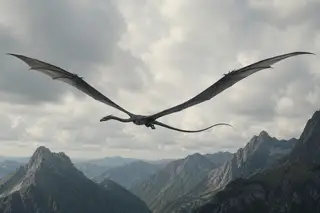
The Vraakhari are the Vraak living on Veyrath, commonly known as dragons. They share the species’ four-limbed winged anatomy, prolonged lifespans and ability to create humanoid avatars. Through those avatars, they participate in local states, houses, businesses and families, particularly in Occara. Most inhabitants of Veyrath do not know that true dragons exist and commonly apply the word “dragon” to wyverns, their non-sapient relatives.
Name and naming traditions
Vraak is the species name in both singular and plural. Vraakhari is the regional designation for those living on Veyrath. The element hari can mean “of the conclave”, giving the name the sense “Vraak of the conclave”.
The Vraakhic naming tradition distinguishes a permanent personal name, a blood-name identifying one immediate parent, a political house affiliation and any earned epithet. The mother is normally the name-parent. A father may take that role through formal acknowledgement. The blood-name uses the High Vraakhic word vruun, meaning “blood”: a consonant-ending name takes -avruun, while a vowel-ending name takes -vruun. An avatar may have a separate public identity.
Morphology and flight
In their true form, dragons are large, tetrapod reptilian creatures with two oversized wings serving as forelimbs and a pair of muscular hind legs. They are built lightly but powerfully, with narrow, thin bodies and long, graceful tails and necks. Draconic wingspans are immense, averaging at least three times their total body length (nose to tail).
Dragons possess hollow bones made of an organic ceramic comprised of mineral fibres and crystalline structures, with a density around 6,000 kg/m³.
Regarding flight mechanics, unlike magical hovering creatures, both dragons and wyverns rely on plausible aerodynamics; they fly similarly to albatrosses, requiring a running start to achieve liftoff and relying on thermals, gliding, and air currents to maintain altitude, rather than sustained flapping.
Dragon scales provide extraordinary insulation, allowing them to withstand sustained temperatures of up to 2500°C and flash temperatures of up to 4500°C, while their internal tissues also possess immense heat tolerance. Furthermore, dragons exhibit reverse senescence; they do not physically age into decrepitude, but instead continue to grow in size and strength until death, adding roughly 10 centimeters per Cycle (about 6.85 centimeters per Veyrathian year) in both length and wingspan.
Growth and life cycle
Dragons mature mentally at a rate similar to humans, typically achieving speech after their first Cycle (about 1.46 Veyrathian years) and possessing young adult mental faculties by their late teens. However, their physical maturity operates on a vastly extended timeline.
Dragons reach physical and reproductive maturity after 200 Cycles (about 292.2 Veyrathian years). At this point they will have an overall body length of approximately 8 meters, and a wingspan over 25 meters. Adult dragons average around 2750 kg.
Life Stage | Age | Body Length | Wingspan | Mass (Avg) | Key Milestones
|
|---|---|---|---|---|---|
Hatchling | 0 Cycles (about 0 Veyrathian years) | 1 Meter | 3 Meters | ~10 kg | Born after 5 Cycles (about 7.3 Veyrathian years) of incubation. Learns speech and becomes capable of forming a first avatar at approximately 1 Cycle (about 1.46 Veyrathian years). |
Juvenile | 20 Cycles (about 29.2 Veyrathian years) | 3 Meters | 9 Meters | ~250 kg | Human-equivalent mental maturity. Growth begins to gradually slow. |
Adult | 200 Cycles (about 292.2 Veyrathian years) | 8 Meters | 25 Meters | 2750 kg | Full sexual and physical maturity. Century Cycle begins for females. |
Elder | 200+ Cycles (about 292.2+ Veyrathian years) | 8 m + about 10 cm per Cycle after maturity (about 6.85 cm per Veyrathian year) | 25 m + about 10 cm per Cycle after maturity (about 6.85 cm per Veyrathian year) | 2750 + kg | Continuous reverse senescence. Increasing natural-body size makes secure torpor chambers progressively more difficult to conceal and maintain. |
Humanoid avatars
A Vraak can create a single humanoid avatar from prepared organic and mineral matter. It is a second living body coupled to the same consciousness through the Void. Only one body can be consciously inhabited at a time; the inactive body enters an unresponsive state.
An avatar’s species, sex, apparent age, physical features, and general anatomy are fixed when it is created. Its appearance may be freely designed, although convincingly imitating a specific individual requires prolonged study. Altering its form requires the existing avatar to be reabsorbed or destroyed and a new one created.
Avatars are biologically complete. They breathe, bleed, eat, sleep, heal and can be affected by disease, poison and injury. Only an avatar matching the Vraak’s natural sex is fertile. Any offspring is genetically descended from the Vraak. The avatar receives the ordinary biological functions of its apparent species but does not automatically acquire that species’ supernatural abilities or additional Attribute points.
Attribute allocation
Creating an avatar requires the dragon to divide its Attributes between its natural body and the avatar.
For each of the dragon’s six Attributes, Strength, Agility, Endurance, Charisma, Intelligence, and Willpower, the dragon must assign at least 1 point to the avatar and retain at least 1 point in its natural body. The scores of the two bodies must together equal the dragon’s normal, unpartitioned Attribute score.
For example, a dragon with Strength 8 could assign Strength 3 to its avatar, leaving its natural body with Strength 5. Alternatively, it could assign Strength 7 to the avatar and leave its natural body with Strength 1.
The allocation is fixed when the avatar is created. Attribute points cannot be shifted between the two bodies while the avatar continues to exist. They are committed rather than permanently spent, but cannot be reclaimed until the avatar is reabsorbed or destroyed.
An avatar may possess Attributes above the normal limits of its apparent species. A dragon may therefore create a physically superhuman, extraordinarily intelligent, or overwhelmingly charismatic avatar, but every such advantage directly weakens its natural body.
The dragon’s memories, learned Skills, personality, and experience are not divided. They follow its consciousness. However, the active body can only access and apply that knowledge through the Intelligence, Willpower, and other Attributes invested within it. A dragon operating through a poorly endowed avatar may remember hundreds of Cycles of experience while lacking the mental clarity or physical ability to use that experience effectively.
Embodiment and control
A dragon has only one consciousness and may actively inhabit only one body at a time.
While the dragon inhabits its avatar, its natural body enters a profound torpor. It continues to breathe and maintain basic biological functions, but cannot consciously perceive its surroundings, defend itself, or take deliberate action. Its metabolism is greatly reduced, although it still requires air, water, suitable temperature, physical care, and periodic nourishment.
While the dragon inhabits its natural body, the avatar falls into an equally unresponsive state. It remains alive but cannot speak, move, perceive, or act.
The dragon may transfer its consciousness between the two bodies at any distance. The transfer requires approximately one uninterrupted minute, during which both bodies are helpless. Attributes remain divided regardless of which body is active. Returning to the natural body therefore does not restore the Attributes invested in the avatar.
Serious injury to an inactive body is felt by the dragon as a distant shock. This conveys distress but no precise sensory information. The dragon may realise that its other body is being harmed without knowing exactly what is happening around it.
Reabsorption
An avatar can only be voluntarily ended by physically returning it to the Vraak’s natural body. Reabsorption requires sustained physical contact and approximately one hour of uninterrupted concentration. The avatar then ceases to exist and all invested Attributes return to the Vraak.
A Vraak may create a replacement avatar with a different appearance and Attribute allocation. Creation takes several days and suitable raw materials. Only one avatar can exist at a time.
Destruction of the avatar
If the avatar is destroyed, all Attributes invested within it return to the natural body.
If the dragon’s consciousness occupied the avatar at the moment of destruction, it is violently forced back into its natural body. The dragon awakens disoriented, exhausted, and temporarily impaired by the shock of losing an inhabited body.
If the dragon’s consciousness occupied its natural body when the avatar was destroyed, the invested Attributes return without transferring consciousness.
Destroying an avatar does not ordinarily kill the dragon so long as its natural body remains alive.
Destruction of the natural body
If the natural body is killed while the dragon’s consciousness occupies it, the dragon dies. The inactive avatar remains an empty biological shell and cannot inherit the dragon’s consciousness after death.
If the natural body is killed while the dragon’s consciousness occupies the avatar, the dragon survives but becomes permanently severed from its original form. Every Attribute point retained within the natural body is lost. The avatar becomes the dragon’s sole remaining body, with only the Attributes that had been invested within it.
A severed dragon cannot recreate its natural body, construct another avatar, recover lost Attributes, fly, produce dragonfire, or use any ability dependent upon draconic anatomy. It retains its memories, personality, Skills, and the body it currently inhabits, but thereafter ages, heals, reproduces, and can be killed according to the nature of that avatar.
This makes the initial Attribute allocation potentially permanent. A dragon that created a weak avatar may survive the death of its natural body only as a frail and greatly diminished humanoid. A dragon that invested heavily in its avatar may remain formidable after severance, but only because it left its sleeping natural body correspondingly defenceless.
Reproduction and Dragon-Blooded offspring
Dragons are highly selective but biologically versatile in their mating practices. Pairings with humanoids occur through biologically functional avatars, while reproduction between dragons may occur through either their natural bodies or their avatars.
Once reaching 200 Cycles (about 292.2 Veyrathian years) of age, a female dragon's ovaries release eggs into the uterus once every 100 Cycles (about 146.1 Veyrathian years), remaining viable for a 10-Cycle (about 14.6-Veyrathian-year) window. For incubation, a fertilized dragon clutch consists of up to 12 eggs, each 30 cm long with a heat-resistant shell, taking 5 Cycles (about 7.3 Veyrathian years) to hatch in environments between 25°C to 500°C, though eggs can be indefinitely suspended in stasis via cooling or freezing. Cross-species mating is also possible, as female dragons are biologically compatible with humans and elves. These mixed pairings yield Dragon-Blooded offspring who physically mirror their non-dragon parent but inherit vast lifespans, as well as extreme physical resilience and strength. Rather than acting as a monolithic faction, the Dragon-blooded exist on a vast spectrum, with some acting as agents for their draconic parent while others leverage their superhuman prowess to climb social ladders or try to lead quiet, normal lives.
Dragonfire
The legendary "fire breath" of Veyrathian dragons is not magical, but a devastating biological weapon born of chemical evolution.
The mechanism for this fire involves specialized glands along their necks containing two distinct, biologically inert chemicals that are projected with immense pressure. These storage glands are protected by the same heavy, heat-resistant scales that cover the dragon's exterior, ensuring that internal damage does not lead to accidental ignition. The dragon is able to spray these two chemicals from a pair of specialized jets located in their mouth, just under the tongue. This results in hyper-golic ignition approximately one meter from the mouth, where the chemicals instantly ignite into a highly adhesive, napalm-like substance in the presence of oxygen. Because the dragon's internal tissues and scales can withstand sustained temperatures of up to 2500°C and flash temperatures of up to 4500°C, the dragon remains unharmed by the intense heat generated just inches from its face.
The combustion profile is intense, with the fire burning at up to 2500°C; it is nearly impossible to physically remove and will violently reignite the instant it is re-exposed to air after any attempt at burial or submersion. Adult dragons can spray their dragonfire up to 100 meters away, in a 10 meter wide fan. Dragon strafing against mass formations of humanoid troops is terrifyingly effective, especially since the dragonfire can be released from a safe altitude above those formations to rain sticky fire down on them. However, this weapon is limited by its finite capacity; a dragon in a protracted fight can exhaust its dragonfire reserves, forcing it to rely on physical strikes with its claws, teeth, and tail.
Only male dragons possess fire glands.
Threats and vulnerabilities
While dragons are virtually immune to heat and fire, and their dragonfire is a devastating weapon, they are not invincible.
Combat exhaustion poses a significant risk, as a dragon in a protracted fight can exhaust its dragonfire reserves and must then rely on its claws, teeth, tail, and wings, becoming significantly more vulnerable to being overwhelmed. They also face biological vulnerability, as they can be defeated by Veyrath's megafauna when caught off guard or suffering from exhaustion. Technological threats are equally dangerous, with dragons being susceptible to damage from large-caliber weapons, including naval cannons and big game rifles. Environmental hazards such as lightning strikes or misjudged landings also present dangers, and structural integrity is a common concern; many deaths occur because dragons overestimate the strength of a building or suffer fatal falls into deep pits.
Diet and society
Dragons are facultative carnivores. Meat is their optimal fuel, optionally supplemented by animal byproducts. They heavily dislike vegetation. An avatar sustains itself through an ordinary humanoid diet. The torpid natural body operates at a greatly reduced metabolic rate but still requires periodic feeding, hydration, ventilation, waste management, and physical care.
Vraakhari are territorial among their own kind but participate extensively in humanoid societies. Their avatars may hold citizenship, noble titles, public office, businesses and estates while their natural bodies remain concealed in guarded torpor chambers. Local houses and personal relationships can persist across many generations of shorter-lived peoples.
To evade modern record-keeping, dragons often create avatars resembling long-lived species such as elves, allow established avatars to age naturally, fake their deaths, and forge inheritance records transferring estates and identities to newly created personas. Their relationship with wyverns is similarly pragmatic; a sapient dragon views a wyvern much like a human views a horse or a hunting dog, appreciating their draconic similarities and commanding them as animals rather than regarding them as equals.
Patronage and client species
Vraak make more extensive use of client species than any other species. These relationships are typically extremely exploitative. Client populations occupy subordinate positions within arrangements directed by Vraak patrons, whose interests take precedence over those of their clients.
Vraakhari exercise influence through local houses, estates, companies and political institutions. Their relationships with other peoples form part of the societies in which they live, with interests and obligations that can continue across many generations.