Characteristics
Argosseans are generally olive-skinned and average of build. Their hair ranges from light brown to glossy black, and eye colour is usually brown, grey, or green. Their noses are straight and often have a slight nasal bump, and their eyelashes are frequently so dark they seem as if they are wearing kohl. Men’s hair is usually worn short (beards and moustaches are optional). Women wear their hair long, at least shoulder length and they knot or interlace their hair behind the shoulders if it is long enough.
Most Argosseans dress in linen, cotton or light wool in deference to the warm climate and they tend to prefer white or muted colours. The style for Argossean men is a type of robe that is knotted in the front with a cape slung over the shoulders. The cape is wide and, if one can afford it, heavily embroidered. The cape is called a tebenna. Argossean women wear long tunics that hang to their feet. These tunics are usually made of a light material, pleated and decorated along the edges. A mantle or shawl of heavier material is worn over the tunic and is usually colourful.
High sandals, ankle boots and shoes with upward curving toes are the most common footwear. People in the coastal cities usually leave their heads uncovered but the country folk and the interior townspeople often wear hats. The most common hat is woollen but the styles vary greatly from social class to social class. The woollen hat comes in a variety of styles, including a cap worn by nobles, a conical type hat, a pointed hood and, for the farmers, a wide-brimmed hat.
The very wealthy, especially those of the city, are easy to spot, as they tend to dress far more splendidly than common folk. They adorn themselves in velvet, brocade and silk at all times of the year, staving off the summer heat with ice imported from the north an army of servants vigorously wielding fans. The wealthy also wear jewellery. Argossean jewellery is unsurpassed in its exquisiteness. The Argosseans have perfected the technique of fixing hundreds of gold granules on jewellery. Earrings, necklaces and bracelets are common.
Social Structure
Milo, king of Argos, sits upon the throne in Messantia, ruling from the largest, and possibly wealthiest, trading city in the Hyborian Age. All the port cities pay into a naval fund that is governed by the king, who also claims the title “Commander of the Navy”. It is King Milo’s duty to safeguard the trading routes, stamp out piracy, and protect Argos from attacks from the sea. The noble houses of Argos only have merchant fleets and wage political intrigue through economic means. Milo, however, does not command trading fleets and thus is maintained this unique balance of power between the king and the merchant dynasties.
In times of war, the king might step back on board the capital ship, especially if the heir is very young, inexperienced, or incompetent. The general division in wartime has the king deciding strategy from the capital while tactical execution is left to the heir and his captains.
The royal navy is funded by a system of taxes collected from all ports and trade that happens in Argos. The merchant houses are responsible for collection and bookkeeping with oversight by the royal accountants. Cheating the taxes is considered a treasonous act, as it directly undermines the security of the nation. In practice, cheating is rare, as punishment is harsh and most Argosseans understand that a strong navy is key to their wealth. The tax business has, however, led to a secondary business of litigation to determine what exactly is owed to the crown.
The merchant fleet is much larger in total than the royal navy but owned by a dozen dynastic merchant houses. The houses have absolute command over their merchant fleets and sail the seas as they please, provided of course they do not engage in overt piracy. In wartime, the king can press the houses to convert the various carracks, galleys, and penteconters into temporary fighting ships to bolster the royal navy. For the duration of the war, the houses are expected to provide the ships, crew, and care, but these are commanded by the authority of the king. In this manner Argos can float a massive fleet very quickly and is why it remains the master of the Western Sea.
One final arena in which the royal navy has considerable sway involves the rewarding of shipwright contracts. Various houses can find themselves dropped from service or gifted with the royal naval contracts in the political games between the king and the merchant houses.
They have a curious relationship with freebooters. While they disrupt trade, kill, and steal, most Argosseans have some affinity with them. Their way of life is, perhaps, the extreme extension of the Argossean nature of free seas, full sails, and a life blown by the winds of fate.
Argos has only a minor standing army, essentially an extension of King Milo’s own forces based in Messantia. Most larger cities have a city guard, primarily loyal to the merchant princes that rule each city, while remote areas might have a local magistrate to enforce the king’s laws. As a sea power, and an even greater economic power, Argos has little need of a standing militia, and so it employs mercenary armies, knows as the Guardians, primarily when needing to marshal larger forces.
Women in Argos
Women and men mix more freely in Argos than they do in many other Hyborian nations, although not by much. In Argos, women, whether noble or peasant, hold a difficult position in society. Often assigned such tasks as cooking, baking bread, sewing, weaving, and spinning. Argossean women, although few ever become masters, do learn to use weapons to defend their homes and property. Women outnumber the men in Argos, so it is not unheard of to encounter well-respected female blacksmiths, merchants, apothecaries, midwives, field hands, writers, musicians, dancers, and painters. Many learn a trade from a father or husband and simply carry on the male’s work when he dies. Women tend to have an easier time in rural settings. Urban Argossean women tend to be more pigeonholed, as many guilds will not admit women save via their husbands. As a result, establishing oneself as a single woman in a field is difficult and many young women who move to the cities and fail to find domestic situations turn to prostitution.
Girls of the merchant or craftsmen classes are often apprenticed out when they are eight. Usually, these girls are apprenticed to another woman, but it is not uncommon to apprentice a girl to a man. These girls learn their master’s or mistress’s trade until they earn the right to perform on their own or find a husband.
Women are under the control of their fathers until they marry. Although peasants have more free choice in marriages because their dowries are either small or non-existent, aristocratic women are subject to arranged marriages. Their lands and potential children are too important to noble families to be given away indiscriminately.
Women in Argos practice trades and many works more than one trade at a time. Many midwives are also weavers, for example. Knowing a profession or craft practicable at home adds to a woman’s value in the marriage market because any extra money brought into the home by the wife only helps the household. Many of the cottage industries are run by the women of Argos, which angers the local guilds and occasionally can lead to exclusion.
Slavery
Slavery is still quite alive in Argos, though it is not so prevalent as it once was. The majority of slaves attached to Argos rarely see the city; they spend their days chained to the oaring benches of a ship, either in Argos’ mighty navy or aboard one of her larger trading vessels. Other slaves are used as labourers; most of Argos’ coastal cities were built via slave labour.
Most Argossean slaves are taken from the lands of Kush and the Black Kingdoms by Argossean pirates and privateers, and are used for menial, dangerous labour. Those not chained to an oar are likely working the croplands, vineyards and orchards that surround the city or are assigned as labour to the Order of Engineers to spend their days hauling stone and timber for the Order’s current project. Their labour is ensured with the chain and lash and the occasional threat to sell them upriver to Athos.
Slavery is considered a necessity by the Argossean elite. No free man works the oars of their trading ships like a slave can be made to, and no free man works their farms and orchards from before dawn until after dusk for a wage low enough to maintain profits. As much as for the practical reasons, though, many nobles’ own slaves simply because they enjoy doing so. Other than gladiatorial slaves, Argosseans tend to prefer females and children for slaves because they are easier to control. Most male slaves are children who have been brought up as slaves and have little concept of a different way of life and little martial skill.
An Argossean master cannot kill a slave unless the slave has previously tried to escape. A recaptured, escaped slave is branded and his life belongs then to the master in all ways – including the slave’s death.
Character Archetypes
Due to the many choices, we advise you create the character you desire and see where they fall under an Archetype. You may also inspire yourself form an Archetype to create a character.
You will find all their descriptions here.
Alchemist
Archer
Bard
Beggar
Captain
Champion
Charlatan
Court Official
Emissary
Entertainer
Galley Slave
Gladiator
Healer
Highwayman
Hunter
Mariner
Master Thief
Mercenary
Merchant
Messenger
Noble
Noble Warrior
Priest/Priestess
Pirate
Sage
Scholar
Scoundrel
Slaver
Smuggler
Spy
Torturer
Unseasoned Youth
Vagabond
Veteran
Skills and Proficiencies
Argos is comprised of Hyborians, one of the most adaptable of all the races; however, the Argosseans and Barachans have grown more specialised, focusing on the sea for the most part. Pirates are the favoured heroes of these people and being a nomad is the most rejected lifestyle. Adventuring Argosseans are more apt to be explorers than river-rat smugglers and aboriginal barbarians from Argos’ fertile valleys. Most adventuring Argosseans naturally gravitate toward piracy.
Religion and Deities
The official religion of Argos is worship of Mitra. The Mitran priests wield considerable power in society and serve as a secondary political structure to bind the merchant city-states of Argos into a cohesive nation. They do not have any fighting orders or military power and rely on the king to defend the faithful. Another of the king’s titles is “Defender of the Faith”.
Mitra’s priests also serve as teachers, judges, lawyers, and many other civil functions in Argossean society. Many second and further-down-the-line noble sons have found purpose in the Mitran Orders and been of great service to Argos.
Most of the major ports of Argos are cosmopolitan, and, as such, small followings of other gods are common and tolerated. Temples raised and dedicated to other gods must pay a religious tax to the king and acquire a license to operate. Some taverns frequented by foreigners might house a small altar to ancient or strange gods of the sea, invoked for whatever protection sailors might procure for their next voyage. Likewise, the many small fishing villages might also pay homage to local deities or old customs, praying for calm waters, good winds, and abundance of fish.
Bel
Another god found in Argos, particularly among the privateers, freebooters and fences, is Bel, god of thieves and commerce imported from the Shemite pantheon. He is often depicted as an eagle carrying a forked bolt of lightning, hinting that he can steal the powers of the heavens if he so desires, including the powers of the other gods. Bel’s priests hold a certain prestige among the thieves and pirates of Argos. In order to serve society, each member of the priesthood must have at least lived as one with the society.
Gita
An obscure spider goddess worshipped deep in the backwoods and among the treacherous hills of northern Argos, in the city of Athos. The spider is a female force in this cult. Her priestesses believe in the superiority of noble blood and some engage in breeding programs to produce strong, pliable slaves. The cult praises cunning, patience, skill and industry. Art and beauty are also emphasised. Gita is the Great Weaver, the Creator of Life, spinning the world and all of its people from her own substance – and all people are attached to Gita through these threads. Mitrans see Gita as a demon, a foul weaver of lies and deception.
Dagon and Thaala
Both have adherents in Argos who worship in secret. They are not above kidnapping, either though rarely does the cult take natives of Argos. They have an infrequent, but reliable, trade in slaves with pirates of the Baracha Isles. It is even said those islands house a colony of dweller hybrids and cultists who aim to raise Dagon from the sea and take all of Argos in his name. Only fools believe such rumours, but the wise heed them.
Argosseans also speak of Thaala, less god than force. Thaala is the sea, quite literally, from its white breakers to its blackest depths. She predates Argos, and her holy ones are more animists than priests. Shrines to Thaala decorate the mantles of many houses, and both private and semi-public ceremonies honour her. There is, of course, more to Thaala than that. The lay members rarely know this, and even priests may be in the dark, but Thaala is only a mask for Mother Hydra, the Great Old One who rules the sea with her consort, Dagon. It is these godlike beings of the Outer Dark they worship, and their taint hangs about Messantia like the stench of a rotting fish.
Anu
Once a predominant deity in Argos, as can be seen on old frescoes in long tumbled palaces of former rulers. Bull jumping, a rare form of sport, is still practiced today. Anu’s influence is present but remains small in Mitra’s light.
Sorcery in Argos
Argosseans, like most Hyborians, revile sorcery. Their legends are replete with stories about degenerate rituals of demonic debauchery, horrifying plagues and worse. Sorcerers and cultists in Argos hide their talents from the people for fear of angry mobs.
Notable Locations
Messantia, Capital of Argos
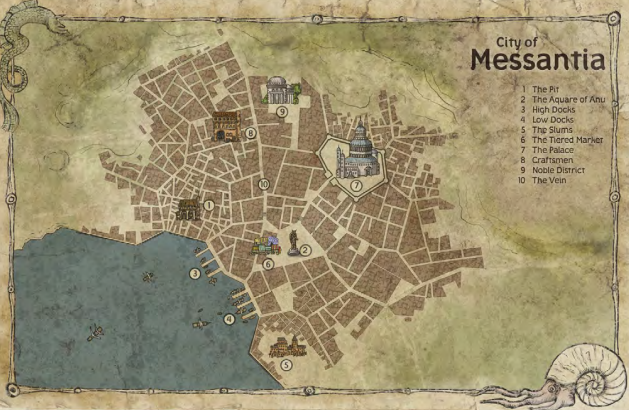
The capital of Argos is also the wealthiest port in the western world. Her spires tower at the edge of a cliff face overlooking the great ocean whose fury and foam break against the rock wall of the sea kingdom. Mighty gates, guarded by a chain said to have been forged by Anu himself, hold back the great waves against the lower docks. Messantia is a feat of engineering unique in the world.
The likes of such a fastness upon the sea has not been seen since the days of Acheron. Sheathed in white marble, the walls and tallest buildings of the city shine in the sun and sparkle under a full moon.
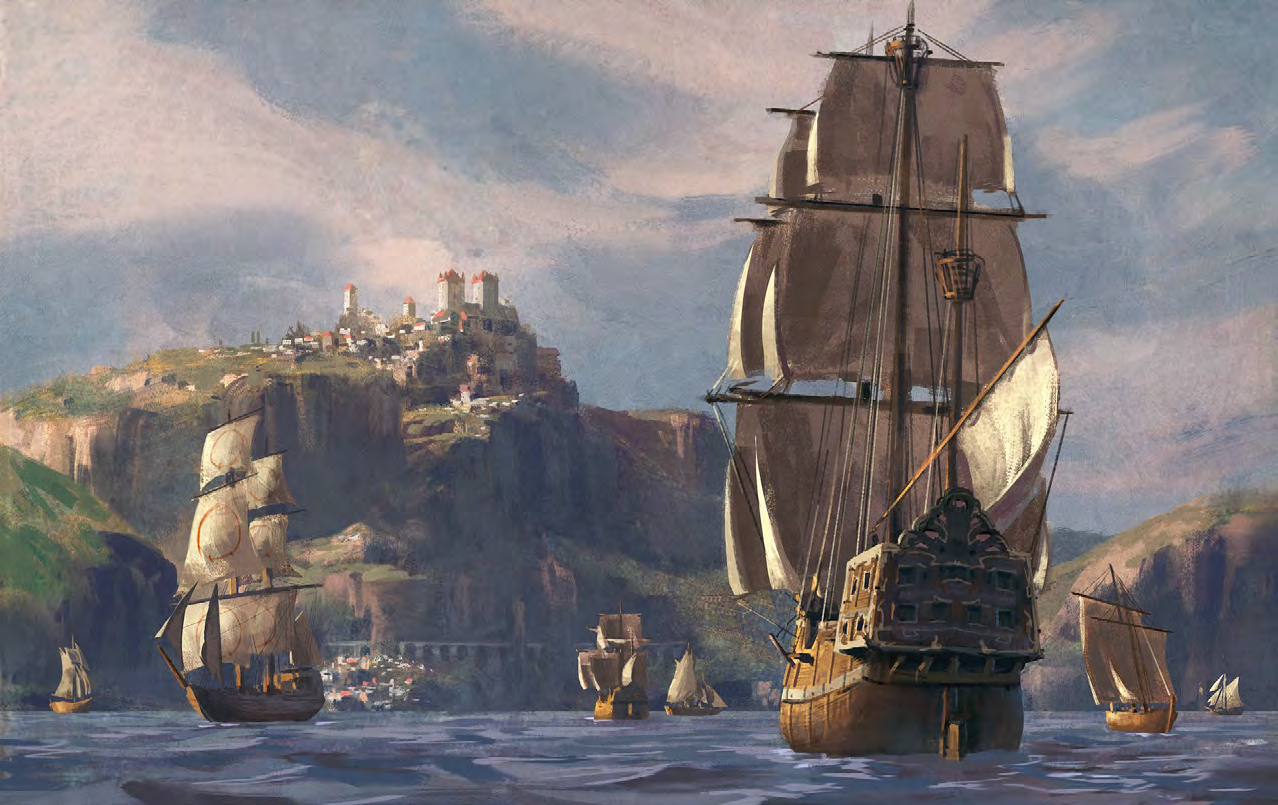
“There is a wonder which catches in one’s throat”
-- famed Nemedian historian Astreas on approach to Messantia from the sea.
The coasts of Argos boast of many other rich port cities grown prosperous from the bounty of the sea and protection of the navy, such as Corypho, Leprium, and Dhilos. In addition to these magnificent city-states, many small fishing villages dot the coastline and continue to produce competent sailors to eventually find service in the merchant or royal fleets.
Relations with Other Cultures
When dealing with foreign powers, Argos wields trade as a powerful weapon to dissuade or persuade their neighbours. Land invasions by the Picts are not a concern as Argos is buffered by Aquilonia and Zingara to the north, and Ophir’s border with Argos is relatively small and easily defended. Koth and Shem are blocked by mountain ranges, and Zingara’s own government and navy are plagued by infighting too strongly to be much of a menace at sea.
Its main rival is the country of Zingara, to the northwest across the Khorotas River and beyond a low mountain range. Directly to the north sits Aquilonia. Argos has stood at times in Aquilonia’s shadow as full vassal or nominal ally depending on how strongly Aquilonia can enforce its imperial desires. To the northeast is the nation of Ophir, while directly east of Argos lie Koth and Shem. The wealth of Argos flows from the monopoly of oceanic trade along the western coast. There are rumours that daring merchants have established routes as far as Vendhya and even Khitai, but no verified proof of such an endeavour.
Their powerful navy enforces their rights and keeps piracy in check. Argossean vessels, from small fishing ships to grand trading galleys, sail secure in the knowledge pirates would seek softer targets rather than risk the wrath of the royal navy. The ports of Argos are open to all ships during times of peace. All are welcome to trade there and to make use of available services, provided the harbour master’s dues are paid. The fees are kicked up to the royal coffers, and in turn are used to keep the royal navy afloat.
While much of the trade is above board and conducted per strict regulations, a persistent search can always find merchant houses who are more interested in profit than following the rules. These shady merchants tend to avoid asking where goods came from, provided of course there is no proof that they originated from Argossean vessels.
As the premier power of the Western Sea, Argossean influence spreads far. Its textiles, pottery, oils, and more find port in a hundred cities, villages, and small towns across the continent. Where their economic strength finds purchase, their cultural ways likewise influence those around them. The Khorotas and Tybor Rivers are great arteries for bringing goods inland to its ports, and the carrying trade goods to the sea.
The royal navy is the pride of Argos. No other sea power that can contest it. Zingara has many ships and a large merchant fleet, but its core is politically fragmented and on the high seas it cannot match Argos militarily or economically. That said, both sides support privateers and freebooters used against each other, and their spies seek news of each other’s trade routes and naval actions. Argos often gets the better end of this and has collected many Zingaran ransoms as proof.