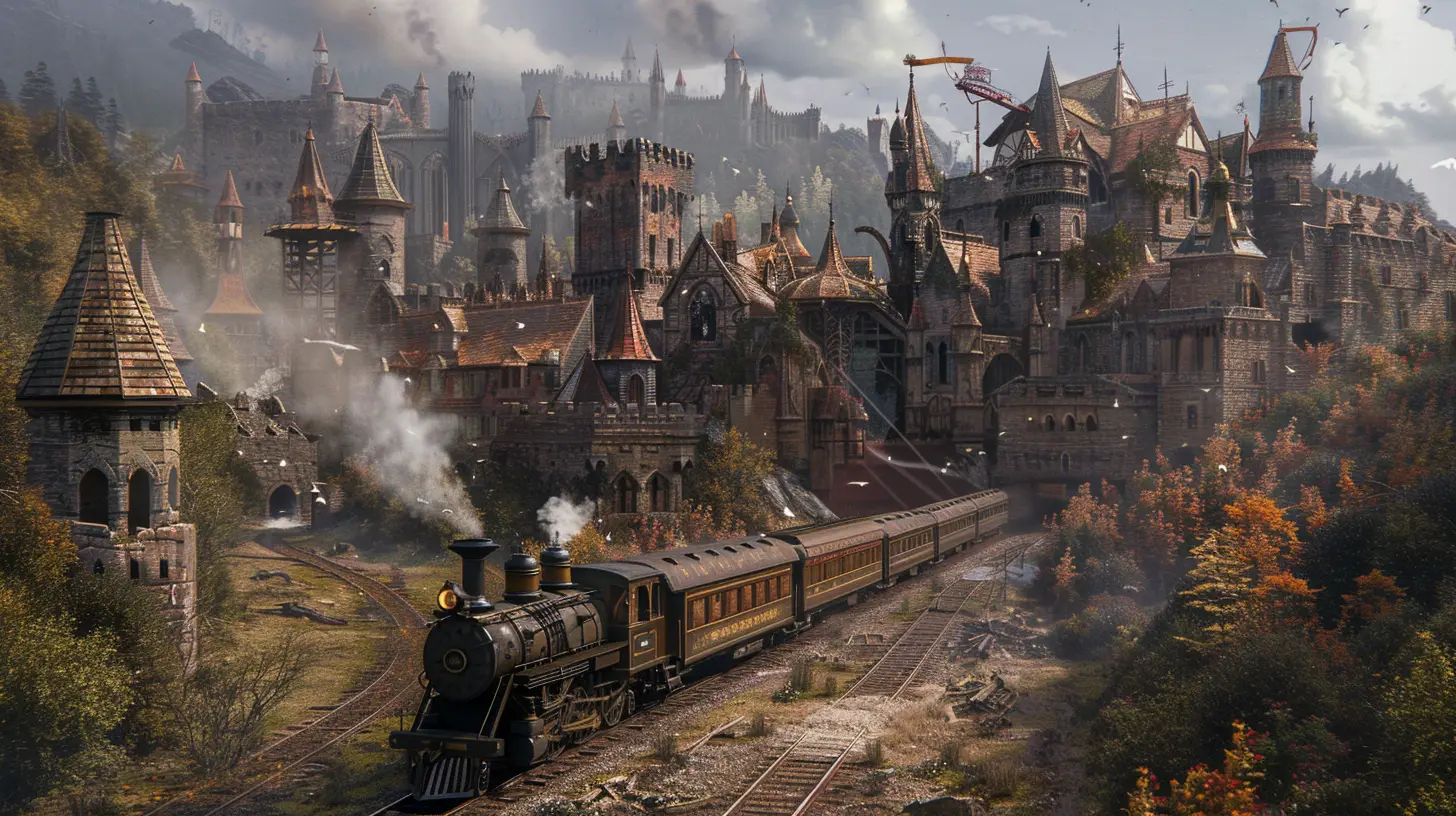
Travel Speeds in Ederia
Caravan - 24 Miles Per Day
Train - 36 Miles Per Day
Ship - 48 Miles Per Day
Airship - 96 Miles Per Day
Overview
Ederia is a diverse and storied nation, its lands ranging from cold highlands and rolling farmlands to spell-scarred regions still marked by the dragons that once roamed here 700 years ago. The lingering remnants of draconic magic divide opinion, seen by some as a blessing and others as a curse. Travel across Ederia is efficient, with well-paved roads connecting the major cities, complemented by a ryanite-powered rail system that offers affordable transportation for its citizens.
At its heart lies Crown's Rest, the capital city and home of the ruling House Falkrest, led by King Talon the Kind and his five children. Across the Dragon’s Strait to the north is Skyhaven, the ancestral seat of House Falkrest. South of the strait lies Tomehold, the arcane bastion of House Astralor, and Kraken's Reach, the maritime stronghold of House Veltaris. On the mainland, Faithspire rises along the northern coastline, eastward Stonewatch stands in ancient dwarven ruins nestled in the mountains, and to the south lies Highfields, celebrated as the “Gem of the South.” These cities form the backbone of Ederia’s rich culture and political intrigue.
History
The history of Ederia stretches back nearly a millennium, beginning under the oppressive rule of the Dragon's Triacy. The people rose in rebellion, slaying the dragons and claiming the land for their own, establishing their rule over the next 700 years. However, Ederia’s history has been far from peaceful. The first queen, Sanaria Warrendell, failed to establish clear succession, leading to centuries of bloodshed as rulers followed their own rules for inheritance. The chaos persisted until 600 AR, when Aetheria the Just of House Nightmoore introduced the Concord of the Crowns, a framework for succession. Yet, even this did not end the strife, as power struggles and short-lived reigns defined the next 500 years.
It wasn’t until the War of the Crimson Court, the defeat of the Lich-King Draven Allister, and the rise of Elendara the Usurper of House Falkrest that the realm finally found stability. Now, in 1103 AR, Ederia enjoys an unprecedented 70 years of peace under the rule of House Falkrest. Though fragile, this peace remains a testament to the resilience of its people and the lessons of its turbulent past.
Culture
Ederians are a resilient and pragmatic people, shaped by centuries of war and hardship. They place immense trust in their fellow commoners, viewing their neighbors as the backbone of the realm. However, their faith in monarchs and nobles is harder to earn; after centuries of bloodshed and unstable leadership, Ederians expect rulers to prove themselves through action and integrity. This skepticism extends to magic, which many regard as a necessary but dangerous force. While arcane practices are respected for their utility in defense and industry, they are often viewed as shortcuts taken by those unwilling to solve problems with grit and determination.
Culturally, Ederians value hard work, community, and directness. They don’t shy away from danger, preferring to face challenges head-on rather than wait for problems to resolve themselves. This has fostered a reputation for bravery and industriousness, as well as a blunt and straightforward demeanor. Storytelling is an integral part of Ederian life, with tales of the dragon rebellion, legendary rulers, and local heroes passed down through generations. Music and dance are common in festivals, often involving simple instruments like lutes, drums, and flutes, with a preference for communal participation over professional performance.
Despite their hardened outlook, Ederians cherish life’s small joys, finding solace in family, shared meals, and local traditions. Farmers, merchants, and artisans form the backbone of society, while nobles and rulers are held at arm’s length unless they earn the people’s respect. Ederia’s common folk pride themselves on being the bedrock of the kingdom, enduring the trials of the past to build a stronger future.
Ederian Holidays
Winter’s Light (Christmas Equivalent): Celebrated in the heart of winter, Winter’s Light honors the endurance of Ederians through dark times, both literal and metaphorical. Lanterns with a small amount of ryanite powder are hung in homes and along streets to symbolize hope and warmth. Families exchange small handmade gifts, share hearty meals, and tell stories of resilience and renewal.
Dragonfall (Independence Day Equivalent): Held in the early autumn, Dragonfall commemorates the rebellion against the Dragon’s Triacy. The holiday begins with reenactments of the rebellion in town squares, followed by feasts and fireworks. Children craft dragon effigies, which are burned or dismantled, symbolizing the triumph of humanity over tyranny.
Summer’s Reach: A vibrant festival in midsummer, Summer’s Reach celebrates community and abundance. Farmers’ markets overflow with goods, and towns host competitions like jousts, archery contests, and foot races. It’s a time for matchmaking, with dances and courting games drawing young people together.
Bloomtide (Spring Holiday): Bloomtide marks the arrival of spring and the renewal of life. Villages and cities hold planting festivals, where the first seeds of the season are ceremonially sown. People decorate homes with fresh flowers, and children participate in scavenger hunts to collect blossoms and magical herbs.
The Forgebright Festival (Innovation Day): Celebrated in mid-summer, the Forgebright Festival honors Ederia’s achievements in magical and technological innovation. The Heights of Crown’s Rest become the heart of the celebration, with its gleaming spires and floating keeps adorned with banners and lights powered by ryanite. Artisans, engineers, and mages showcase their inventions and advancements, including new trains, weapons, and arcane technology. Public demonstrations and exhibitions fill the streets, while competitions reward the most groundbreaking designs. The day concludes with a grand display of ryanite-fueled fireworks over The Heights, symbolizing Ederia’s commitment to progress and innovation.
Lover’s Oath (Valentine’s Day Equivalent): Celebrated in late winter, Lover’s Oath honors devotion and bonds. Couples exchange handwritten letters or small tokens, often inscribed with promises of loyalty or affection. Public declarations of love and marriage proposals are common. For others, the day celebrates friendship and family, with shared meals and storytelling that strengthen non-romantic connections.
Traditions of Ederia
The Choosing: When an Ederian child is between ages 3 and 12, a tradition known as The Choosing takes place. The child is presented with an array of small items—such as a toy sword, a boat, a doll, or a quill—and whichever item the child is drawn to is said to hint at their future path. While not binding, this tradition influences how the child is perceived by their family and community, often shaping their early upbringing.
Oaths of Fealty: Following the coronation of a new monarch, all lords and ladies swear oaths of fealty in a grand ceremony in Crown’s Rest. Common folk participate by lighting lanterns in their homes, symbolizing their hope for the new ruler’s success.
Harvest Wards: In rural areas, farmers place small ryanite shards or protective charms in their fields during planting seasons. This tradition, blending superstition and practicality, is believed to ward off bad luck and ensure a bountiful harvest.
Daily Life in Ederia
The daily life of Ederians varies greatly between classes. For common folk, life revolves around hard work and community. Farmers rise before dawn, tending to crops or livestock, while artisans and merchants fill bustling markets and workshops. Meals are simple but hearty, with a reliance on locally grown produce, salted meats, and bread. In villages, the evenings are often spent in communal gatherings, where music, dance, and storytelling help ease the day’s burdens.
For the middle class—such as successful merchants, skilled artisans, or minor bureaucrats—life offers more comfort. They enjoy access to education, finer foods, and the ability to travel via the ryanite rail system. Many aspire to climb higher through hard work and strategic marriages, bridging the gap between commoners and nobility.
The nobility lead lives of luxury but bear heavy responsibilities. Their days are filled with political meetings, estate management, and ceremonial duties, though their wealth affords them access to exotic goods, private tutors, and lavish feasts. However, noble life is not without peril; the constant need to secure alliances and maintain favor with the crown ensures their lives remain fraught with intrigue and danger.