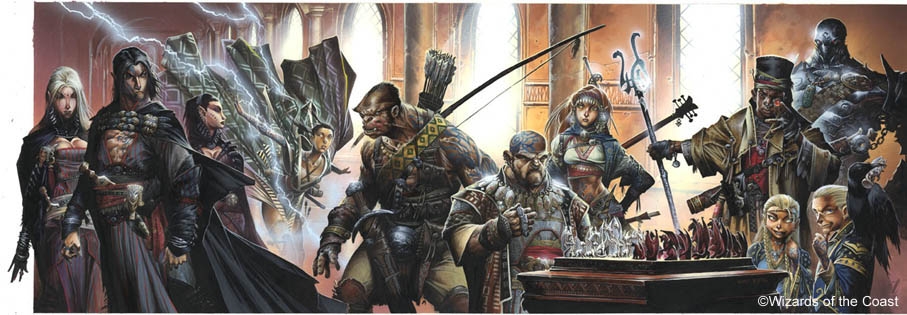
The Dragonmarked Houses
The Bloodlines That Run the World
"You can change your king. Try changing your mail service." — Unattributed, popular saying in Sharn's tavern districts
Thirteen families control the movement of goods, the transmission of messages, the healing of wounds, the forging of steel, and the vaults where nations keep their gold. Nobody elected them. Nobody appointed them. What happened, over several thousand years, is less dramatic and more effective: families with useful magical abilities figured out that those abilities were more valuable when delivered as services than wielded as weapons, built institutions around that insight, and waited for civilization to become dependent on them. By the time anyone thought to ask whether hereditary monopolies controlling the bones of Khorvaire's economy was a healthy arrangement, the answer no longer mattered — the bones were already set.
Twelve recognized dragonmarks are distributed among thirteen houses (two houses share the Mark of Shadow). Each mark manifests within a specific bloodline and grants reliable, repeatable magical abilities within a defined domain. The houses are coordinated — loosely, fractiously, but functionally — through the Twelve, an inter-house body that mediates disputes, sponsors joint research, and coordinates economic interests from its tower in Korth. In practice, the houses function as the backbone of Khorvaire's magical economy. Their power lies not in raw magical strength but in making magic dependable, scalable, and commercially viable. A Jorasco healer is not necessarily more powerful than an unaffiliated divine caster, but she is better insured, better equipped, and backed by an organization that guarantees her work. She also carries tools — proprietary focus items developed over centuries by House Cannith and the Twelve — that amplify her mark's abilities far beyond what an unequipped healer can match. This combination of talent, tools, and institutional support is what separates the houses from every independent practitioner on the continent.
"I am asked, sometimes, whether the houses are families or corporations. The answer is yes." — Merrix d'Cannith, public remarks, 997 YK
Origins
Dragonmarks first appeared several millennia ago within isolated family lines scattered across Khorvaire and Aerenal. Each mark arose not within a single family but across multiple families in the same region, bound by race and aptitude — the Mark of Sentinel among the warrior clans of Khorvaire's northern coast, the Mark of Making among the smiths and tinkers of the Metrol League, the Mark of Scribing among the gnomes of Zilargo. These early mark-bearers discovered, through trial and practicality, that their abilities were most useful when applied narrowly and repeatedly. Rather than pursuing individual power, they focused on service provision — moving goods, transmitting messages, securing vaults, treating injuries — and in doing so laid the first foundations for what would become continental monopolies.
The transition from "family with a useful gift" to "hereditary corporation" did not happen overnight, but it happened thoroughly. As the marked families grew in influence, they began to seek each other out. House Sivis and House Cannith both claim credit for the early work of unification, and both have reason to — Sivis envoys traveled across Khorvaire identifying other marks, while Cannith provided the organizational model the other families adapted. Over generations, these loose alliances hardened into formal structures: guilds, charters, standardized training, carefully managed bloodlines, and the system of barons, viceroys, seneschals, and enclaves that House Sivis helped design and that most houses still use today. For Sivis heirs, bureaucracy is a delightful puzzle to play with, and their fingerprints are on the governance structure of every house on the continent.
As the houses initially spread, it was natural for them to forge alliances through marriage. This blending of bloodlines produced a wave of aberrant dragonmarks — unstable, dangerous, and destructive. It took generations for people to recognize the full impact: that someone who manifested an aberrant mark lost all connection to the true marks of their parents and could not pass either mark to their children. The houses' response was the War of the Mark — a bloody purge, framed as a defensive campaign against a monstrous threat, that drove the aberrant-marked to the edge of extinction and cemented the alliance between the houses. The War of the Mark was less a war between equals and more an inquisition with extraordinary propaganda. Deneith soldiers, Vadalis tracking hounds, and Medani inquisitives hunted aberrant-marked individuals across the Five Nations. Sivis and Phiarlan propagandists amplified genuine tragedies into universal terror. House Ghallanda alone had a substantive number of dissenters — many of whom were exiled or worse when they sheltered aberrant-marked individuals from execution. When the aberrant champion Halas Tarkanan and his companion, the Lady of the Plague, made their last stand in Sharn, they shattered the city's towers and unleashed plague upon attacker and defender alike, leaving Sharn in ruins for centuries. In Karrnath, the purge was carried out with particular brutality, a fact that most Karrnathi today know only through the propagandized version of events — the houses valiantly defending common folk from marauding aberrant monsters.
The War of the Mark proved what the houses could accomplish when they worked together, and the leaders of the houses were not about to let that coalition dissolve. In its aftermath, Baron Hadran d'Cannith proposed a permanent inter-house alliance. The architect and artificer Alder d'Cannith, whose inventions had played a critical role in the war, insisted the organization be named the Twelve — believing that though only ten marks were known at the time, a total of twelve true dragonmarks would eventually be discovered. He was vindicated a millennium later when House Tharashk was inducted in 498 YK.
By the time of the Kingdom of Galifar, the houses had already become infrastructure — woven so deeply into trade, governance, and daily life that removing them would have been less like dissolving a business and more like pulling out a load-bearing wall.
The Korth Edicts
"We don't rule you. We simply provide the services without which your rule would be impossible. The distinction matters to lawyers." — Overheard at a Twelve gala, attributed to a Sivis negotiator
The Korth Edicts were negotiated between Galifar I and the Twelve approximately a thousand years ago, establishing principles that continue to govern house behavior — at least in theory. The deal was essentially this: the houses agreed not to challenge Galifar politically or militarily; in return, Galifar would not challenge them economically. One of Galifar's key diplomatic insights was to offer this exclusive status directly, negotiating with the Twelve rather than with individual nations, granting the houses favored economic standing across his entire kingdom in exchange for their support. The houses hold monopolies on a scale that would be illegal in any modern nation acting alone, and under the edicts they regulate their own industries. For most houses, the lack of antitrust enforcement is far more valuable to their bottom line than any noble title could be.
The four core provisions:
Neutrality. Houses are prohibited from holding land as sovereign territory, holding noble titles, or fielding armies (with an exception for House Deneith). Essential magical services remain available to all recognized states.
Bloodline Integrity. Intermarriage between houses is forbidden — mixed bloodlines produce aberrant marks and sever both parents' lines. Further, members of a house may not marry into nobility without legally divesting themselves from the house entirely. A noble can marry a dragonmarked heir, but one of them must completely sever all legal ties to their family — if a Deneith heir chooses to marry into a noble house, they must cut all ties including their family name. Some tension exists where this rule has been bent, notably in the case of Queen Aurala of Aundair's marriage to Sasik of House Vadalis; though Sasik formally severed his claims to the Vadalis fortune, he maintains ties that make the other houses deeply nervous about what advantages Vadalis might be gaining in its dealings with Aundair.
Domain Exclusivity. Each house is restricted to its recognized sphere of magical commerce. Cannith does not heal. Jorasco does not manufacture. Overlap destabilizes markets and erodes trust.
Standardization. Guild practices, heraldry, naming conventions, and internal governance follow uniform structures across all national borders.
Special provisions exist. House Deneith is permitted to maintain military forces for mercenary service. House Ghallanda's enclaves are treated as sovereign territory — an amendment negotiated after a Ghallanda quartermaster saved Galifar's life during the War of Unification. Those within a Ghallanda enclave are beyond the legal reach of any nation or house, a provision that has sheltered as many fugitives as Dreadhold has held prisoners.
The houses complain about the edicts periodically. The houses also historically enforce them rigorously against each other to prevent unfair advantage, which tells you everything you need to know about how the system actually works.
Today, many within the houses consider the Korth Edicts obsolete — and they may be right. Under united Galifar, the crown had the strength to impose its will. In the fractured postwar landscape, no single nation clearly has that power, and the houses know it. Aundair granted the island of Stormhome to House Lyrandar in a clear violation of the edicts, and nothing was done. House Deneith's military forces at Korth have grown beyond even the generous provisions granted to it, and Karrnath has yet to challenge this. The elves of Valenar are effectively appointing Lyrandar heirs to the duties of viscounts, though they avoid using that title; these Lyrandar administrators don't sever their ties to the house. In Stormreach, far from any Five Nations oversight, the houses operate entirely unbound by the edicts and pursue their own agendas openly. The edicts carry the weight of centuries of tradition, but tradition without enforcement is just a suggestion with a fancy name.
The Houses
House | Race | Mark | Domain |
|---|---|---|---|
Cannith | Human | Making | Fabrication, constructs, industrial enchantment, manufacturing. The unspoken leader of the Twelve. Emblem: the gorgon. |
Orien | Human | Passage | Land transportation, courier services, lightning rail. Emblem: the unicorn. |
Lyrandar | Half-Elf | Storm | Elemental airships, galleons, weather control via storm spires. Emblem: the kraken. |
Sivis | Gnome | Scribing | Communication, translation, documentation, notarization, speaking stone networks. Emblem: the cockatrice. |
Kundarak | Dwarf | Warding | Banking, vaulting, letters of credit, extradimensional storage, Dreadhold prison. Emblem: the manticore. |
Jorasco | Halfling | Healing | Standardized curative services, trauma care, published treatment protocols. Emblem: the griffon. |
Ghallanda | Halfling | Hospitality | Inns, taverns, food services, licensed hospitality venues, sovereign enclaves. Emblem: the blink dog. |
Tharashk | Human / Half-Orc | Finding | Dragonshard prospecting, inquisitive services, bounty hunting, Droaamish mercenary brokerage. Emblem: the dragonne. |
Vadalis | Human | Handling | Magebreeding, animal husbandry, exotic mounts. Emblem: the hippogriff. |
Medani | Half-Elf | Detection | Threat assessment, investigation, protective services, the Warning Guild. Emblem: the basilisk. |
Phiarlan | Elf | Shadow | Entertainment, artistry, espionage, and services best discussed quietly. Emblem: the hydra. |
Thuranni | Elf | Shadow | Split from Phiarlan during the Last War (the Shadow Schism, 972 YK). Same mark, different management. Similar discretion. Emblem: the displacer beast. |
Deneith | Human | Sentinel | Mercenary services, bodyguards, martial security. The only house permitted to maintain military forces. Emblem: the chimera. |
How the Houses Work
Marks and Heirs
Dragonmarks manifest around adolescence. Each house puts its heirs through a trial called the Test of Siberys — specific tests vary by house, but they place the heir in circumstances where the mark is likely to manifest. The trials are not gentle. The stress does not have to be life-threatening — it can derive from the threat of social humiliation, professional ruin, or the knowledge that failure will shame your family before the entire enclave. The Trial of Making might lock a young Cannith heir in a room with half the tools they need and demand they fix something under a punishing deadline. The Trial of Finding might set a Tharashk youth on a hunt with one chance at success. About half of a bloodline's members develop a mark through this process. Those who do are permitted to add the d' prefix to the house name — Merrix d'Cannith, Bali d'Orien — and are recognized as true heirs with all the privileges and obligations that entails. Despite the Korth Edicts' prohibition on noble titles, regional leaders within the houses are called barons, a distinction the houses maintain is purely traditional.
On rare occasions, a Siberys dragonmark manifests — a larger, far more complex pattern granting powers that surpass those of other heirs. These are prized enormously by the houses. A Siberys mark typically evolves from an existing mark following an extraordinary feat, but on rarer occasions someone with no prior mark at all spontaneously manifests one — an event that shakes the house, draws the attention of forces far beyond mortal politics, and may signal that the bearer has been marked for a role in the Draconic Prophecy that dragons, fiends, and other powers will seek to exploit.
Excoriates and Foundlings
Not everyone with a mark stays in the family. Excoriates are dragonmarked heirs who have been cut off from their houses — the term dates to an era when the mark was physically flayed from the exile's body. The mutilation is no longer practiced, but the name persists, carrying all the weight of that original cruelty. An excoriate might be a criminal, a dissident, a researcher who crossed a forbidden line, or simply someone who defied their house one time too many. Excoriation strips you of the right to wear house insignia, present yourself as an heir, or access house resources. In the eyes of the house, you are dead — though the mark on your skin remains stubbornly, inconveniently alive.
Foundlings are people who manifest a dragonmark but have no known tie to a dragonmarked house — their ancestors left the bloodline generations ago, or the connection was never recognized. A foundling might know nothing about the houses, might have grown up on the streets or in a remote village, unaware of what the mark on their arm means until someone in a gorgon-stamped cloak shows up to explain. The houses usually try to recruit foundlings, because every dragonmark outside the house is both a missed asset and a potential threat. Whether the foundling wants to be recruited — whether they want to trade their freedom for a family that comes with contracts, obligations, and a bureaucracy older than most nations — is another matter entirely.
Enclaves and Guilds
Most houses maintain enclaves in major cities — strongholds that serve as hubs for house business and local operations. A city may also have any number of businesses licensed by or affiliated with a house, but these are simply providing services and do not have direct connections to house leadership. The enclaves are where policy is set, contracts are brokered, and house resources are concentrated.
Each house operates through guilds that organize and regulate specific services. Even independent businesses are typically licensed by a house guild and conform to its standards. Not every tavern is run by House Ghallanda, but the Ghallanda seal on an inn sign assures customers the establishment meets health and safety standards. Not every smith learned their trade at a Cannith academy, but many did, and the Cannith quality mark on a blade tells you the steel meets guild specifications.
Governance
Each house is led by a matriarch or patriarch who serves as both bloodline head and executive authority over guild operations. Succession is hereditary but constrained by internal councils, legal precedent, and the practical reality that a leader who disrupts service reliability tends to find their authority eroding from within. The houses are not monarchies in the way nations are — they are family businesses at continental scale, and family businesses survive by being useful.
Dragonmarked heirs hold the highest authority, but the houses rely on vast numbers of non-marked labor: guild members, administrators, magewrights, contracted specialists. Strategic marriages and adoptions reinforce bloodlines or secure alliances, governed by economic calculation rather than sentiment. A house does not marry for love. A house marries for mark stability and favorable contract terms.
"My house built the modern world. Orien may drive the lightning rail, but it's Cannith who builds the cars and lays the stones it travels on. Cannith makes the everbright lanterns that hold the night at bay. Smith, carpenter, alchemist — the best all carry my seal." — Baron Merrix d'Cannith
The Houses in the Last War
The houses generally thrived during the Last War, and it is fair to say that they profited enormously from it. Each house's unique talents adapted easily to the war effort. Ostensibly neutral under the terms of the Korth Edicts, they sold services and materiel to every nation involved in the conflict simultaneously — healing Brelish soldiers on one front while shipping Karrnathi munitions on another. The war years were a period of vigorous growth and increased influence, growth that came at a cost the houses are still reckoning with.
House Cannith suffered the worst of it. Many foundries were destroyed. The Treaty of Thronehold forced the dismantling of the creation forges that produced the warforged. And the destruction of Cyre — Cannith's ancestral seat — killed the house patriarch, Starrin d'Cannith, and left the house fragmented into three semi-independent branches (Cannith East, West, and South), each led by a baron claiming the right of succession that no one has the authority to resolve.
House Thuranni broke away from House Phiarlan in the Shadow Schism of 972 YK, splitting the Mark of Shadow between two rival organizations — a fracture driven by the impossible conflicts of interest that arise when an espionage house serves every side of a complex war.
And the overlapping interests of the houses — always present but manageable under Galifar — have sharpened into open friction. Orien's control of land transportation is threatened by the growing reach of Lyrandar airships. Tharashk's arrangement brokering Droaamish monstrous mercenaries threatens Deneith's monopoly on military services. The Twelve mediates, but mediation only works when both sides prefer compromise to confrontation.
Contemporary Position
The Treaty of Thronehold formalized the houses' position: essential, tolerated, monitored, and not to be trusted with sovereignty. The houses accepted this publicly and continued doing what they have always done privately — accumulating leverage through indispensability rather than conquest.
House | Post-War Position |
|---|---|
Cannith | Fractured into three competing branches. Lost patriarch, ancestral headquarters (Cyre), and creation forges. Weakened but still dominant in fabrication. Cannith's role in rebuilding Khorvaire's infrastructure — and its central place in the magical economy through focus item production — ensures it remains the most influential house even in its broken state. |
Orien | Lightning rail network split into eastern and western circuits by the Mournland. Baron Kwanti d'Orien struggles to fund reconstruction, traveling western Khorvaire in his personal rail coach, the Silver Unicorn. |
Lyrandar | Airship demand surging as overland routes remain unreliable. First airships entered service only in 990 YK — the house's influence is expanding rapidly. Stormhome is governed with near-total autonomy. |
Kundarak | Stronger than ever. Post-war debt, reconstruction loans, and security contracts have made the banking house indispensable. Its extradimensional vault network gives clients access to stored goods at any Kundarak enclave on the continent. Kundarak has a close alliance with House Sivis; both houses have built their reputations on unshakable integrity, and both enforce that reputation ruthlessly against renegades who use their marks to freelance. |
Tharashk | Expanding aggressively into dragonshard prospecting in Q'barra and Xen'drik. Brokering Droaamish mercenary services. Growing faster than any other house. The youngest house, and the least traditional. |
Deneith | Mercenary demand high. Former soldiers need employment. Nations need security they can no longer field themselves. Deneith's military forces at Korth have quietly grown beyond what the edicts technically allow. The house's families each originate from different Karrnathi duchies and maintain unique chimera heraldry representing different combinations of dragons and beasts. |
The houses regulate the flow of magical labor the way governments regulate currency. They determine who can heal at scale, who can move goods safely, who can transmit information securely, and who can manufacture enchanted tools reliably. Innovation exists, but it proceeds cautiously, filtered through guild research arms and the Twelve's shared interests — though not even that body is immune to the strains of inter-house competition. The default trajectory of Khorvaire is one in which the houses continue to accumulate influence while the divided nations squabble. There are whispers — in Sharn's upper salons, in Korth's diplomatic circles, in the private correspondence of worried monarchs — that if Khorvaire is ever united again, it will not be a descendant of Galifar who sits on the throne, but a baron of the Twelve.
"The dragonmarked houses do not rule nations. But they shape how civilization functions, and they have ensured — through centuries of patient work — that the distinction is academic." — Augusta Wainwocket, "The Invisible Throne," Korranberg Chronicle special report