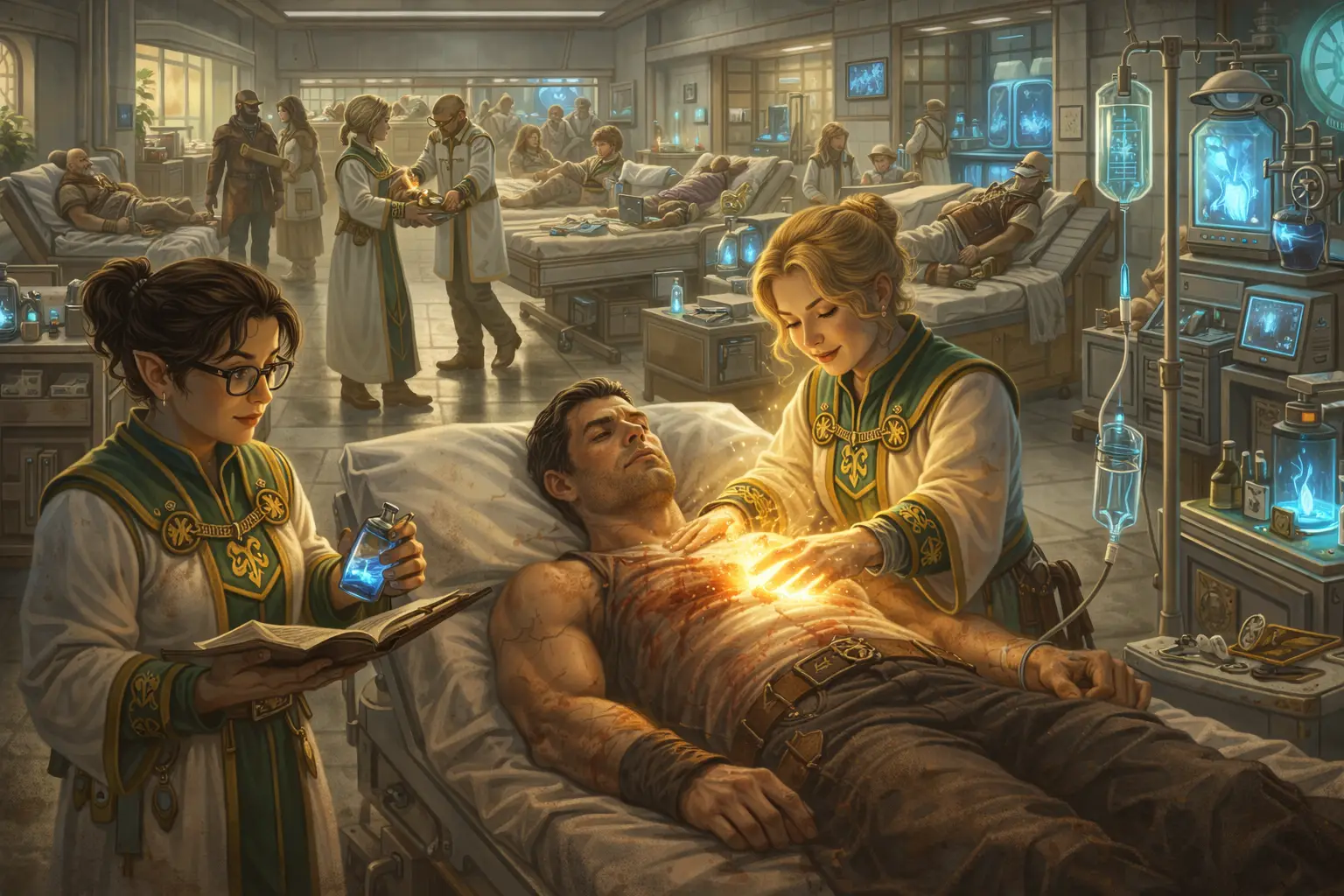
House Jorasco — Dragonmark Focus Items
"She didn't chant. She didn't pray. She put one hand on my chest and the other on the charm around her neck, and I felt something warm move through me — not heat, not magic the way a wizard does it. More like my body remembering how to be whole. When it was over she told me to rest, drink water, and come back in two days. Then she moved on to the next bed." — Brelish veteran, recounting treatment at a Jorasco field clinic
Mark: Healing | Symbol: The Griffon Production: House Cannith and the Twelve (exclusive) Requirement: All items below require the Mark of Healing unless otherwise noted.
The Principle
The same principle governing all dragonmark focus items applies here: these items amplify an existing magical gift; they do not create one from nothing. A Jora charm does nothing in the hands of someone without the Mark of Healing. This is the structural basis of Jorasco's medical authority. Because focus items are easier and cheaper to produce for a marked heir than equivalent items for unmarked users, the house maintains a permanent practical advantage that no independent healer — no matter how talented, no matter how well-funded — can simply purchase away. A gifted divine adept of the Silver Flame can heal with blades of light. A talented herbalist in the Eldeen Reaches can treat diseases with foraged remedies and primal magic. But neither of them can walk into a Cannith workshop and order a Jora charm, because the charm requires the mark, and the mark belongs to the halflings of Jorasco.
Where other houses' catalogues center on personal tools carried into the field — shields, gloves, wands — Jorasco's most important instrument is a permanent installation. The Altar of Resurrection is an immovable artifact that defines the absolute ceiling of what the mark can do. The portable items below are the working layer: the tools that keep people alive in clinics and on battlefields. The altar is the point everything else builds toward — the reason the house's finest healers are stationed where they are, and the reason those locations matter more than any other medical facility in Khorvaire.
Focus items are produced exclusively by House Cannith and the Twelve using proprietary techniques. They are not found in shops. Each bears the image of the Mark of Healing somewhere on its surface — typically alongside the griffon crest — and incorporates a Siberys dragonshard. Acquiring one outside of house channels is unusual and worth noting; the house takes unlicensed possession seriously.
HEALER'S GUILD — FOCUS ITEM PROTOCOL All dragonmark focus items bearing the Jorasco griffon remain the property of House Jorasco for the duration of the recipient's active service or guild certification. Items are to be maintained in sanitary working condition, reported if lost or damaged, and returned upon conclusion of service. Focus items may not be transferred, sold, or lent to any person not currently holding valid Healer's Guild certification. Violations are subject to disciplinary action and may result in suspension of guild privileges. — Standard addendum, all Healer's Guild certification documents
Mark-Specific Focus Items
Jora Charm
Wondrous item, common (requires attunement by a creature with the Mark of Healing) Duplicates: periapt of wound closure
A small amulet bearing the griffon crest of House Jorasco, set with a sliver of Siberys dragonshard at its center. The charm functions as a periapt of wound closure — stabilizing its wearer against death and slowing the bleeding of wounds that would otherwise prove fatal without immediate attention — but is accessible only to a bearer with the Mark of Healing, making it simpler to produce and less costly to manufacture than its unmarked equivalent.
The Jora charm is not dramatic. It does not flash with light or hum with arcane power. When it activates, the wearer feels a gentle warmth where the charm rests against their skin, and their body stops dying. That is all it does, and it is enough. In the chaos of a battlefield aid station, with a dozen wounded soldiers waiting for treatment and only one healer on shift, the charm buys time — sometimes minutes, sometimes hours — that the healer cannot otherwise create. It keeps the next patient alive while the healer finishes with the current one.
House role: The most widely distributed focus item in the house's inventory. Nearly every licensed Jorasco medic in the field carries one. It is often the first mark-assisted tool an heir receives upon completing their Healer's Guild certification — a practical item, unglamorous, and quietly responsible for more survived injuries than any other piece of Jorasco equipment. The question among healers is not whether you have one but whether yours is standard issue or something a senior chirurgeon crafted for you on completion of your apprenticeship — a small, personal distinction that means more to Jorasco heirs than outsiders might expect.
Universal Channeling Items
These items are not Healing-specific in design — the same mechanical frameworks exist for every dragonmark — but those keyed to the Mark of Healing are standard equipment for Jorasco healers in clinical and field roles. They are the tools that allow a marked healer to sustain output across a full shift, a long triage, or a multi-day field operation without exhausting the mark's natural reserves.
Dragonmark Channel (Mark of Healing)
Wondrous item, common (requires attunement by a creature with the Mark of Healing)
A brooch embedded with a small Siberys dragonshard, engraved with the Jorasco griffon. While worn, the bearer may cast any 1st-level spell on the Mark of Healing's spell list once per day. Recharges at dawn.
For an apprentice healer working their first rotation in a teaching clinic — treating real patients for the first time, under the watchful eye of a senior chirurgeon who will not tolerate mistakes — the channel provides a safety net. The mark is there, but an apprentice's control is not always reliable under pressure. The channel ensures that when they reach for cure wounds, it answers. It is a functional statement that the house regards them as a working healer, not just a student.
House role: Entry-level mark support. Issued to apprentice healers and Healer's Guild trainees. Often the first formal piece of house equipment an apprentice receives.
Dragonmark Reservoir (Mark of Healing)
Wondrous item, uncommon (requires attunement by a creature with the Mark of Healing)
A bracelet or amulet bearing the Jorasco griffon, set with a Siberys dragonshard. The reservoir holds 7 charges and allows the bearer to cast any spell on the Mark of Healing's 1st- or 2nd-level spell list by expending charges equal to the spell's level. Charges regenerate daily at dawn.
The reservoir is the tool that makes long shifts possible. A Jorasco healer working a mass triage event — a factory collapse in Sharn's Cogs, a plague outbreak in a border village, a battlefield littered with wounded from both sides — cannot afford to burn through the mark's natural reserves in the first hour and spend the remaining eleven working with nothing but mundane skill and exhaustion. The reservoir extends capacity across the full duration of the crisis. A healer with a reservoir and a Jora charm can treat a ward of twenty patients in a day, providing lesser restoration where it is needed and cure wounds where it is not, without reaching the point where the mark has nothing left to give.
House role: Assigned to senior clinic staff and field medics on extended operations. More common than the channeling wand but still not standard issue — it is given when a clinic's patient load or an operation's scope warrants it.
Channeling Wand (Mark of Healing)
Wand, rare (requires attunement by a creature with the Mark of Healing)
A short metal wand tipped with a Siberys dragonshard, engraved with the Jorasco griffon. The wand has 7 charges, regaining 1d6+1 daily at dawn. By expending charges as part of casting a spell on the Mark of Healing's spell list, the bearer can: double the range of a touch spell to 30 feet (1 charge), double the spell's duration to a maximum of 24 hours (1 charge), or cast a 1-action spell as a bonus action (2 charges). If the last charge is expended, roll a d20 — on a 1, the wand crumbles to ash.
The range extension is what makes the channeling wand indispensable in specific medical contexts. A healer treating a patient in quarantine — a plague victim behind a sealed door, a soldier contaminated with necrotic residue from Karrnathi deathbolts, a patient whose condition is itself contagious — cannot safely approach within touch range. With a channeling wand, lesser restoration reaches thirty feet. The healer can cure the disease without entering the contaminated space, without risking their own health, and without breaking the quarantine that protects every other patient in the ward.
The casting-time reduction serves a different purpose: battlefield triage. When a Jorasco medic is working a line of wounded and the next patient is bleeding out, the difference between a bonus action and a full action is the difference between reaching one patient and reaching two. The wand does not make the healer more powerful. It makes them faster — and in medicine, faster often means alive.
House role: Issued to senior healers managing multiple patients simultaneously, battlefield chirurgeons, and quarantine specialists. Not standard issue; earned through demonstrated need and service.
Greater Siberys Item
Altar of Resurrection
Greater Siberys item (requires the Mark of Healing)
The only named Siberys-tier item associated with the Mark of Healing, and one of the rarest permanent magical installations in Khorvaire. The Altar of Resurrection is a large, immovable construction — not a portable device, not a tool that can be carried into the field, not something that fits in a pack or a wagon. It is a permanent installation built into the architecture of the enclave that houses it, incorporating Siberys dragonshards of a quality and size that make the altar itself worth more than most noble estates. It enables the performance of raise dead and represents the full upper limit of what the Mark of Healing can accomplish.
The altar carries risks its operators do not conceal. Drawing a spirit back from Dolurrh requires the shade to want to return — and the longer a soul remains in Dolurrh, the more it falls under the sway of ennui. Memory fades. The will to return fades with it. Even a willing spirit is not always recoverable. A resurrection attempt may attract the attention of a marut — an inevitable of Daanvi, drawn to enforce the natural boundary between life and death. The wrong spirit sometimes returns: a hostile ghost escaping from the netherworld, or a malevolent personality wearing a familiar face. These outcomes are not theoretical. They have occurred. The house maintains records of failed resurrections that its senior healers study as part of their training, and those records are not comforting reading.
Most religions hold that raising the dead defies the natural order. The house takes no theological position on this. It takes a practical one: augury is cast before every attempt, and if the divination indicates looming disaster, the request is refused regardless of what the patient's family has paid. This is not a negotiating position. It is policy. A Jorasco healer who performs a resurrection against the guidance of the augury has violated the house's most fundamental operating principle, and the consequences — for the healer, for the patient, and potentially for everyone in the enclave — are not something the house is willing to risk.
House role: Present only at the house's most significant enclaves. In Khorvaire, confirmed locations include the Panaceum in Dragon Towers (Sharn) and Resthold in Vedykar. The altar does not leave its enclave. It is not assigned to individuals. It is the final expression of what the Mark of Healing can do — the instrument that most clearly defines the ceiling of Jorasco's medical authority, and the reason the house's most accomplished healers spend their careers in two specific rooms in two specific cities.
"People ask me why I don't travel. I tell them: because the altar doesn't travel. Everything I've spent my life learning to do — every technique, every prayer, every hour of study — leads to that room. The patients who need me most are the ones who come through that door. I stay because they cannot come to me if I am not here." — Attributed to a senior Panaceum healer
Acquisition & Distribution
Item | Rarity | Mark Requirement | Typical Recipient |
|---|---|---|---|
Jora charm | Common | Mark of Healing | All certified Jorasco medics |
Dragonmark channel | Common | Mark of Healing | Apprentice healers, Guild trainees |
Dragonmark reservoir | Uncommon | Mark of Healing | Senior clinic staff, field medics on extended operations |
Channeling wand | Rare | Mark of Healing | Senior healers, battlefield chirurgeons, quarantine specialists |
Altar of Resurrection | Greater Siberys | Mark of Healing | Major enclaves only (house holds title; item does not move) |
The distribution pattern is simpler than other houses' catalogues — and that simplicity is itself revealing. Jorasco does not have a dozen specialized items for different tactical situations the way Deneith does, or a catalogue of construction tools the way Cannith does. It has a charm that keeps you alive, channeling tools that let the healer work longer and faster, and an altar that can bring you back from the dead. The progression is not from lesser tools to greater ones but from the individual (the charm on your neck) to the communal (the altar in its room). Everything in between — channel, reservoir, wand — exists to help the healer reach more patients, not to make any single patient's treatment more impressive.
None of these items are available for open purchase. The Jora charm and dragonmark channel are effectively permanent issues — a certified healer carries them for the duration of their career, and replacing a lost charm is routine. The reservoir and wand are assigned based on operational need and returned when the assignment ends. The altar belongs to no one. It belongs to the room.
A Note on the Catalogue's Shape
Other houses' focus item catalogues tell stories about ambition, force, or craft. Cannith's catalogue builds toward the Sky Forge — a portable factory. Deneith's builds toward the Rings of Shared Suffering — a tool that makes the guard's body an extension of the client's survival. Jorasco's catalogue builds toward a room.
The Altar of Resurrection is not carried. It is not wielded. It is not deployed. It sits in a room in Sharn and a room in Vedykar, and the most accomplished healers in Khorvaire spend their lives walking into those rooms and trying to bring people back from the dead. Every other item on this list exists to support the work that happens everywhere else — the clinics, the battlefields, the quarantine wards, the teaching hospitals — so that fewer patients ever need to be carried into that room at all. The charm buys time. The reservoir extends endurance. The wand extends reach. And the altar waits, for the cases where none of that was enough.
That is the shape of Jorasco's focus item catalogue. It is the shape of medicine itself.