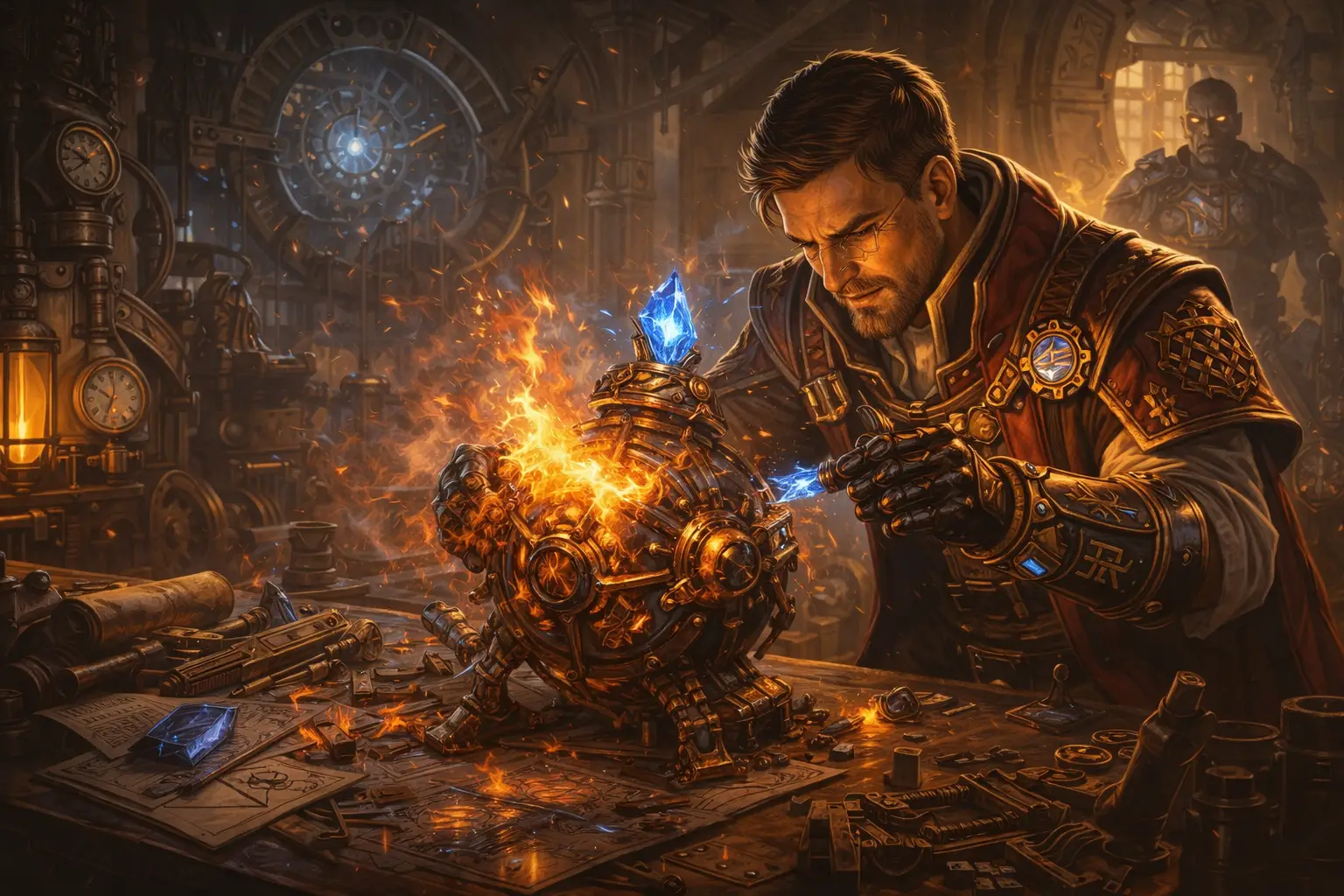
House Cannith — Services & Prices
"My house built the modern world. Orien may drive the lightning rail, but it's Cannith who builds the cars and lays the stones it travels on. Cannith makes the everbright lanterns hold the night at bay. Smith, carpenter, alchemist — the best all carry my seal." — Baron Merrix d'Cannith
Mark: Making | Guilds: Fabricators Guild, Tinkers Guild Branches: Cannith East (Korth), Cannith West (Fairhaven), Cannith South (Sharn)
Every everbright lantern that flickers on a Sharn street corner, every lightning rail car that hums along its conductor stones, every speaking stone that carries a voice across a thousand miles of wilderness — all of it was designed, manufactured, or maintained by House Cannith. The House of Making does not merely sell goods. It sells the infrastructure of civilization itself, and it charges accordingly.
Cannith's services span dragonmark-assisted magical functions, commissioned item production, construct repair and maintenance, industrial-scale fabrication, and arcane infrastructure installation. Most of the people assembling magic items at Cannith forgeholds are not artificers in the adventuring sense — they are skilled craftspeople working with industrialized processes, massive tools that enhance the creation process (arcane forges, creation patterns, Genesis forge techniques), and collective house resources. A Cannith line worker could not simply create a wand at home; the process depends on equipment, schemata, and refined dragonshards that only the house can supply at scale.
Prices are listed in gold pieces (gp). Complex commissions require deposits, contracts, and non-disclosure agreements as standard practice. Availability varies by branch and location.
The Three Branches: What You're Actually Buying
Since the destruction of Eston and the death of Patriarch Starrin d'Cannith, there is no unified House Cannith — only three branches operating under the same name and gorgon seal. A contract with one branch carries no weight with the others, and the branches do not share resources, research, or pricing structures. Understanding which branch you are dealing with matters enormously.
Cannith East (Korth Enclave, Karrnath) — Led by Zorlan d'Cannith. Specializes in weapons, arcane artillery, and traditional arcane theory. Maintains the closest relationship with a national military of any branch. Cannith East will perform necromantic artifice work for Karrnathi military clients but will not export such work to other nations; Zorlan's relationship with Karrnath is too politically valuable to jeopardize with unauthorized proliferation.
Cannith West (Aundair Enclave, near Fairhaven) — Led by Jorlanna d'Cannith. Excels at alchemy, civilian applications, and academic partnerships. The strongest alchemical production of the three branches. Military contracts are available but priced at a premium and require additional review. Jorlanna's branch prioritizes reputation and diplomatic engagement over raw volume.
Cannith South (Cannith Tower and the Forgehold, Sharn) — Led by Merrix d'Cannith. The broadest general industrial capacity of the three branches, handling manufacturing across Breland and Zilargo. Cannith South has the most opaque operations. Merrix takes private commissions that other branches would refuse, particularly those touching warforged research or experimental construct design. These arrangements are unofficial, expensive, and require the right introductions.
NOTICE — HOUSE CANNITH COMMERCIAL LICENSING OFFICE, SHARN Clients are advised that contracts executed with any single branch of House Cannith are binding only upon that branch. The House of Making regrets that inter-branch service transfers cannot be guaranteed at this time. Clients requiring multi-regional fulfillment should negotiate separate agreements with each relevant branch office. — Posted in the vestibule of Cannith Tower, Dragon Towers district
What Cannith Will and Won't Do
The house generally will sell to any client with coin and no disqualifying legal status, regardless of nationality. It maintained this posture throughout the Last War — Cannith armed every side of the conflict simultaneously — and has not abandoned it. It will commission work for private individuals, city governments, military forces, and other dragonmarked houses. It will repair warforged and maintain construct systems lawfully. It will license quality standards and trade certifications to independent artisans.
The house will not create new warforged or provide creation forge services of any kind. This is a Treaty of Thronehold prohibition, and any "offer" of such a service from a Cannith agent is either fraudulent or criminal. It will not take contracts lacking proper national authorization for siege weaponry or arcane artillery. It will not provide services to clients whose work actively destabilizes Cannith's neutral commercial position — the house sells to all sides of a conflict and will not become a tool that exclusively advantages one buyer against another in a way that threatens its access to both markets. It will not reveal proprietary production methods or research; intellectual property protection is aggressively enforced. It will not produce weapons for clients on proscribed lists or under active trade sanctions from treaty partners.
I. Dragonmarked Magical Services
Cannith magewrights perform spell-like effects using the Mark of Making. These are cast as extended rituals with a minimum casting time of ten minutes. Each casting consumes refined Eberron dragonshards worth 20 gp per spell level, plus any costly material components. House Cannith charges clients at minimum twice this baseline cost; specialized or mark-enhanced services command higher rates.
The Mark of Making provides an intuitive bonus to any work done with artisan's tools — an instinctive understanding of creation that stacks with formal proficiency. When a Cannith magewright operates an arcane forge, they do not actually expend a spell — like a Sivis heir operating a speaking stone, it is something they can repeat indefinitely, provided they have materials and residuum. The heir walks through the process of creation in their mind; the mark makes it real.
Service | Description | Price |
|---|---|---|
Mending | Repairs minor damage to mundane items (smooths dents, restores burnt cloth, lubricates rusted metal) | 5 gp |
Make Whole (lesser) | Structural repair of larger objects | 25–80 gp |
Magic Weapon | Temporarily enhances a weapon (any heir can cast this once per day) | 30–50 gp |
Continual Flame | Permanent magical light source | 50–80 gp |
Identify | Determines magical properties of an item (heir uses artisan's tools to run systematic tests) | 40 gp |
Heat Metal / Grease | Tactical or industrial application of mark-granted effects | 40–80 gp |
Fabricate (standard) | Converts raw materials into finished goods — heir visualizes the creation, mark imposes vision on matter | 160–300 gp |
Summon Construct | Temporary construct manifested from raw materials and arcane essence; collapses when spell expires | 200–400 gp |
Wall of Stone (structural) | Permanent arcane reinforcement, construction use | 400–600 gp |
Creation | Manifests matter from pure arcane essence | 500–800 gp |
Dragonmarked Hireling (lesser mark) | Mark-assisted general labor | 10–15 gp/day |
Understanding the tiers. The everyday magic of the Five Nations encompasses spell effects of up to 2nd level; most people encounter 3rd-level effects only in wartime or among the wealthy. Effects of 4th level — like fabricate — are rare and costly. Effects of 5th level — like wall of stone and creation — are exceptional, offered only by senior mark-bearers at major forgeholds, and are not part of everyday commerce. Material costs are additional unless otherwise specified.
Mending and lesser make whole are the most commonly available services at any Cannith outpost or Tinkers Guild station. Continual flame, as a common magic item, ranges from 20–80 gp installed; as a magewright service the price includes installation labor. A farmer's 20 gp everbright lantern is ugly but functional. For 80 gp you get one inlaid with beautiful patterns, and you might even be able to adjust the shade and brilliance of the light source.
II. Arcane Forge Services
Arcane forges are stationary eldritch machines that amplify the Mark of Making — the backbone of Cannith's industrial advantage. A standard arcane forge can only be operated by someone who can cast fabricate as a spell of the mark, which limits operators to those with the greater or lesser manifestation. Arcane forge services are not available at every Cannith outpost; they require a forgehold or major enclave with the appropriate equipment.
A forge requires a schema — a blueprint attuned to a particular object. Attunement takes time, so on a typical day a forge is producing only one kind of item. Most forges are specialized for a particular material (metal, wood, or stone) and limited in the size and complexity of what they can fabricate. All forges require residuum — refined Eberron dragonshards — to operate. This is a minor cost far outweighed by the speed and efficiency of the forge, but it is a requirement nonetheless, and in the past it limited how many forges the house could operate simultaneously. The rise of House Tharashk ensured a steadier flow of dragonshards, allowing Cannith to expand production.
Service | Description | Price |
|---|---|---|
Base forge production run | Component fabrication via base forge (assembly required) | Cost of materials + 20–40% markup |
Grand forge commission | Finished goods via grand forge (no assembly) | Cost of materials + 40–80% markup |
Schema attunement (existing) | Retooling a forge to a new schema | 50–200 gp + 1–3 days |
Custom schema development | Designing a new schema for a novel object | 500–5,000 gp (negotiated) |
Creation pattern rental | Access to a creation pattern for a specific magic item (reduces creation time/cost by ~33%) | 100–500 gp per project |
Base forges produce standardized components; final assembly is performed by workers on a line. Grand forges produce fully finished goods — a longsword from raw iron, a suit of plate from ingots — but require an heir proficient in the relevant artisan's tools to walk through the entire fabrication process mentally and make quality checks throughout. The distinction matters: base forge work is cheaper and faster but produces parts, not products. Grand forge work is a complete commission.
Creation patterns are proprietary Cannith tools — metal rods or tablets engraved with arcane sigils, holding the imprint of a particular magical device. They reduce the time and cost of producing the embedded item by roughly a third, provided the artisan has the Mark of Making and access to the pattern throughout the creation process. Creation patterns are never sold, only rented to approved clients or used in-house.
III. Commissioned Item Production
A. Common Magic Items
Common magic items are common throughout Khorvaire — but "common" does not mean "cheap." Even the simplest item costs at least 20 gp, and a farmer might treasure the everbright lantern and the gown of clothes of mending that have been in her family for generations. Cannith forgeholds produce common items using industrialized processes, collective house resources, and Genesis forge techniques where available, allowing consistent pricing at the lower end of the range for volume orders. Bespoke or decorative versions command the higher end.
Common magic items are generally not sold from a single "magic shop." Cannith distributes them through specialist vendors, trade guilds, and Tinkers Guild stations. A high-class tailor sells magical clothes; a lamp merchant sells everbright lanterns. People do not think of these as a separate class of "magic item" — they are simply the most effective tools of their type, the same way a fine steel knife is better than a dull iron one.
Item | Price Range | Notes |
|---|---|---|
Everbright lantern | 20–80 gp | Ubiquitous; functional versions cheap, ornate versions adjustable |
Clothes of mending | 20–50 gp | Automatically repairs minor wear and damage |
Cleansing stone | 20–60 gp | Cleans clothes and gear on contact |
Spellshard (personal) | 50–100 gp | Records text and arcane notation |
Common wand (cantrip) | 30–80 gp | Battle rod, war staff equivalents |
Armor of gleaming | 20–50 gp | Self-cleaning armor, popular with officers |
Drybrooch | 20–40 gp | Repels rain and minor precipitation |
Orb of time | 20–40 gp | Pocket-watch equivalent |
"Feeling worn down? Perhaps you've had a little fall? Get back on your feet with a shot of Vivacity!" — Street barker in Upper Menthis, advertising a civilian healing potion. The same formulation sold to the Brelish army was called a "copper" for its metallic taste; a Brelish soldier would call a superior healing potion a "copper-3." Same product, different label.
B. Uncommon Magic Items
Uncommon items are available in major cities — especially in Aundair, where the Arcane Congress pushes the boundaries of what independent artisans can produce — and from exceptional weaponsmiths or Cannith enclave commissioning desks. They are not reliably stocked; selection varies by location and current production runs. The standard price range is 200–500 gp, set by item power and quality.
Item | Price Range | Notes |
|---|---|---|
+1 weapon or armor | 300–500 gp | Commission; not always in stock |
Custom arcane weapon (masterwork) | 150–400 gp | Non-magical; precision-crafted |
Custom prosthetic limb (articulated) | 300–600 gp | Standard mechanical; can add tool mounts |
Dragonmark focus item (lesser mark) | 200–400 gp | e.g., channeling wand, Cannith's marvelous miniatures |
Dragonmark reservoir | 200–400 gp | Amplifies mark spells of any dragonmark; Siberys shard required |
When buying a +1 weapon from a Cannith dealer, consider what you're actually getting. Is it a civilian model crafted for a noble to wear to the Tain Gala? Or is it a Brelish Bear cloak — military surplus, originally issued to an elite commando? Military gear is functional rather than decorative, may bear the markings of a particular nation, and might show signs of battlefield use. Civilian products, by contrast, need to lure in customers: expect polished finishes, elegant embossing, and a Cannith seal prominently displayed. The magic is identical. The provenance is not.
Dragonmark focus items are not sold on open markets. They are produced exclusively by House Cannith and the Twelve, distributed only to trusted house agents, and typically offered as rewards for service rather than direct purchase. Any focus item seen outside these channels has almost certainly changed hands illegally.
C. Cannith-Specific Focus Items
House Cannith produces a range of proprietary items that duplicate the effects of existing magic items but require the Mark of Making to use. These are internal house tools — not available for general sale. In each case, the item draws on the power of the mark; the compact constructs, instant fortress, and Onatar's Gift literally build themselves when activated, using the principles of creation to fabricate temporary matter.
Item | Equivalent Effect | Notes |
|---|---|---|
Onatar's Gift ("Ony") | All-purpose tool | Standard issue for capable Cannith artificers; +1 version is baseline |
Cannith's Marvelous Miniatures | Quaal's feather tokens | Small metal objects in the shape of the token effect (anchor, bird, fan) |
Talin's Compact Constructs | Figurines of wondrous power | Articulated metal models that expand in size when activated |
Merrix's Instant Fortress | Daern's instant fortress | Created by the same artificer who developed the warforged titan |
Apparatus of Cannith | Apparatus of Kwalish | Submersible; requires constant Mark of Making to keep stable |
Sky Forge | — | Greater Siberys focus item for the Mark of Making |
Reparation Apparatus | — | Greater Siberys focus item for the Mark of Making |
These items are never sold. They are assigned to trusted agents or produced for specific missions. The Apparatus of Cannith was developed over the last decade of the war as a potential submersible, but Cannith has been unable to produce a version that does not require constant application of the Mark of Making — meaning it is useless to anyone outside the house.
D. Rare & Exceptional Commissions
Rare items exist in Eberron but are genuinely rare — they typically represent the output of named artificers rather than Cannith production lines. Availability should be treated as uncertain and prices as heavily negotiated. At this tier, you are not buying a product; you are hiring an artist.
Item | Approximate Price | Notes |
|---|---|---|
+2 weapon or armor | 2,000–4,000 gp | Requires senior artificer; dragonshard components |
Specialized construct component | 1,000–5,000 gp | e.g., docent interface, warforged chassis upgrade |
Exceptional bespoke commission | 5,000 gp+ | Negotiated; contracts and NDAs required |
IV. Warforged & Construct Services
Creation of new warforged is prohibited by the Treaty of Thronehold, which mandated the destruction of all creation forges. Repair, retrofit, and standard construct services remain legal throughout Khorvaire.
It is worth understanding what Cannith does and does not understand about the warforged. The house gave direction to the warforged body — their physical forms are Cannith designs, assembled using Cannith techniques. But the warforged mind was never designed. The creation forges are imperfectly understood derivatives of ancient quori technology recovered from Xen'drik, and the Mark of Making serves as a mystic shortcut for a connection the artificers do not fully comprehend. The accidental sentience of the warforged, along with unexplained features like the ghulra identity marks, reflects this gap between what Cannith built and what the forges actually produced.
Service | Description | Price |
|---|---|---|
Warforged repair (light) | Surface and minor structural repairs | 25–100 gp |
Structural refit | Limb, plating, or component replacement | 100–300 gp |
Major retrofit / upgrade | Armor integration, systems overhaul | 300–800 gp |
Deep internal overhaul | Full systems reconfiguration | 800–3,000 gp |
Docent interface calibration | Bonding a relic intelligence to a warforged | 200 gp |
Homunculus creation | Small utility construct | 500–1,500 gp |
Golem contract (stone) | Guardian construct, full commission | 15,000–25,000 gp+ |
Cannith complies with national laws governing warforged rights. The Treaty of Thronehold granted warforged freedom; Cannith cannot be hired to "own" or conscript free warforged. Warforged who seek repairs from Cannith do so as clients, not as property returning for maintenance — a distinction some Cannith artificers navigate with more grace than others. Golem contracts include loyalty-binding protocols and maintenance agreements. Exotic parts and rare dragonshards increase costs for advanced repairs. Creation forge access is not a legal service. Any house agent who suggests otherwise is acting outside official house capacity.
V. Industrial Fabrication & Infrastructure
Cannith's industrial capacity — arcane forges, Genesis forges, foundries, and coordinated magewright teams — can undertake large-scale production and civic projects. The Genesis forges are particularly powerful applications of the Mark of Making, allowing proficient Cannith heirs to transform raw materials into finished goods using a fraction of the time and effort conventional methods require. However, House Cannith was unable to replicate the success of the Genesis forges outside of the city of Making before the Day of Mourning destroyed those facilities; current Genesis forge capacity is significantly reduced, and all three branches are working to recover the missing techniques.
Service | Description | Price |
|---|---|---|
Bulk mundane weapon production | Spears, swords, crossbows, per dozen | 30–80 gp/dozen |
Bulk armor production | Leather to chain, per unit | 20–150 gp/unit |
Siege engine construction | Ballista, catapult | 1,000–3,000 gp |
Arcane artillery construction | Siege staff, long rod, or equivalent | 5,000–15,000 gp+ |
Blast disk production | Standard explosive disk (common); national authorization required | 50–200 gp per disk |
Breath of Siberys | Refined dragonshard charge for priming arcane artillery | 25–50 gp per globe |
Everbright lantern installation (civic) | Street or building lighting arrays | 50–80 gp/unit + labor |
Arcane generator installation | Power for mills, forgeholds, enclaves | 5,000–10,000 gp |
Elemental binding (vehicle core) | Locomotive propulsion for rail or vessel | 2,500–8,000 gp |
Dragonshard refinement | Cutting and attunement of raw shards | 50–300 gp |
On arcane artillery. Siege staffs are the primary form of arcane artillery — massive wooden foci around fifteen feet long, engraved with mystic sigils and inlaid with dragonshards. Activating one requires three actions: prime, aim, fire. Different models produce different effects: blast staffs for bombarding massed troops, force staffs for focused energy blasts, and focus staffs that amplify a spellcaster's own magic to devastating range and area. A long rod is the smaller cousin, roughly eight feet long, requiring a stand to brace. Operating either requires specialized training; the typical operator is called a bombardier. Cannith also manufactured fully animated siege engines during the war — self-aiming, self-loading — though these followed only simple instructions and had little ability to adapt.
On blast disks. A blast disk is a nine-inch-diameter metal disc embedded with dragonshards and engraved with arcane symbols. It holds a stored spell effect triggered by time delay, proximity, or impact. Under the Code of Galifar, blast disks are illegal for civilians to own or carry. Cannith manufactures them but will not sell to civilians openly. Different nations developed distinct variations during the war: Aundairian cloudkill disks, Karrnathi necrotic disks that animated the dead, Thrane radiant disks, and Cyran psychoactive disks that dealt confusion and psychic damage. Abandoned battlefields across Khorvaire are still riddled with untriggered blast disks — an ongoing hazard for travelers and salvage teams alike.
On elemental binding. Vehicle elemental bindings for lightning rail and airships are typically coordinated with House Orien and House Lyrandar respectively. Cannith supplies hardware — the vessels, the focus items, the conductor stones — but the binding itself is performed by Zilargo's elemental binders, and the mark-bearing pilots and operators come from the client houses. Elemental binding at the infrastructure scale is not a routine service; it requires a senior Cannith artificer and a dedicated Khyber shard of appropriate quality.
VI. Arcane Construction & Facilities
Cannith builds and installs permanent magical infrastructure across Khorvaire, from everbright lantern arrays to arcane security systems. These are not adventuring tools — they are the bones of cities, the locks on vaults, the lifts in towers.
Service | Description | Price |
|---|---|---|
Everbright lantern (single installation) | Permanent magical light | 50–80 gp |
Arcane lift platform | Magical elevator; tower or building use | 1,000–2,500 gp |
Reinforced arcane lock | Vault-grade security | 200–500 gp |
Defensive glyph array | Wards and magical traps | 400–2,000 gp |
Houseward installation | Guards and wards equivalent; building security | 3,000–8,000 gp |
Teleport anchor circle | Fixed teleportation matrix (4th-level) | Rare; 3,000–6,000 gp |
Focusing node installation | Critical component for large-scale arcane systems (rail engines, airships) | Rare; negotiated |
Focusing nodes have no function on their own but are crucial to maintaining the flow of power through large-scale arcane systems. They were previously produced at the White Knight forgehold near Kalazart; the house is scrambling to repurpose existing facilities to compensate for that loss. Static magic items — large, immovable installations designed for public use rather than adventuring — are also part of Cannith's portfolio. An Aundairian village might have a large cleansing stone set into the town square; a theater might have a magical tool the size of a pipe organ that generates minor illusions for performances. These installations blur the line between "magic item" and "civic infrastructure," and Cannith builds both.
VII. Research & Specialist Services
Cannith operates training academies, research halls, and specialist consulting services. Even independent artisans across Khorvaire often learn their craft at Cannith academies and work to Cannith standards — the house sets the baseline for what "good work" means in most trades that involve arcane components.
Service | Description | Price |
|---|---|---|
Artificer training (trade school) | Vocational instruction in arcane crafting | 50–150 gp/month |
Master artificer consulting | Specialized arcane engineering advice | 50–100 gp/day |
Arcane item identification | Determines magical properties (heir uses artisan's tools as focus) | 40 gp |
Prototype development (minor) | Supervised experimental device | 1,000–3,000 gp |
Hazardous material containment | Volatile lab or storage setup | 1,500–3,000 gp |
Cannith enforces strict intellectual-property agreements on all research and prototype work. Reverse engineering of Cannith-produced systems without a license is grounds for contract cancellation and legal action through the Twelve. Arcane theory consulting for sensitive topics — warforged design, creation forge mechanics, experimental weaponry — is available only to known clients with established house relationships and the appropriate security clearances. House Cannith did not build the world's most sophisticated arcane industrial base by sharing its secrets freely.
CANNITH INTELLECTUAL PROPERTY NOTICE All schemata, creation patterns, proprietary techniques, and house research remain the exclusive property of House Cannith under the Korth Accords and the commercial articles of the Treaty of Thronehold. Unauthorized reproduction, reverse engineering, or dissemination of Cannith proprietary methods is subject to civil action before the Committee of the Twelve, injunctive relief, and liquidated damages. This notice constitutes formal assertion of rights. — Standard contract addendum, all Cannith commercial agreements
VIII. Hirelings & Specialists
Hireling Type | Description | Price |
|---|---|---|
Master smith (non-magical) | Elite mundane crafting | 5–10 gp/day |
Magewright (general) | Mark-assisted labor, basic ritual casting | 10–15 gp/day |
Journeyman artificer | Repairs, commissions, moderate enchantments | 20–35 gp/day |
Senior artificer (lesser mark) | Complex enchantments, item creation | 50–100 gp/day |
Cannith inspector | Quality certification, standards audit | 10 gp/day + expenses |
Construct handler | Oversight of golems or complex constructs | 25–40 gp/day |
Wand adept (Sharn, Cannith South only) | Elite wand specialist | Rare; negotiated |
On wand adepts. The wand adepts of House Cannith are a small, elite cadre of artificers trained through one-on-one mentorship — when a candidate is accepted, they are assigned a mentor who becomes not only their teacher but their financial and political patron. Wand adepts are fiercely protective of their own. A great number put their talents to work on the battlefields of the Last War, and as a result their ranks are significantly depleted. The surviving members are actively recruiting new students to carry on their traditions, but wand adepts are not routinely available for hire. Engaging one requires connections within Cannith South and a commission significant enough to merit their attention.
On wands of magic missiles. The wand of magic missiles is an uncommon magic item that does not require attunement and can be used by any creature — making it a favorite of criminal enforcers, royal guards, and wealthy wandslingers alike. However, the wand was perfected by the Arcane Congress of Aundair just twelve years ago, and House Cannith has yet to replicate the technique. As a result, these wands are primarily found in Aundair or in the hands of Aundairians; a wand being sold in Sharn is likely surplus or battlefield salvage. Sooner or later Cannith will crack the technique and they will become available at any Cannith enclave. For now, they remain an Aundairian specialty.
Cannith hirelings are covered by house contracts and work to house quality standards. They cannot be directed to perform illegal work, work against house interests, or violate active NDAs. If you hire a Cannith artificer, you are hiring the house as much as the individual — and the house has opinions about what its people should and should not be doing.