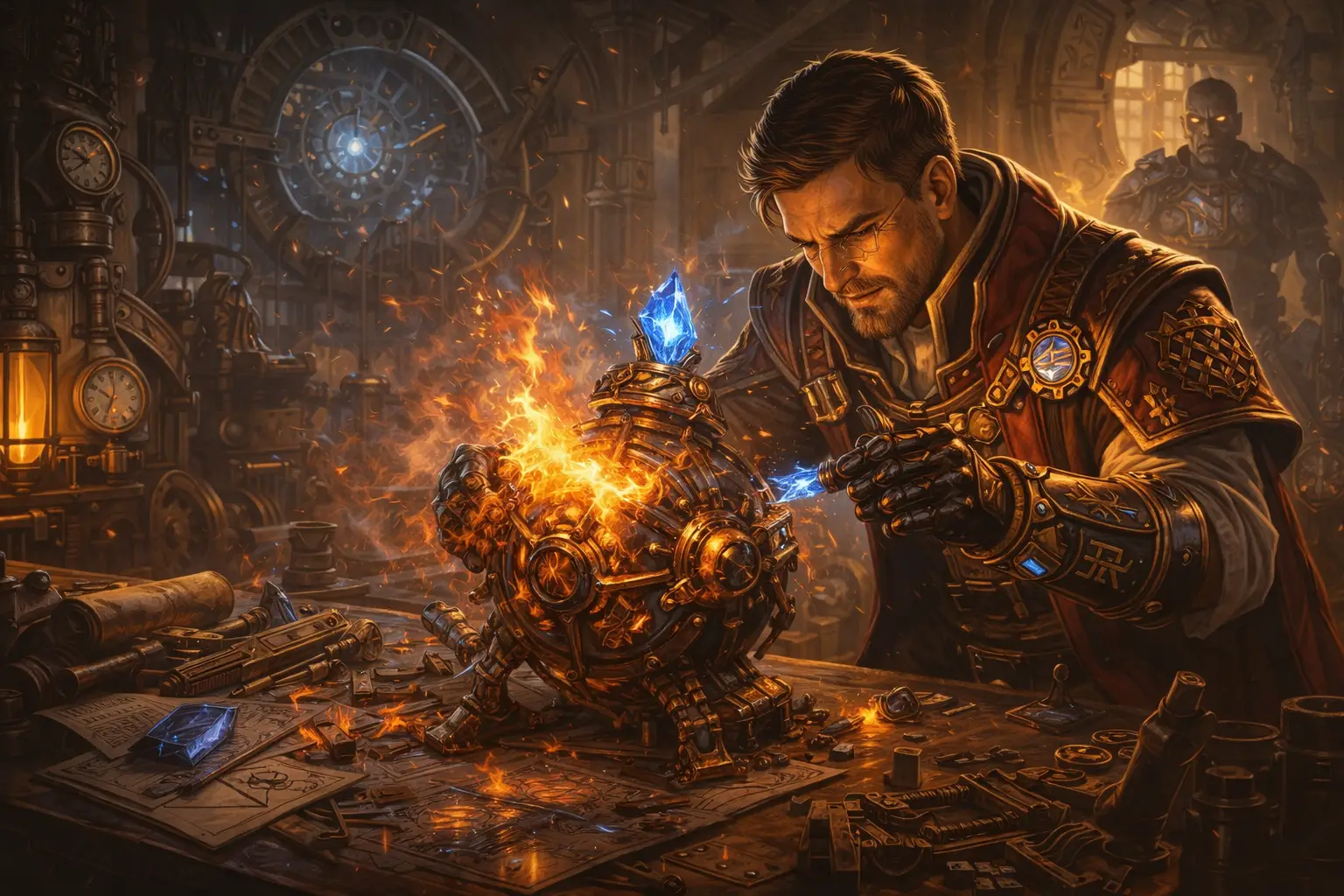
House Cannith
"The coldfire lantern hanging from the ceiling? That flickering's due to a poorly etched sigil. Give me five minutes and a crown's worth of residuum and I could have it steady and brighter. There's a crack in the cleansing stone, and if it continues another inch it's going to start soiling instead of cleansing. But that's not the worst of it. In my mind I can see a better design. I could make a cleansing stone that's half the size, using half the shards, that would make colors even brighter. I can see it. I could make it. I know I could. I just don't have the time." — Overheard from a Cannith journeyman, Fairhaven market district
Mark: Making | Race: Human | Symbol: The Gorgon | Leaders: Jorlanna d'Cannith (West), Zorlan d'Cannith (East), Merrix d'Cannith (South) | Guilds: Fabricators Guild, Tinkers Guild
Walk through any city in the Five Nations after dark and you walk through Cannith's world. The everbright lanterns that hold the night at bay, the lightning rail carriages that thunder across the countryside, the speaking stones that carry messages a thousand miles in the space of a breath — all designed or manufactured with Cannith hands and the Cannith seal. The house's gorgon emblem is stamped on the tools other houses depend upon, on the coaches that drive the streets, on the arcane artillery that won and lost battles throughout the Last War. For more than two millennia, House Cannith has functioned as the uncontested authority on industrial artifice in Khorvaire, the silent engine beneath the civilization everyone else takes for granted. Its heirs consider themselves the equals of any noble, and the house the greatest power on the continent.
At least they did until the Mourning.
The destruction of Eston — the house's ancestral seat, its creation forges, its patriarch, and nearly all of its senior leadership — shattered that certainty overnight. Three surviving barons now compete for a succession that no one has the authority to resolve. The house endures on infrastructure and momentum, but the cracks are spreading. The question is no longer whether Cannith can reclaim its former dominance, but whether it can hold itself together at all.
Origins & Lineage
The Mark of Making appeared approximately 2,500 years ago among three human families in the Metrol League, a prosperous collection of city-states — Metrol, Eston, and Tolan — in the fertile heartland of what would become Cyre. Each family brought a different tradition to the mark's first flowering. The Harns of Tolan traced their roots to Nulakesh in Sarlona and had earned a reputation as armorers and weaponsmiths; their first marked heir, Costa Harn, forged a set of enchanted swords that would feature in legends for centuries. The Vowns of Eston were Pyrinean in origin, and Eliasa Vown declared her dragonmark a blessing of Onatar, crafting reliquaries and octograms charged with divine resonance. The Jurans were wanderers with Rhiavhaaran roots, traveling the roads between the great cities, carrying goods and news and using their talents to mend broken things and transform raw materials into finished goods.
It was Dedra Vown who engineered the alliance. Charismatic and possessed of a grand vision, Dedra convinced the Harns and Jurans that pooling their diverse talents — and establishing a regional monopoly — would make them capable of marvels no single family could achieve alone. She proposed the name Cannith, after a legendary shrine of Onatar in Sarlona. Castal Harn and Dedra Vown were wed, and the united house was born. It was said at the time that they gave birth to a Gorgon, as this was the first joint product the new house unveiled — its enduring symbol.
A fourth bloodline joined the house over the centuries that followed: the Edoros of Thaliost, a family of brilliant alchemists. Though the Edoros did not carry the Mark of Making, their techniques were so valuable that the house slowly absorbed the entire family. Today the Edoro are considered one of the founding lines of House Cannith, and the mark runs firmly through their descendants.
As the house grew, the Making families developed the first arcane forges — initially used to refine ore and turn raw iron into fine steel — and pioneered the earliest forms of magecraft, extending their reach across Khorvaire by sending expeditions into ancient ruins and foreign cities and adapting any innovations they found. When the dragonmarked houses began to intermarry and the resulting cross-bloodlines produced dangerous aberrant marks, it was the Vowns who interpreted this as blasphemy — the marks were gifts of the Sovereigns, and tainting them was the work of the Shadow. Their religious fervor, amplified by the propagandists of House Sivis, became one of the driving forces behind the War of the Mark. In its aftermath, Hadran Vown Cannith and Alysse Lyrriman Sivis forged the proposal for permanent inter-house cooperation, though it was the architect Alder Juran who insisted the alliance be called The Twelve.
The rise of Galifar Wynarn brought the Korth Edicts, which hit House Cannith particularly hard. The Harns were the Lords of Making; the house held vast territories in Eston. Under the edicts, they were forced to surrender their noble titles and landed holdings. But Galifar promised the house would retain its enclaves and forgeholds, and built his new nation of Cyre around Cannith as an economic pillar. The house prospered through Galifar's golden age, but it also splintered internally into what one baron described as "the hundred kingdoms of Cannith" — viceroys and ministers building tiny empires, diverting funds for personal projects, rivalries escalating between forgeholds. A strong baron could hold the house together and force it to move in a single direction. Without one, the Cannith seneschals have always looked to their own interests first.
That structural weakness would prove decisive when the Mourning came.
The Mark of Making
The Mark of Making grants its bearers an innate capacity for creation and repair that goes far deeper than simple craftsmanship. At its most fundamental, the mark provides an intuitive understanding of tools — not formal proficiency, but something more instinctive, a sense for how materials want to be shaped that applies equally to weaving, painting, baking, and smithing. This guidance extends into the arcane; any marked heir has a natural facility with arcane principles, and the ability to cast magic weapon once per day comes as naturally as breathing. Magic and craft are not separate disciplines for a Cannith heir — they are the same thing expressed through different materials.
The most basic manifestation of the mark is mending — the ability to repair breaks and tears with a touch, smooth out dents, restore burnt cloth, lubricate rusted metal, and undo countless small damages that accumulate on the objects of daily life. Cannith tools amplify these gifts in small and sustainable ways, while the greater spells of the mark allow dramatic, instantaneous effects. Some say the Mark of Making draws on Onatar's Forge; others claim it is tied to the Fires of Fernia. Whatever the source, a dragonmarked heir can instantly heat metal or grease a surface. Fabricate allows an heir to visualize a finished creation and impose that vision upon raw materials, while the ultimate power of creation manifests matter from pure arcane essence — making the vision real from nothing. An heir capable of casting spells of the mark can also cast identify as a ritual, using artisan's tools to run a systematic analysis of an object rather than requiring the traditional pearl component.
What this means in practice is that Cannith heirs tend to be confident, practical, and quietly restless. When they look at a weapon, they know they could improve it. When they see something broken, they know they could mend it. For some, this knowledge becomes an obsession — they cannot pass a cracked stone or a flickering lantern without reaching out to fix it, and the designs running through their minds are always more interesting than the conversations around them. But for most it is a background detail and a point of pride: a soothing awareness of how things are made, and the perpetual itch to make something better. Cannith heirs often have some small project keeping their hands busy — a trinket, a device, a half-finished tool — but they can set it aside when duty calls.
Guild Operations
House Cannith's commercial operations are organized through two principal guilds, each with a different relationship to the cities and nations they serve.
The Fabricators Guild oversees fixed facilities: industrial foundries, arcane workshops, research complexes, and large-scale production sites. Its output encompasses weapons, armor, siege equipment, tools, and civilian goods both magical and mundane. The backbone of the guild's productivity is the arcane forge — a stationary eldritch machine that amplifies the powers of the Mark of Making. A standard arcane forge can only be operated by someone with a greater or lesser manifestation of the mark, someone capable of casting fabricate as a spell of the mark. The operator walks through the process of production in their mind, and the forge makes it real — not by casting the spell once, but by repeating it indefinitely, provided the forge is supplied with raw materials and a small amount of residuum. In practice, most forges use schemata — blueprints attuned to the forge for a specific object — and are specialized for a particular material. A base forge produces components that workers then assemble on a line; a grand forge can produce fully finished goods. Either way, the process still requires skilled labor and quality checks from the heir operating the forge, but the speed and uniformity of production far outstrips what conventional workshops can achieve.
Smaller tools supplement the forges. Creation patterns — metal rods or tablets engraved with arcane sigils — hold the imprint of a particular magical device and reduce the time and cost of creating that item by roughly a third, provided the artisan has the Mark of Making and access to the pattern throughout the creation process.
The Tinkers Guild provides mobile services. Its members travel widely to repair infrastructure, maintain magical devices, and service Cannith-produced systems embedded in cities, rail lines, and vessels across Khorvaire. Where the Fabricators Guild builds the world, the Tinkers Guild keeps it running — and ensures continued dependence on Cannith expertise even where the house holds no direct ownership. If your everbright lantern sputters, if your cleansing stone cracks, if the arcane locks on your vault need recalibrating, the Tinkers Guild is who you call.
Although the Treaty of Thronehold formally outlawed the creation of new warforged and mandated the destruction of all creation forges, Cannith manufacturing remains central to the operation of lightning rail systems, elemental vessels, and civic infrastructure throughout Khorvaire. The house continues to operate under licensed contracts across all three branches, though production priorities differ by faction.
CANNITH TINKERS GUILD — SERVICE NOTICE To residents of Upper Dura and surrounding wards: Routine maintenance of everbright lanterns along the Bazaar Bridge corridor will proceed on 12–14 Olarune. Residents may experience intermittent dimming. Do NOT attempt independent repairs. Unauthorized tampering with Cannith-sealed components voids all service agreements and may result in arcane discharge. For emergency service, present your maintenance token at any guild outpost bearing the Gorgon seal.
Focus Items & House Products
House Cannith is the primary source of dragonmark focus items in Khorvaire — specialized tools and devices that amplify the powers of a specific dragonmark, produced exclusively by Cannith artificers and the Twelve for use by trusted agents of the dragonmarked houses. These items are almost never sold in stores; they are earned through service, granted by superiors, or commissioned for specific tasks. Siberys dragonshards are a vital component, and each focus item bears the sigil of the mark it requires somewhere on its surface.
Within the house itself, several focus items have become standard equipment. Onatar's Gift functions as an all-purpose tool, standard issue for any capable Cannith artificer. It is universally shortened to Ony — as in, "You got your Ony?" Cannith's Marvelous Miniatures function identically to feather tokens, but appear as small metal objects in the shape of their effect — a tiny anchor, a metal bird, a folding fan — that expand and activate at the heir's command. Talin's Compact Constructs resemble articulated metal models that expand into full-sized animated companions when activated. The most dramatic example is Merrix's Instant Fortress, created by the same artificer who developed the warforged titan — the grandfather of the current Merrix d'Cannith.
Beyond focus items, Cannith goods pervade everyday commerce. House products range from military-grade equipment — arcane artillery, enchanted armor, field-issue healing potions — to polished civilian goods marketed with bright labels and catchy names. A healing potion sold to the Brelish army was called a "copper" for its metallic taste, with potency clearly marked for field use; the same potion sold to a Sharn noble might be labeled "Vivacity," available in several flavors, with a barker on a street corner calling, "Feeling worn down? Perhaps you've had a little fall? Get back on your feet with a shot of Vivacity!" If you buy a +1 sword from a Cannith dealer, it's worth asking whether it's a civilian model crafted for a noble's collection — or Brelish military surplus, battle-worn and bearing the markings of a regiment that no longer exists.
The Succession Crisis
The defining feature of modern House Cannith is fracture.
Before the Mourning, the house was led by Starrin d'Cannith, a ruthless patriarch usually called "the Gorgon" — a man whose talents as an artificer were matched only by his salesmanship and his willingness to set ethics aside when they threatened the house's interests. Starrin held the fractious house together through force of personality and a willingness to crush internal dissent. His named successor was Norran, who administered the city of Making. Both are presumed dead, lost along with the house's senior leadership, its creation forges, and its ancestral seat when the Mourning consumed Cyre.
Three surviving barons moved to fill the vacuum, each representing a fundamentally different vision for the house's future.
Jorlanna d'Cannith leads Cannith West from the Aundair Enclave near Fairhaven. An alchemist and diplomat, Jorlanna leans toward research, education, and diplomatic engagement. Cannith West's alchemical production is the strongest of the three branches, and Jorlanna cultivates Aundair's arcane and academic circles. She envisions a reunified Cannith operating through consensus and negotiation, though her critics call her vision naive and her patience a weakness.
Zorlan d'Cannith leads Cannith East from the Korth Enclave in Karrnath. A weaponsmith by training, Zorlan arrived in Karrnath with the first warforged in 966 YK and carefully built relationships with the Karrnathi military establishment. Cannith East emphasizes traditional arcane theory, weapons production, and an increasingly close relationship with Karrnathi military structure. Zorlan has been described as spearheading secretive weapons research that blends Karrnathi traditions with conventional artifice techniques. Of the three, Zorlan is perhaps the most willing to use force — or the threat of it — to settle the succession.
Merrix d'Cannith leads Cannith South from the Forgehold beneath Sharn. The youngest and most reclusive of the three, Merrix is an innovator obsessed with the warforged and with the secrets still buried in the Mournland and Xen'drik. Cannith South handles general industry and manufacturing across Breland and Zilargo, but Merrix's personal interests run toward experimentation rather than empire-building. He has little desire to reunify the house and less affection for either of his cousins; he simply wants to be left alone with his research. His grandfather developed the first warforged, and the family tradition of pushing the boundaries of construct creation continues.
No consensus successor has emerged. None of the three has been recognized as legitimate by the Twelve or the other dragonmarked houses. The house continues forward on inertia, shared contracts, and the sheer weight of its infrastructure — but pressure is building. If the house cannot mend itself and unite behind a single leader, it will splinter into three permanently. The irony is not lost on anyone: the house whose mark heals broken things cannot heal itself.
"Stronger in Making" — Inscription on a silver hammer forged jointly by Merrix, Jorlanna, and Zorlan d'Cannith for the Treaty of Thronehold commemorations. Diplomatic observers noted that the three heirs stood as far apart as the stage would allow during the ceremony.
Internal Politics
The three-way succession contest dominates Cannith's politics, but beneath it run older and deeper currents. The house has always been a nest of rivalries. Seneschals compete for resources, contracts, and prestige. Forgeholds jealously guard proprietary techniques. The founding families — Harn, Vown, Juran, and Edoro — maintain their own identities and loyalties even within the unified structure of the house.
The Vown family runs Cannith's Aundair operations. The Harn family, formally led by Lady Seneschal Vazyin, oversees the Breland operations and the industrial facilities in Sharn and Starilaskur. The Harns are pragmatists, willing to bend the rules of the Korth Edicts in exchange for favors from the Brelish crown. The Jurans remain wanderers and tinkerers by tradition, the least politically organized of the founding lines but responsible for some of the house's most eccentric innovations.
A notable undercurrent is the presence of Traveler cultists within the house. While Onatar is the acknowledged patron of House Cannith — the god of the forge, of honest craft and steady labor — some believe the Traveler is the true source of the house's most dramatic breakthroughs. Followers of the Traveler pursue innovation at all costs, creating tools and weapons that could shatter the existing balance of power or cause chaos in unforeseen ways. The earliest Cannith tinkers revered the Traveler openly; today, that veneration is secretive but persistent. Some outsiders blame the Traveler — and Cannith's more reckless experimenters — for airships, for warforged, and for the Mourning itself. Those who invoke the Traveler know its gifts come at costs that could shake the foundations of civilization.
An opposing movement, Onatar's Chosen, operates as a secret order of magewrights and artificers who believe they are directly inspired by the Sovereign of the Forge. Members of Onatar's Chosen believe that artifice should serve the greater good, and they seek to drive Cannith's various operations toward positive purposes — a quiet counterweight to the Traveler cults' recklessness.
Political Relations
By law and the traditions of the Korth Edicts, House Cannith remains formally neutral, prohibited from owning land, holding noble titles, or maintaining military forces. In practice, each surviving branch has cultivated deep ties to its host nation. Cannith East aligns with Karrnathi military institutions and weapons contracts. Cannith West moves in Aundair's arcane and academic circles. Cannith South is woven into the fabric of Brelish industry and the informal networks of Sharn's Dragon Towers.
Many within the houses now consider the Korth Edicts obsolete. The edicts were designed to check house power when a united Galifar stood behind them, and no single postwar nation commands the authority the old kingdom once did. Whether the edicts will be formally renegotiated, quietly ignored, or violently tested remains one of the defining questions of the postwar order.
The house's dependence on Zilargo's elemental binding industry is worth noting. The Zil binders — not Cannith — bind the elementals that power airships and other major systems. It is Cannith that builds the dragonshard focus items that allow Lyrandar heirs to control those ships, and Cannith that manufactures the vessels themselves, but the binding is a gnomish specialty the house has never been able to replicate at scale. This interdependence gives Zilargo quiet but significant leverage over the House of Making.
Notable Holdings & Infrastructure
Korth Enclave (Cannith East, Karrnath) — The eastern branch operates in close proximity to the Tower of the Twelve. Its emphasis runs toward traditional arcane theory, weapons production, and a deepening relationship with the Karrnathi military. Zorlan d'Cannith has made Korth his seat of power and uses the enclave to project influence across eastern Khorvaire.
Aundair Enclave (Cannith West, near Fairhaven) — The western branch leans toward research, education, and diplomatic engagement. Jorlanna d'Cannith operates from here, and the enclave's alchemical production is the strongest of the three branches. The Vown family manages day-to-day operations with an emphasis on fashionable presentation and strategic networking.
Cannith Tower (Dragon Towers, Sharn) — The house's diplomatic face in Breland's greatest city. Cannith Tower handles trade negotiations and formal relations for Cannith South. Smaller Cannith enclaves are scattered throughout Sharn, primarily alchemical workshops and Tinkers Guild outposts.
The Forgehold (Ashblack, Upper Cogs, Sharn) — The true heart of Cannith South. Deep beneath Sharn's towers, this subterranean industrial complex houses a wide range of forges — including Fernian-fed furnaces — alchemical workshops, and arcane research facilities of considerable depth. The air in Ashblack shakes with the constant rumble of foundries; the corridors are dimly lit and coated in soot. Merrix d'Cannith spends most of his time here, surrounded by warforged laborers and his closest associates. The Forgehold is designed to withstand both magical and physical assault, protected by warforged soldiers and the five elite wand adepts of the Darkwood Watch — a small cadre of proud artificers trained through one-on-one mentorship, fiercely protective of their own, and significantly depleted by the Last War.
Eston (Mournland) — The former seat of the house, destroyed by the Mourning. Before the Day of Mourning, Eston was a city that never slept. Clockwork birds perched and sang in silvery trees covered in steel bark. Skycoaches carried smiths and magewrights from forge to forge. An iridescent dome protected the city from storms. Three active creation forges churned out warforged in endless production runs. The city held the residence of Starrin d'Cannith and the heads of every major Cannith family — except the wandering Jurans. Today it is a disaster zone. Arcane catastrophes triggered by the Mourning collapsed the upper city into its tunnel network; the adjacent Brey River has flooded much of the remainder. The constructs and living spells that survived have grown strange and deadly — living continual flames that crawl along streets and flee from strangers, living scrying spells that shimmer and display distant scenes on their amorphous skin. The famed Clockwork Vaults, once a showcase of Cannith artistry, are now guarded by the house's own symbol turned monstrous: Alaran's Gorgon, which scouting reports say has gained corrupting powers no one anticipated. And in the Steel Gardens — where experimental techniques grew trees with metal bark as a renewable source of raw materials — the growth has gone wild, overtaking entire districts, perhaps fed by the energies of a surviving creation forge.
Making (Mournland) — The mundane industrial center of House Cannith. Where Eston was the crown, Making was the backbone — textile factories, ore processing, a grid of plain, functional architecture that contrasted sharply with other Cyran cities. Making sat on the northern edge of the Galifar Forest and was administered by Norran, Starrin's named successor. Both are lost. The city's ruins lie beneath the obsidian flats of the Glass Plateau, haunted by innumerable living spells. The Genesis Forges that once let proficient Cannith heirs transform raw materials into finished goods at miraculous speed were never successfully replicated outside the city, and recovering their secrets remains a prize all three surviving branches covet.
The Warforged & the Creation Forges
No aspect of House Cannith's legacy is more consequential — or more controversial — than the warforged.
The creation forges themselves were not a Cannith invention, at least not originally. During expeditions into Xen'drik beginning around 920 YK, Cannith explorers discovered ancient forges built by the quori of a previous age — massive arcane machines designed to create construct bodies that could serve as vessels for immortal spirits. The original Quorforged were non-sentient puppets, built from patchwork wood and mithril, intended to weather the Turning of the Age. Cannith artificers studied these relics, recovered components, and over decades of trial and reverse-engineering, built derivative versions in Khorvaire — smaller, partially jury-rigged, and only partly understood, with the Mark of Making acting as a mystic shortcut to replace the connection to Dal Quor that the originals relied upon.
In 960 YK, Aaren d'Cannith achieved the breakthrough. After an expedition to Xen'drik that uncovered ancient schematics, Aaren used what he had learned to create the first modern warforged — constructs that were unexpectedly, undeniably alive and sentient. This was not entirely intended. The accidental sentience of the warforged, along with unexplained features like their ghulra identity marks, reflects the fact that Cannith's forges are something the house does not entirely understand, even though they work.
The creation forges gave Cyre — and then every nation willing to pay — an inexhaustible supply of soldiers. They made the Last War longer, bloodier, and more terrible than it would otherwise have been. They also raised questions about personhood, freedom, and the ethics of manufacturing life that Khorvaire is only beginning to grapple with. The Treaty of Thronehold demanded the forges be shut down and warforged granted legal personhood — a compromise that satisfied no one completely.
Aaren himself became furious when the house used his invention as a weapon of war. He disappeared under mysterious circumstances, and speculation about his fate has never ceased. Some believe he is dead. Some believe he transferred his consciousness into a warforged body to seek vengeance on behalf of his children. The truth, like so much about House Cannith, remains buried.
What You Might Encounter
If you deal with House Cannith, you will most likely deal with the Tinkers Guild — a traveling mender who arrives to fix your town's everbright lanterns, or a workshop where you can commission repairs to damaged equipment. In a major city, you might visit a Cannith enclave to purchase goods, commission custom work, or hire an artificer for a specific job. Cannith heirs are practical, confident, and often carry a faint air of superiority — not malicious, but bone-deep, the quiet certainty that they built the world you're standing in.
Cannith contracts are ubiquitous. The house supplies tools and components to nearly every other dragonmarked house. It manufactures the lightning rail cars that Orien operates, the dragonshard focus items that Lyrandar uses to control its ships, and the vault mechanisms that Kundarak depends upon. Alienating House Cannith means alienating the supply chain of modern civilization. This gives the house enormous leverage — leverage that each of the three branches wields independently, and sometimes against each other.
Adventurers may find employment with any branch: recovering lost Cannith artifacts from the Mournland, exploring Xen'drik for ancient schemas and quori technology, investigating rival houses or rogue artificers, or navigating the byzantine internal politics of a house that cannot agree on who should lead it. Cannith patrons pay well. They also tend to have agendas they don't fully disclose.