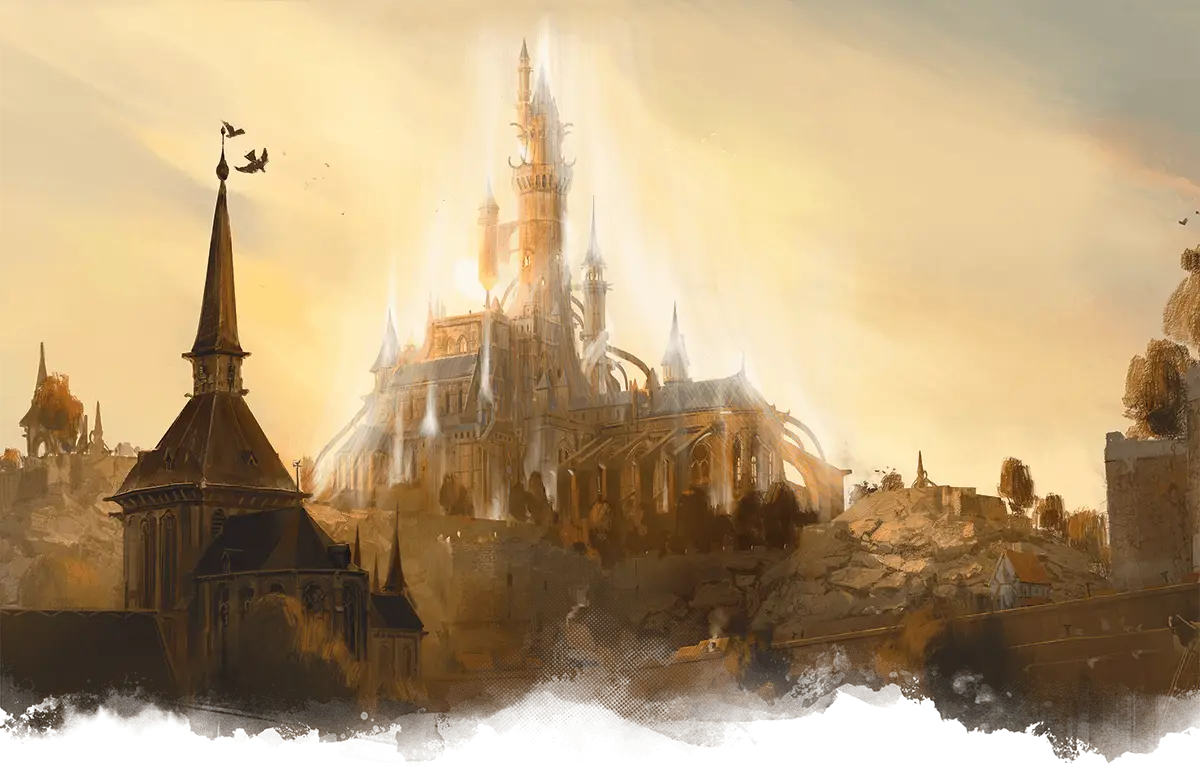
Tenets of the Church of the Silver Flame
"A few basic tenets guide the faithful masses. As a farmer, you may not have the strength to fight alien evils, but you can always guard against the evil within and help those around you to choose light instead of darkness." — From the common catechism of the Church of the Silver Flame, Flamekeep seminary primer
The Tenet of Purity
The Church is united by a single foundational doctrine: the Tenet of Purity.
Burn the corruption and taint of evil from all Eberron.
This is not a call to hatred of the world. The Purified acknowledge the existence and divinity of the Sovereign Host and the Dark Six. They do not deny the worth of what the Sovereigns created. What they believe — and what other faiths find profoundly arrogant — is that creation is unfinished. Evil is not a condition to be managed or endured. It is a wound in the world that will one day be healed, and it is the purpose of the Silver Flame and its faithful to do the healing.
This eschatological ambition distinguishes the Church from most other traditions. Where the Sovereign Host asks its followers to honour the world as it is, the Silver Flame asks them to transform it into what it should be. The practical consequence is a faith that does not merely preach virtue — it deploys it, templars and friars and ministers as parts of a living institution that wages active war on supernatural darkness.
Foundations of the Faith
Below the Tenet of Purity, several principles describe how the Flame works and what the faithful owe it.
The Flame is a power, not a god. The Silver Flame is not an anthropomorphic deity. It does not shape harvests or send storms. It is a force of celestial energy with a specific purpose: the cage that keeps apocalyptic evil at bay. It does not speak to mortals directly. The Voice of the Flame — Tira Miron, merged with the Flame in 299 YK — guides those who seek its counsel. The Flame is a resource. Those who take up its purpose may draw on its power; those who do not cannot.
Coexistence with other faiths is possible. Because the Flame does not govern harvest or storm, there is no inherent conflict with those who ask Arawai for rain or Dol Dorn for strength. The Church is pragmatic: what matters most is whether the darkness is fought. Paladins of Dol Arrah coordinate with templars regularly. Vassals of the Host are generally glad of templar assistance when monstrous threats arise.
The Flame defends all, not merely the faithful. The core obligation is universal: protect the innocent from supernatural evil. This means everyone. The faith does not elevate one nation or people above another. A Thrane templar serves the Flame first and Thrane second. During the Last War, templars of all nations continued to unite against supernatural threats even while fighting one another on conventional battlefields — because the mission of the Flame is to defend the world, not to govern it.
Evil within must be resisted as well as evil without. Every follower holds the capacity for sin. The Shadow in the Flame is always whispering. It is arrogant to believe oneself immune. The Purge fed Bel Shalor precisely because its architects believed their righteousness placed them beyond his reach.
The Five Broad Edicts
The Church's most widely taught practical guidance, learned in childhood, reinforced through liturgy:
Trust the Flame. The Silver Flame is the eternal force that holds apocalyptic evil at bay. Those who seek to protect the innocent may draw upon it.
Heed the Keeper. The Voice of the Flame speaks through the Keeper, who maintains the fountain and communes with Tira Miron. The Keeper's doctrinal authority is the living channel between the Voice and the faithful.
Fight evil. The world is genuinely dangerous. Supernatural evil is not passive — it presses, corrupts, and spreads. When it arises, those with the strength to face it are expected to do so.
Live nobly. A life of virtue is the greatest offering. The faithful are urged to act with empathy and compassion, to lighten burdens rather than add to them, to turn to violence only as a last resort. Living well is not a supplement to service — it is service.
Share the faith. Redemption is possible for many. The faithful are called to illuminate the path — not through compulsion, but through example, counsel, and visible commitment to goodness.
These edicts are simple in statement. They are consistently difficult in practice, and the history of the Church is in large part a record of the ways in which each of them has been betrayed.
The Hierarchy of Evil
The Church classifies evil into five theological categories. This taxonomy is specifically defined by the Keeper and the doctrine of the Church of Thrane; other paths of the faith — the Ghaash'kala, serpent cults — have their own traditions with the same core principle: the Silver Flame is a tool that allows the virtuous to fight fiends and unnatural horrors.
Entities of Alien Evil — fiends and aberrations. Foreign to Eberron, fundamentally incompatible with the world's spiritual health. No redemption is possible.
Entities of Unnatural Evil — undead and lycanthropes, once native to Eberron but corrupted. Where it is possible to cure rather than kill, that is the more laudable path. The Silver Crusade focused on eradication because the templars rarely had the resources to attempt curing — a practical failure as well as a moral one.
Entities of Innate Evil — the most contested category. Historically applied to medusas, harpies, yuan-ti, trolls, and worgs. The assumption that entire species are irredeemably malicious has caused serious harm. In 992 YK, Keeper Lavira Tagor ruled that the Church must re-examine this category. Trolls, harpies, and medusas serve alongside humans in the armies of Droaam and behave no more or less monstrously than the humans beside them. The Council of Cardinals is still debating.
Those Who Choose Evil — mortals born innocent who chose darkness. The goal should always be to lead them back to the light. The sword is the last resort — "it should never be the first choice, however." This principle is what the Pure Flame rejects; the distance between the core faith and its most dangerous internal faction is precisely here.
The Evil Within — the most insidious category, and the one no mortal can claim exemption from. The Shadow in the Flame never stops whispering, and his whispers find purchase in fears, suspicions, and self-interests that every person carries. Church doctrine holds that once all other evil is destroyed, mortals must finally purge the very desire for evil from their souls. Only then will Bel Shalor's hold be broken entirely. Until that day, the Shadow is always one moment of weakness away.
Eternal Vigilance
The doctrine does not hold that evil can be permanently eradicated. The overlords cannot be destroyed — only bound. The darkness does not end; it waits. Even in the most peaceful era, a gate could open from Mabar, a fiend break free from Khyber, or a virtuous town be slowly corrupted. The templar stands ever ready. The minister works to keep the community on the virtuous path. The farmer in Thrane who will never fight a fiend still contributes by living justly, raising children who understand what the Flame asks, and maintaining a community that stands together.
The faith's demand is not heroism from everyone. It is attention, from everyone, at all times.
"The message of the Silver Flame isn't that evil can ever be permanently eradicated. It is that we must be ever vigilant and prepared to deal with evil when it arises." — Attributed to a friar of the Order of the Silver Flame, cited in the Korranberg Chronicle, 991 YK