The Church of the Silver Flame
Faith Profile: Theocratic–institutional monotheism
Dominant In: Thrane (state religion), with significant presence in Breland, Aundair, and border regions
Symbol: Stylised flame inlaid with silver; or a silver arrowhead etched with the symbol Followers: The Purified
"Growing up on the streets of the Callestan district in Sharn, I learned not to put my faith in anything I couldn't see or hold. I think that's why my editor sent me to Flamekeep to cover the Ascension; surely I'd see clearly, with eyes untouched by faith."
"I thought so, too. But then I found myself in the Chamber of Tira's Sacrifice, a pillar of silver fire marking the spot where one woman gave her life to protect countless innocents. I saw people from all nations joined together in song, celebrating both that ancient sacrifice and the end of our current war. And looking into the innocent eyes of the child priestess, I truly heard the words of that song for the first time: a call for all of us to be better than we are, to protect those in need, to remember that we are all one people in the light of the Silver Flame." — Korryn Ashdale, foreign correspondent, Sharn Inquisitive, on the Ascension ceremony at Flamekeep, 994 YK
The Church of the Silver Flame is one of the most influential religious institutions in Khorvaire, defined by its vigilance against supernatural evil and its commitment to the protection of the innocent. The faith centres on a singular divine force — the Silver Flame — understood not as a god in the traditional sense, but as a pure force of celestial energy: the cage that keeps apocalyptic evil bound beneath the world.
Unlike the Sovereign Host, the Silver Flame does not grant harvests or send storms. It does not influence daily life as a divine patron; it empowers those who take up arms against fiends, undead, and the unnatural. Where the Sovereigns are worshipped for what they give, the Flame is served for what it demands. Those who seek to protect the innocent from supernatural evil may draw on its power — and they must beware the deceiving whispers of the Shadow in the Flame, the demon that still lingers within it and yearns to trick good people into evil.
The Flame does not speak directly to its faithful. Instead, it is the Voice of the Flame — the spirit of the martyr Tira Miron, now merged with the Flame itself — that guides the church. Prayer is affirmation and resolve, not petition. A life of virtue, the faith teaches, is the greatest offering a mortal can make. The Purified attend services on the faith's thirteen holy days, offer brief prayers in moments of fear or gratitude, and light silverburn candles at the family table. What the Flame asks most is that its followers live well and fight darkness when darkness comes.
The institutional heart of the Church lies in the holy city of Flamekeep, Thrane. Since 914 YK, the Church has governed that nation as both religious and political authority, producing the continent's only theocracy. Elsewhere, it operates as a transnational moral institution — respected for charity, education, and its templar orders, and remembered, more darkly, for the Lycanthropic Purge. The faith is the only major religion in Khorvaire that specifically preaches a need to change the world and the ultimate triumph of good over evil, justice over injustice — and this missionary ambition, for better and worse, has shaped everything the Church has built.
Doctrine and the Nature of the Flame
The Silver Flame is not a deity. This distinction is core to the faith and frequently misunderstood by outsiders. The Sovereigns and the Six are gods, understood to shape every facet of daily existence. The Flame is something else: a cosmic resource. It does not take sides between nations. It does not elevate one people above another. Any soul that seeks to protect the innocent from supernatural evil may draw on its power. The Silver Flame was kindled to bind the fiendish overlords — immortal spirits that cannot be destroyed. The overlords are the embodiments of hatred, fear, greed, and cruelty, and like the overlords themselves, these things can never be permanently destroyed, only held at bay.
Core tenets of the faith, as taught to every Thrane child:
The Silver Flame is a force of light that holds fiends at bay. Those who seek to defend the innocent from evil can draw on its power.
Every mortal soul can find the light. Inspire and guide others to virtuous behaviour; force is a last resort.
Listen to the Voice of the Flame. Beware the deceiving whispers of the Shadow in the Flame.
That last entry is not rhetorical. Bel Shalor, the Shadow in the Flame, remains bound beneath Flamekeep — sealed there through Tira Miron's sacrifice — but is not silent. Bel Shalor embodies the fear of one another and the capacity for even the most virtuous person to do evil. He thrives on paranoia and smiles when a good person harms an innocent or ignores their conscience. Anyone who can hear the Voice of the Flame can also hear his whispers. He does not urge violence directly; he amplifies fear, suspicion, and self-interest. He is most satisfied when virtuous people do terrible things in the name of righteousness. The Lycanthropic Purge fed him well.
Institutional Structure
At its apex stands the Keeper of the Flame, understood to be chosen through divine resonance rather than succession or election. The Keeper serves as both primary spiritual representative and — in Thrane — head of state. The current Keeper is Jaela Daran, selected at age six in 993 YK and now eleven. She has demonstrated remarkable power — summoning angels and reportedly resurrecting Cardinal Halidor following his assassination.
Supporting the Keeper is a layered ecclesiastical structure:
The Diet of Cardinals — the actual governing body, drawn from the broader Council of Cardinals. Cardinals are nominated and elected by other Cardinals, with the overwhelming majority from the Order of Ministers. The Diet handles practical administration; its deliberations shape policy on everything from templar deployments to doctrinal questions the Keeper has not yet ruled upon.
Below the Cardinals: Archbishops (authority over several major cities), Bishops/Prefects (individual cities), Priests (the bulk of functionaries, addressed as Father/Mother, Brother/Sister, or Sir/Lady depending on their order), and Pilgrims (beginning members of the Order of Friars).
The Church maintains three primary orders:
The Order of Templars — the primary armed force of the faith, with chapterhouses throughout Thrane, Aundair, and Breland. Templar battalions prosecute war against supernatural threats; peasant militias supplement them at the local level. Archery is both devotional practice and practical preparation — some say the rainbow-feathered arrows represent the couatl defending the innocent, but they also reflect the practicality of remaining as far away from danger as possible.
The Order of Friars — charged with pastoral care, guidance of the wayward, and spiritual ministry. Friars are charged to wander the world and combat evil through acts of compassion and charity.
The Order of Ministers — the administrative and sacramental backbone of the Church, from which most Cardinals are drawn.
Additionally, the Argentum began as an order tasked with finding and destroying dangerous magic items but has since become the Church's espionage arm.
The seminary pipeline is formal and demanding. Acolytes serve under an ordained priest, then petition for admission to a seminary — the most prestigious being the Psalm of the Flame Seminary at Flamekeep and Saint Ignatius the Mentor's School for Divine Service in Passage, Aundair.
Worship and Practice
The Purified do not fill their days with prayer. The faith's greatest axiom holds that a life of virtue is the greatest gift a mortal can offer. Sin against another is a religious offence, requiring atonement before the sinner is again worthy of the Flame. Church doctrine urges the faithful to act with empathy and compassion: seek to understand the troubles of those around you and to lighten their burdens; resist responding to anger with anger; turn to violence only as a last resort.
Temples and shrines span an enormous range. A room with a silverburn flame burning bright enough to light the space entirely can serve as a shrine — common in private homes and small communities. True churches and cathedrals are built to Flamic style: soaring ceilings, enormous arches, flying buttresses, stained glass with silver filigree, mosaic floors with the Flame at their centre, and a real silverburn flame that is never permitted to go out. White and silver dominate the palette; deep blue marks mourning; red and gold signify active war. The priesthood seeks manifest zones tied to Syrania and Irian when selecting sites for major cathedrals.
Silverburn is a fine powder created by exposing pure silver to alchemical substances and acids, producing a powder that causes a mundane flame to burn a deep silver hue. Any creature with damage reduction overcome by silver weapons finds the luminous flames slightly uncomfortable. An ounce of silverburn affects a torch-sized fire for thirty minutes (or a candle for its entire lifespan); a pound is needed for a bonfire. Variants produce different hues by mixing other minerals with the silver. Most temples keep a small store of silverburn for poor Purified who cannot afford their own.
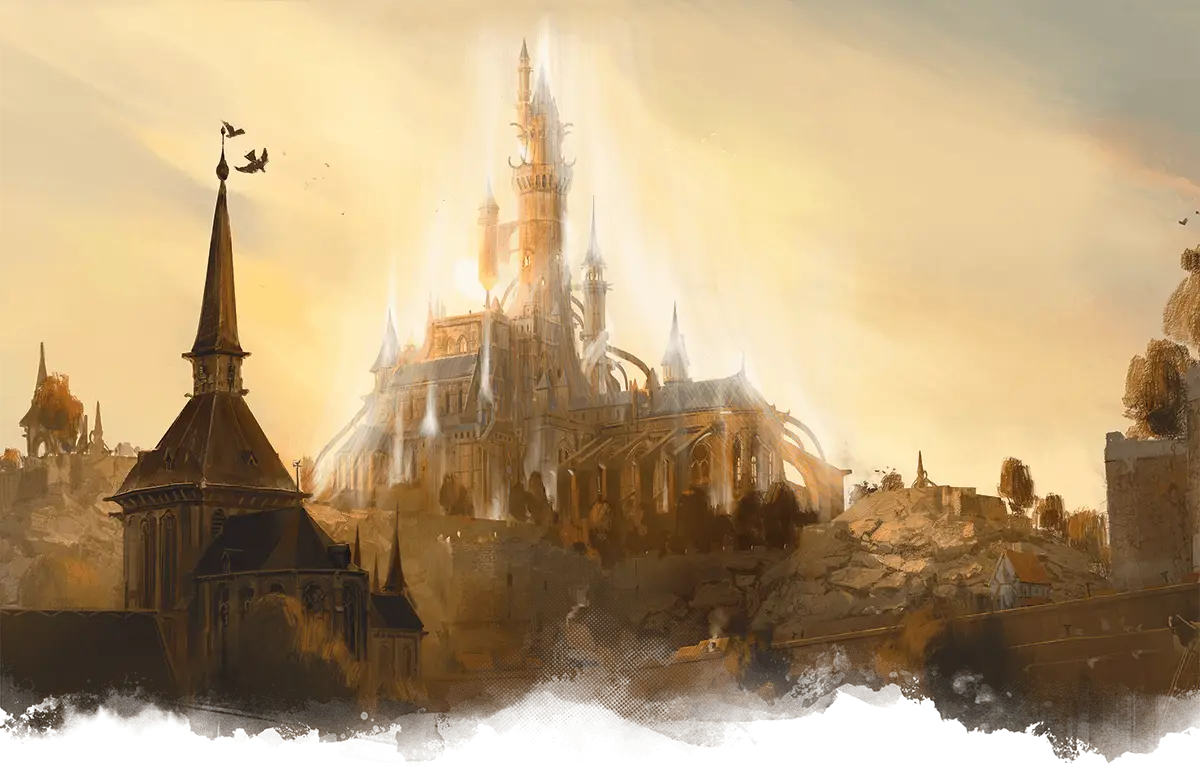
The greatest is the Cathedral of the Silver Flame in Flamekeep — formerly a castle, now grown to the size of a town, entirely self-sufficient, lit day and night by a great fire atop its towers. The Cathedral contains the Chamber of Tira's Sacrifice, where a pillar of argent fire marks the place of her binding. This pillar is a manifestation of the Flame, not its source; the Flame itself stretches across Eberron, binding overlords on every continent.
An exchange overheard at a tavern in Passage, Aundair, 997 YK:
"Are you Pure Flame?" "I'm Purified." "That's not what I asked." "It's the only answer I'm giving you."
Relationships with Other Faiths
Sovereign Host — cooperative. The Church holds that the Sovereigns created a world the Flame would later complete. Paladins of Dol Arrah frequently coordinate with templars. Tira Miron herself was raised a worshipper of the Host. Promisetide (28 Dravago) honours the Sovereigns for creating the world "and graciously stepping down to allow the Flame its rightful place" — a framing the Host's followers find profoundly offensive.
Blood of Vol — actively opposed. The Church views necromantic practices as spiritually ruinous and its rejection of divine authority as dangerous.
Undying Court (Aerenal) — cautiously acknowledged. A past Keeper ruled that the deathless of Aerenal are not creatures of unnatural evil, distinguishing them from necromantic undead.
Dark Six and Cults of the Dragon Below — suppressed wherever Church authority reaches.
Druidic Sects — acknowledged but considered insufficient. The Church extends an ongoing invitation to conversion the druids are seldom interested in accepting.
Path of Light — respected at a scholarly distance; ethical parallels are noted but metaphysical frameworks are incompatible.
Cultural Role and the Theocratic Legacy
Within Thrane, the Church is inseparable from public life. Doctrine informs law, education, architecture, military service, and civic identity. Communities are built around fortified churches. Every town maintains a militia of skilled archers. Champions of the light are welcomed; necromancers and warlocks find Thrane dangerous.
Queen Diani ir'Wynarn serves as the "blood regent" — a symbolic advisor to the Keeper. A minority seeks the monarchy's restoration; many clerics believe governing a nation has compromised the faith's spiritual integrity.
Outside Thrane, the Church functions as moral institution rather than government. Its hospitals, orphanages, and exorcists are widely valued across Khorvaire. The invitation to convert is implicit in almost everything the Church does.
The faith produces more clerics and paladins than any other nation in Khorvaire — and while the Church cannot grant divine powers (these come through faith and noble intent), its structure provides the training, resources, and mission that channel those powers into organised service. You can draw power from the Flame without having any formal tie to the church itself. The primary question is why — if you are a paladin, why have you not become a templar? Do you feel the hierarchy is corrupt? Or do you feel you are called to follow a different path?