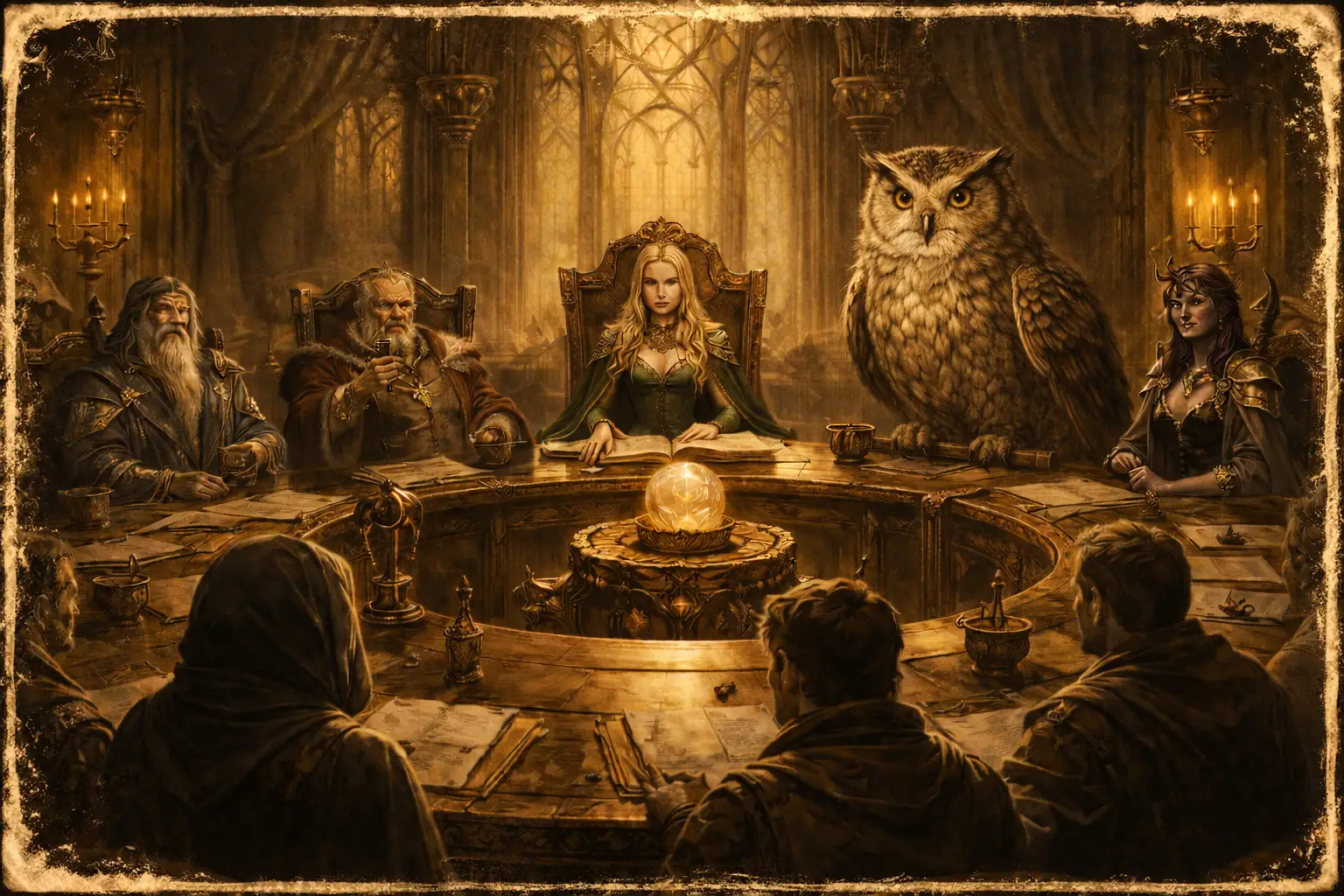
The Sharn City Council
Governing body of Sharn · 17 members, one per ward · Meets in Council Hall, Highest Towers, Upper Central · Lord Mayor: Cathan ir'Demell
"Bureaucracy mires Sharn's political landscape. Many make the mistake of assuming that the Lord Mayor holds the greatest power within the city. In fact, the City Council appoints the Lord Mayor, and the commanders of the Sharn Watch report to the Council."
Seventeen people govern the largest city in Khorvaire, and at least four of them answer to a crime boss.
The City Council is Sharn's governing body. It sets municipal law, controls civic taxation, appoints the city's high officers — including the Lord Mayor — and determines how the resources of Sharn are directed, from taxes to the power of the Sharn Watch. The commanders of the Watch report to the Council, not the Mayor. The Lord Mayor is a viscount appointed by the Council, a reminder that Sharn's civic government is not merely local administration but a recognized political instrument within Breland's noble structure. In practice, the Council is the point where Sharn's wards become policy — and where every faction with money, muscle, or leverage attempts to shape what that policy looks like.
The Council has seventeen members, one representing each ward of the city. Cliffside's representation is folded into Dura, and a single seat covers both Ashblack and Blackbones in the Cogs. The body formally meets in Council Hall at the top of Sun Tower in the Highest Towers district of Upper Central. All major political appointments in Sharn occur on 9 Rhaan, Boldrei's Feast. City councilors serve three-year terms with no term limits; it is entirely common for an election to pass with no changes whatsoever.
How the Council Works
The Council establishes municipal law, though it cannot pass ordinances that directly contradict the Code of Galifar or Brelish legal traditions without attracting attention from the crown or parliament. Laws can vary by ward, allowing individual councilors to shape the legal environment of their districts for the benefit of their backers. The Council also controls how Sharn's tax revenues are directed, who commands the Watch, and what gets funded, built, or shut down.
The selection of a councilor varies by ward and carries no legal restrictions on eligibility — anyone who builds sufficient support in a ward can hold the position. In some wards, anyone with sufficient income or property participates in elections or ward councils. In others, the seat is effectively controlled by trade guilds, noble families, or organized crime. The method of selection determines what kind of councilor a ward gets, and what it costs to keep them.
In theory, every councilor has an equal voice. In practice, influence derives from backers. The local merchants of Lower Menthis support Savia Potellas, and she knows better than to openly oppose Caskar Havalik, who has the backing of the Boromar Clan — if she stirs up too much trouble, she might wind up at the bottom of the Dagger River. But she finds other ways to deal with Caskar and pursue her own goals, including hiring adventurers to upset his plans. The Council's work happens in two layers: public sessions with votes and civic messaging, and the private coalition-building that actually determines outcomes.
The Council does not appoint Sharn's three representatives to the Brelish Parliament — those seats are filled by popular election, with every legitimate resident of Sharn having the right to participate. However, the Council manages and administers parliamentary elections, and individual councilors exercise considerable influence over voters in their wards, whether through persuasion or graft. Members of the Breland Parliament serve two-year terms; the Lord Mayor's performance is usually reviewed every four years.
The Boromar Bloc and the Council's Fault Lines
Four councilors have direct ties to the Boromar Clan, the halfling criminal syndicate that has dominated Sharn's underworld for generations. Ilyra Boromar represents Lower Dura and reports directly to Saidan Boromar, with executive authority to make decisions on the clan's behalf. Bestan ir'Tonn, Thurik Davandi, and Caskar Havalik form the rest of the bloc. These four typically vote together, and enough other councilors fear the Boromars that the bloc carries significant weight even beyond its formal membership.
The Boromar Clan's position has weakened in the past two years. Daask has been launching violent raids against Boromar holdings, and the majority of the Council has so far refused to devote city resources to fighting Droaamites in the lower wards. Several councilors are openly pleased to watch the Boromars absorb the damage, and are waiting for the clan's position to erode further before taking any action. At least three councilors oppose the Boromars from genuine concern for their constituents; two more oppose them because they serve rival powers — the Aurum and the Tyrants.
On the other side of the Council's fault lines sit Sava Kharisa, Hruit, Kilk, and Borian Haldorak — figures who either lack fear of Boromar reprisal or have patrons strong enough to protect them.
The Seventeen Councilors
Upper Central — Javan Tomollan (human male). Shrewd, fair, and a tough bargainer. He earned his fortune representing House Lyrandar before parting ways with the house on poor terms, and remains one of Sharn's wealthiest citizens. He believes that hard work and dedication should be rewarded, and his greatest concern is protecting the interests of Upper Central's residents — the problems of Lower Dura hold no interest for him. The Aurum has sought to recruit him for the Platinum Concord without success. His ongoing rivalry with Sorik Sensos has become a personal obsession for Sensos, who is determined to humiliate him.
Middle Central — Sorik Sensos (half-elf male). One of the oldest and most influential voices on the Council, and a brilliant orator. His supporters are increasingly aggravated by the widening economic gap between Middle and Upper Central, and his fixation on bringing down Javan Tomollan has become personal as well as ideological. He is rumored to be embedded in a web of bribery and graft. The rivalry between Sensos and Tomollan is quite literal — Middle Central lacks the wealth of Upper Central but makes up for it in political connections across Khorvaire.
Lower Central — Sava Kharisa (human female). The most outspoken member of the Council. Kharisa espouses a wide range of radical philosophies and political views, is one of the few councilors who genuinely attempts to help all of Sharn's people rather than her political career, and has made substantial enemies as a result. The Boromar Clan has considered having her removed from office permanently. She advocates for Sharn to be recognized as an independent province — a position she shares with Evix ir'Marasha. Due to her radical views, connections, and desire to fight corruption, Sava makes an excellent patron for adventurers.
Upper Menthis — Thurik Davandi (gnome male). Born and bred in Sharn, as cunning and deceptive as any Zilargo gnome. He obtained his Council seat through a clever combination of flattery and blackmail and maintains leverage over many of the more powerful merchants of Menthis. He has strong ties to the Boromar Clan and the Zilargo Embassy, assists both when convenient, and simultaneously looks for ways to increase his own power at his allies' expense. He is a member of the Boromar Bloc in voting. His capacity for intrigue across the city is matched only by Kilk. He may lure adventurers into his web of conspiracy and deception.
Middle Menthis — Caskar Havalik (halfling male). Born in the Talenta Plains. Before his political career, Havalik worked as a Boromar enforcer and became a celebrated clawfoot racer in Little Plains. Saidan Boromar helped transform that fame into political cachet. He enjoys the prestige of his position but prefers to leave political maneuvering to Ilyra Boromar and Bestan ir'Tonn. A member of the Boromar Bloc in practice, if not in temperament.
Lower Menthis — Savia Potellas (human female). Owns a brothel in Firelight, an appointment that outraged the Council's conservative members. She is extremely sharp at business but caught in a bind: she has grown tired of paying tribute to both the Boromar Clan and the Tyrants to operate, and is afraid to move openly against either. Despite her amoral personal calculus, she could be a valuable ally for adventurers working against Boromar interests.
Upper Northedge — Maza Thadian (elf female). One of the oldest, wealthiest, and most respected elves in Sharn. She has served as head chef and owner of the Oaks — widely regarded as one of the city's finest restaurants — for over three hundred years, and assumed her Council seat six years ago. Stubborn and set in her ways, she fights to maintain the status quo and uphold tradition, consistently puts the concerns of the wealthy before those of the poor, and is capable of surprising subterfuge when she believes Sharn's best interests require it. She has the highest regard for the law, but is in no way naive.
Middle Northedge — Doran Cantar (human male). A former advocate. He obtained his Council position through charisma, dedication, and the support of the priests of High Hope, and is devoutly faithful to Boldrei. Genuinely honest and committed to his constituents — his honesty is consistently a hindrance in Council intrigue. He attributes every success to the goddess rather than his own work.
Lower Northedge — Shassa Tarr (shifter female). Born in North Market from a long line of merchants, and a skilled negotiator. She has successfully maintained working alliances with all major Council factions without fully committing to any of them — a difficult feat on a body where most seats are controlled by organized power. Her allegiance runs to the merchant lords of Lower Northedge and to Sharn's shifter community.
Upper Tavick's Landing — Bestan ir'Tonn (halfling male). Thirty years on the Council. He presents himself as a proud guardian of Tavick's Landing's wealthy commercial interests, with longstanding connections to the Boromar Clan. He has a reputation for stirring up conflict and setting councilors against one another, and he largely views his ward as a separate city within the city.
Middle Tavick's Landing — Dalaina Ironhand (dwarf female). A plain-spoken, hard-nosed negotiator with no interest in anything beyond the bottom line for the merchants of Middle Tavick's Landing. She drives for the best bargain for her constituents and opposes the Boromar Bloc whenever the opportunity arises. She has no taste for underhanded intrigue, which the Boromars find manageable: she never commands enough votes to threaten their core interests, but her opposition provides useful cover that the Council contains genuine debate.
Lower Tavick's Landing — Kilk (changeling, identity uncertain). Represents the merchant lords of Lower Tavick's Landing. On the surface, Kilk advocates for the commercial interests of the ward and has cultivated useful relationships with the King's Citadel and the Guardians of the Gate, developing powerful allies within both organizations. Only Thurik Davandi can match Kilk for intrigues and scheming, and Kilk has a web of informants and spies across the city.
Upper Dura — Borian Haldorak (dwarf male). His Council position derives from the powerful bankers and merchants of Highhold. He is also a member of the Aurum's Gold Concord, and the conspiracy's interests are his actual operating concern. He is disarmingly cheerful and plays up his age with elaborate stories about the great deeds of his youth — beneath that facade he is a sharp and ruthless negotiator. Most interactions between the Aurum and the Boromar Clan pass through Borian and Ilyra.
Middle Dura — Hruit (druid, owl). A mysterious figure on the Council who keeps his own counsel and advances his own agenda. A druid with a particular affinity for owls, he once rode a giant owl in the Race of Eight Winds as the representative of Dura's Bazaar. His primary responsibility is to the merchants of the Bazaar, protecting their interests from the Boromar councilors and the representatives of other market wards. He is among the faction that reliably opposes Ilyra Boromar.
Lower Dura — Ilyra Boromar (halfling female). The Boromar Clan's personal representative on the Council. Born of Saidan Boromar and Mala Boromar d'Jorasco, she reports directly to Saidan and holds executive authority to make decisions on the clan's behalf. Her family affiliation is openly known and politely overlooked — the Boromars are one of the Sixty families of Sharn, and Ilyra has the skills, credentials, and lineage to compete with any of her colleagues. Of all seventeen councilors, she is the most ruthless and dangerous. Councilors who have opposed her have disappeared. The ongoing Daask conflict has shaken the clan's grip and her own position on the Council — the Boromar Clan is no longer seen as an infallible, omnipotent force, and the majority of councilors have so far declined to direct city resources against Daask.
Skyway — Evix ir'Marasha (human female). A member of the Sharn Sixty who owns the Celestial Vista restaurant and a host of other valuable properties. One of the most eloquent members of the Council, she takes a great interest in Sharn's role in the greater politics of Breland. She supports abolishing the monarchy when King Boranel dies, is a close friend of Hass ir'Tain, and believes Sharn should be recognized as an independent province — views she shares with Sava Kharisa. In practice she represents the interests of Skyway's wealthiest residents first, and typically votes with Javan Tomollan, Maza Thadian, and Bestan ir'Tonn.
The Cogs — Nolan Toranak (dwarf male). Represents the industrial powers behind Ashblack and Blackbones — the nobles and merchant princes of Skyway and the Upper-City who own many of the foundries and forges. He usually aligns himself with one of the more eloquent councilors on most matters. The one issue he holds with genuine personal conviction is the status of the warforged: his children were killed by warforged during the Last War, and he has never forgiven House Cannith or the warforged collectively. He tries to find ways to bypass the Treaty of Thronehold to have warforged treated as property, channels funds to organizations that share his hatred of warforged, and suppresses warforged activists in the Cogs. If there is a warforged among the party, Nolan could use his power to discredit the adventurers and drive them from the city.
FROM THE SHARN INQUISITIVE
Councilors gathered this week to debate the allocation of Watch resources in the lower wards, a discussion that — predictably — concluded without resolution. Councilor Kharisa's impassioned plea for increased patrols in Callestan was met with polite silence from the majority of her colleagues, while Councilor Boromar reminded the body that the people of Lower Dura have never asked for more Watch presence and would prefer the Council respect their wishes. Councilor Sensos used the occasion to deliver a forty-minute speech on wealth disparity that never once mentioned the lower wards by name. The Lord Mayor was observed reviewing documents unrelated to the session.
The Lord Mayor
Lord Mayor Cathan ir'Demell is the Council's appointed executive instrument and its public face, particularly in dealings that touch Breland's crown. He is a rotund, bored-looking bureaucrat dressed in fine clothes well tailored to his great bulk, with a bald head that shines with sweat and pale blue eyes that have a somewhat glazed appearance. He carries a heavy golden scepter as his badge of office and wears a golden circlet. He is a political administrator who appears more at home managing paperwork than navigating the currents his appointers generate. As long as the city's wealthy elite are content to keep him in power, he does little more than maintain the status quo.
The City Council and the Lord Mayor represent the interests of Sharn; they are not direct servants of the king. The King's Citadel looks after the interests of the crown and can assert jurisdiction over any criminal matter or issue concerning espionage or national security.
Notable Relationships
The Sharn Watch. The Watch is where Council decisions become street reality. Funding, leadership, and enforcement priorities flow from Council authority. When the Council wants quiet, the Watch is expected to produce it; when it wants visible action, the Watch is expected to produce arrests and headlines. Watch commanders report to the Council, not the Mayor.
The Boromar Clan. Four Council seats answer to the Boromar Clan in whole or in part. Enough additional members fear the Boromars that the clan has historically been able to prevent the Council from taking direct action against its operations. This grip has loosened since the Daask conflict began.
The Aurum. Borian Haldorak's Gold Concord membership makes the Aurum a presence on the Council, one that prefers to work through financial pressure and political machinations rather than direct confrontation. The Aurum has unsuccessfully approached Javan Tomollan for Platinum Concord recruitment.
The Sixty. The Sixty are Sharn's most powerful families — those with standing invitations to the monthly Tain Gala hosted by the ir'Tain family in Skyway. While many members of the Aurum are also members of the Sixty, the two organizations are quite different. The Sixty is more of a social club — a visible manifestation of the city's most powerful families. Members discuss politics and business at the galas, and these discussions can have an impact on adventurers, Sharn, or even Breland, but the Sixty almost never act as a concerted unit, and many members are bitter rivals beyond the walls of the Tain Manor. All noble families and dragonmarked families are members of the Sixty — including the Boromars.