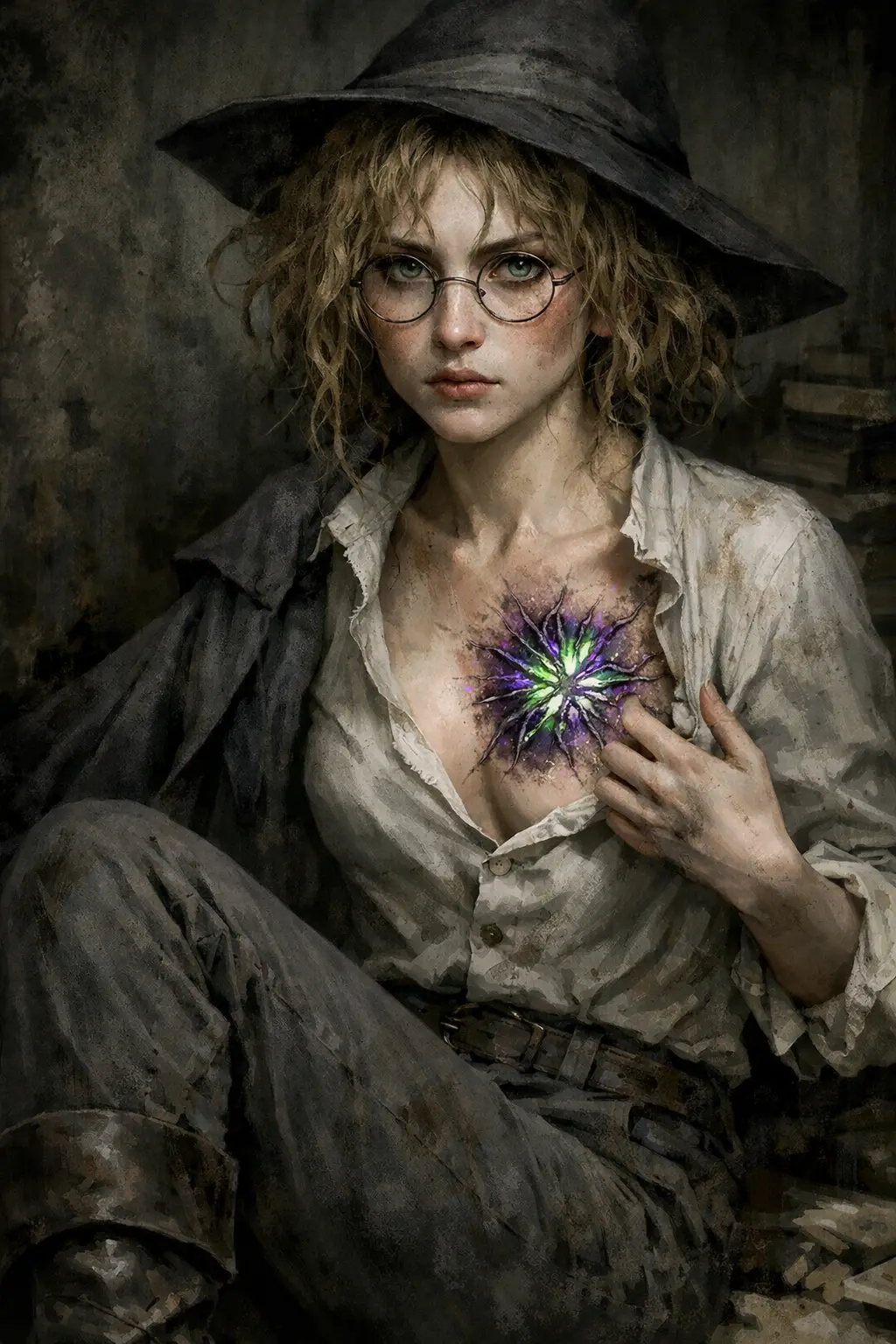
Aberrant Dragonmarks
The Marks That Don't Belong
When Filara d'Cannith married the Deneith soldier she loved, the houses stripped her name, her title, and her access to every enclave on the continent. When their daughter grew to be unmarked, the couple breathed a sigh of relief and considered the matter settled. When their granddaughter manifested at age thirteen — not a mark of Making or Sentinel, but a livid red sigil that writhed like a burn across her collarbone and set her bedroom curtains ablaze while she slept — the girl's grandparents learned in the worst possible way why the Korth Edicts forbid intermarriage between dragonmarked houses. The granddaughter survived. Her house did not. Her parents did not. And the mark on her collarbone — unique, unrecognized, answering to no guild and fitting no known pattern — never went away.
A true dragonmark is a contract. It appears in a known bloodline, grants a defined ability, and plugs its bearer into one of thirteen hereditary institutions that have spent centuries turning arcane talent into predictable, insurable commerce. An aberrant dragonmark is none of these things. It appears where it wants, does what it wants, and answers to no guild, no house, and no precedent. The dragonmarked houses do not regulate aberrant marks; they do not even acknowledge them. Officially, an aberrant bearer carries no guild protections, holds no licensed standing, and is entitled to nothing — not even an explanation.
"A true mark is a profession. An aberrant mark is a condition." — House Sivis internal training materials, widely circulated
Origins
The most reliable way to produce an aberrant mark is the union of two different true dragonmarked bloodlines. When bearers of different true marks have children, the result is not a hybrid mark — it is something else entirely, something neither house can claim and neither house can control. The child does not inherit either parent's mark. They cannot pass either mark to their own children. What they manifest instead — if they manifest anything at all — is an aberrant dragonmark that may bear no resemblance to either parent's abilities. A man with the mark of the Sentinel and a woman with the Mark of Making might produce a child who can spontaneously create fire. The connection between parent and child is severed completely; the aberrant mark follows its own logic, if it has any logic at all. This is the reason the Korth Edicts forbid intermarriage between houses, and it is the reason the houses enforce that prohibition with a fervor that goes well beyond mere corporate policy.
Other aberrant marks appear without any connection to true bloodlines at all — manifesting in members of any race, at any age, regardless of ancestry. These spontaneous manifestations are actually the most common source of aberrant marks in the modern era, because the houses have successfully maintained their intermarriage taboos for centuries. No one can explain why they appear. A dockworker in Wroat, a shepherd in the Talenta Plains, a child in the Lhazaar Principalities — any of them might wake one morning to find a mark that belongs to no known pattern spreading across their skin. Any race can develop an aberrant mark at roughly the same rate, including races that do not normally bear true marks. This randomness is precisely what makes aberrant marks so unsettling to the houses: true marks are predictable, hereditary, and controllable. Aberrant marks are none of those things.
No two aberrant dragonmarks are exactly alike. Even if two bearers manifest the same power, their marks differ in appearance, behavior, and side effects. Where a true mark is a standardized sigil — two bearers of the lesser Mark of Passage have exactly the same design on their skin, drawn in vivid blue and green — an aberrant mark is unique to its bearer, as individual as a fingerprint and considerably less welcome. In the distant past, aberrant marks were more common and far more powerful than they are today. Historical accounts describe bearers whose abilities rivaled the most devastating magic known to Khorvaire — destructive, uncontrollable, and terrifying to populations that were only beginning to trust regulated magic.
The War of the Mark
Roughly fifteen hundred years ago, the growing number and power of aberrant bearers forced a confrontation. The united houses launched the War of the Mark — a continent-spanning campaign to eliminate aberrant bearers and secure the legitimacy of the true marks.
The name implies two even sides. It was closer to a purge. Some members of the Twelve genuinely believed aberrant marks were abominations — they had seen the damage uncontrolled marks could cause, and they feared what would happen if such power proliferated unchecked. Others considered the aberrant-marked a convenient scapegoat to unite the houses and strengthen their collective position. It was House Sivis that tipped the balance. Sivis propagandists took true stories of innocents harmed by uncontrolled marks and amplified them, turning legitimate fear into deadly panic. They promoted the idea that the house marks were blessings of Siberys while aberrant marks were the curse of Khyber — a framing that had no basis in arcane scholarship but proved devastatingly effective as propaganda. During the War of the Mark, most commoners gladly helped Deneith forces track down aberrant bearers, because they truly believed the Sentinels were protecting them from a monstrous threat. That belief was Sivis's work.
The campaign escalated to squads of Deneith soldiers, Vadalis trackers, and Medani inquisitors systematically hunting aberrant-marked individuals across the Five Nations. In Karrnath, the purge was carried out with particular brutality. House Ghallanda alone had a substantive number of dissenters — many of whom were exiled or worse when they sheltered aberrant-marked individuals from execution.
The aberrant side was not without champions. Halas Tarkanan could devastate cities with seismic power, and he proved a brilliant tactician who rallied scattered aberrant forces into something resembling an army. The Lady of the Plague wielded disease and commanded vermin — she had destroyed her own village as a child before mastering her mark, and had to exercise constant control to keep from harming the people around her. The Dreambreaker had the power to cause madness, but the power corroded his own mind; he saw visions no one else could see and believed the true battle was with gods and the fabric of space itself, with the people around him merely manifestations of patterns. When Tarkanan and the Lady seized Sharn and declared it a haven for aberrant bearers, the Twelve laid siege. When victory became impossible, Tarkanan and the Lady unleashed the full power of their marks and leveled Old Sharn — Tarkanan's mark shattered the towers and called rivers of lava from the fiery lake deep below, while the Lady summoned plagues and swarms of vermin from the ruins. The destruction killed themselves, the aberrants sheltering there, the civilians caught within, and much of the besieging army. Sharn remained in ruins for over five hundred years before Galifar I ordered its reconstruction.
The war ended with aberrant marks nearly eradicated and the true marks formally recognized as protected economic instruments. The line between legitimate dragonmark and aberrant deformity was drawn in blood.
"We did not fight the War of the Mark to protect people from aberrant bearers. We fought it to protect the market from uncertainty." — Unsigned letter, House Cannith archives, date unknown
How Aberrant Marks Differ
Feature | True Dragonmarks | Aberrant Dragonmarks |
|---|---|---|
Lineage | Tied to specific bloodlines and races; about half of heirs manifest | Not reliably hereditary; can appear in anyone of any race, most commonly through spontaneous manifestation; mixed dragonmarked parentage increases the likelihood but does not guarantee it |
Appearance | Consistent and standardized within a mark type; vivid blue and purple, shimmering | Unique per individual; no two alike; often red, black, or livid in color; may shift, pulse, or move in disturbing ways |
Power | Defined abilities within a consistent domain; constructive or neutral in nature | Variable, unpredictable, often destructive; powers may have no connection to any true mark's domain |
Control | Reliable from manifestation; can be channeled through focus items | Difficult to control, especially at first manifestation; focus items keyed to true marks do not function with aberrant marks |
Institutional Status | Basis of the dragonmarked houses; guild-regulated, commercially integrated | No house affiliation, no guild protection, no licensed standing |
Burden | None; true marks place no physical or psychological strain on the bearer | Almost always accompanied by physical, psychological, or social drawbacks |
The Weight of the Mark: Manifestations and Drawbacks
The defining experience of an aberrant dragonmark is not its power — it is the cost that accompanies the power. True dragonmarks place no burden or strain on the bearer. An heir to the Mark of Making feels a gentle intuition when they pick up a tool, a warmth when the mark activates, and nothing more. Aberrant marks are different. They always have flaws — burdens that may not actively harm the bearer in every moment but are always present, always felt, and always a weight that a weaker will might buckle under.
The concept, as described by scholars who have studied aberrant marks from a safe distance, is that even when a bearer can control their mark now, they almost certainly could not when it first manifested. The first activation of an aberrant mark is frequently involuntary, frequently destructive, and frequently the worst day of the bearer's life. A teenage girl's hands catch fire in the middle of a classroom. A boy's touch kills the family dog. A woman's voice, raised in an argument, shatters every piece of glass within thirty feet. The mark does not wait for readiness. It does not offer a tutorial. It simply happens, and whoever is standing nearby when it happens pays the price.
Possible Manifestations
Aberrant marks draw primarily from destructive or unsettling magical effects, though not exclusively. A bearer might manifest:
Destructive effects — fire that leaps from the hands, a touch that burns or withers, blasts of force or necrotic energy, the ability to shatter objects at close range, an acidic residue that seeps from the mark itself.
Psychological effects — the ability to induce fear, confusion, or compulsion in others; the power to invade dreams or project nightmares; a gaze that causes disorientation or psychic pain.
Biological effects — command over vermin or insects, the ability to spread disease by touch, accelerated rot in organic material, involuntary production of poison or toxic fumes.
Sensory effects — the ability to detect lies, sense the presence of specific creatures, perceive through walls or at great distances, hear whispered conversations miles away. Even these relatively benign abilities tend to manifest with unpleasant side effects — the lie-detector hears constant background static that worsens in crowds, the distant-seer suffers crippling migraines.
Subtle or unusual effects — minor telekinesis, the ability to produce light or darkness, the power to alter small objects by touch. These are the rarest and least feared, but even a subtle aberrant mark carries the stigma of its classification and the unpredictability of its first manifestation.
Even powers that have positive aspects may manifest in chaotic and disturbing ways. An aberrant bearer who can heal might find that their touch also causes agonizing pain in the recipient, or that every wound they close opens a corresponding wound on their own body.
Common Drawbacks
The flaws associated with aberrant marks vary enormously, but they are common enough that the association between aberrant marks and suffering is not merely prejudice. Documented drawbacks include:
Physical burdens. The mark burns constantly, like a brand pressed to the skin that never cools. The skin surrounding the mark is scarred, withered, or discolored. The bearer's body deteriorates visibly as the mark grows in power — their vitality drains in ways that no healing magic can restore. One arm withers. Hair falls out in patches. Teeth loosen. The mark itself may weep, blister, or crack.
Psychological burdens. The mark whispers to its bearer — not coherent speech, but a pressure at the edge of thought, an urging. Mood swings accompany use of the mark's power: rage, despair, or euphoria that hits like a wall and recedes slowly. Nightmares recur with punishing regularity, often themed around the mark's specific power. A bearer who commands fire dreams of burning alive. A bearer who controls vermin hears the chittering of rats in every silence.
Sensory disturbances. The mark hisses audibly under stress, alerting anyone nearby that something is wrong. The bearer's eyes change color — not to anything natural, but to something unsettling: solid black, luminous red, the flat reflective sheen of an insect's compound eye. Animals react to the bearer's presence with unease — dogs growl, horses shy, cats flee.
Social consequences. The mark is visible and cannot be concealed by normal means. It is instantly recognizable to anyone with even passing familiarity with dragonmarks as wrong — the wrong color, the wrong pattern, the wrong feel. The bearer cannot use focus items keyed to true marks. They cannot present themselves at a house enclave without inviting suspicion or hostility. They carry no guild license, no identification papers marked with a house seal, no proof that their magic is regulated and insured.
At higher levels of power, the cost intensifies. A bearer whose aberrant mark grows to rival the strength of a Greater or Siberys dragonmark gains abilities that can match epic boons — but the mark feeds on the bearer's body. Vitality drains permanently, year by year, in a way that cannot be restored by any known magic. The most powerful aberrant bearers in history were also the most visibly damaged by their marks, and there is a reason that the War of the Mark's greatest champions were also its most desperate.
FROM THE CASE FILES OF INSPECTOR DARA KESSLAN, SHARN WATCH Precinct: Warden Towers — Lower Menthis Date: 15 Olarune, 982 YK
Incident: Structure fire, Boldrei's Hearth boarding house, room 4C. No casualties. Tenant (female human, approx. 8 years) found on the landing in a state of distress. Tenant displayed a mark of unknown type across the left forearm — red and black coloration, non-standard patterning. Mark was warm to the touch and appeared to be the source of ignition.
Tenant stated the fire began while she was sleeping. No prior incidents reported. Tenant had no identification papers, no house affiliation, and no guild license. Tenant was unable to explain how the fire started. When pressed, she stated: "It just happens sometimes." Tenant's guardians perished in the fire.
Referred to Jorasco triage for burns. Flagged for Warning Guild follow-up.
Living With an Aberrant Mark: The Societal View
Context changes everything. A Medani heir who can detect lies is an inquisitive — licensed, respected, and employed. An aberrant bearer who can detect lies is a threat. The distinction has nothing to do with the power itself and everything to do with the institutional framework that surrounds it. A true dragonmark is a credential backed by centuries of regulation, quality control, and political negotiation. An aberrant mark is an unregulated magical ability carried by someone with no institutional accountability, no training infrastructure, and no one to vouch for them. In a society that has built its entire economy on the principle that magic should be reliable, standardized, and insured, an aberrant mark is a walking violation of the social contract.
The fear is not entirely irrational. Aberrant marks are harder to control than true marks, especially in the early period after manifestation. People have been hurt by uncontrolled aberrant magic. The Lady of the Plague killed thousands. Halas Tarkanan leveled a city. These are not legends — they are documented history, and the ruins of Old Sharn still lie beneath the modern city as a reminder. But the prejudice that these events spawned has outlived any reasonable connection to the present day. Most aberrant bearers in the current era manifest a single cantrip and a 1st-level spell at most. They are not city-destroying weapons. They are teenagers who set their bedsheets on fire and dockworkers who can't shake hands without leaving a burn mark. The gap between the fear and the reality is enormous, and it is sustained by centuries of propaganda, institutional self-interest, and the simple human tendency to fear what cannot be categorized.
Public attitudes vary by region and community. In most of the Five Nations, aberrant bearers face a combination of superstition, legal discrimination, and social exclusion. They cannot join dragonmarked guilds. They cannot obtain house-backed identification papers that mark them as regulated practitioners. In some jurisdictions, they are required to register their marks with local authorities. In others, no formal policy exists, which often means that aberrant bearers are at the mercy of whatever the local watch captain decides is appropriate. The Silver Flame's templars tend to view aberrant marks as threats to be monitored, though some priests have argued for creating sanctuaries where bearers can learn to control their abilities — much like the havens for tieflings that already exist in Thrane. Among scholars and arcanists, opinion ranges from genuine academic interest (the Arcane Congress has begun studying aberrant marks with renewed intensity since the Mourning) to reflexive hostility (the Twelve treats aberrant marks as an existential threat to the dragonmarked economic order and has never wavered from this position).
The deepest cut, for many aberrant bearers, is theological. The houses have spent centuries promoting the idea that true dragonmarks are blessings of Siberys — the Dragon Above — while aberrant marks are the curse of Khyber, the Dragon Below. This framing has no basis in serious arcane scholarship. Both true and aberrant marks are dragonmarks; both are considered indicators of significance to the Draconic Prophecy. But the Siberys-versus-Khyber distinction is deeply embedded in popular culture, and many aberrant bearers internalize it. They believe their mark is a corruption, a punishment, a sign of something fundamentally wrong with them. Some never recover from this belief. Others reject it with a fury that makes them dangerous for entirely different reasons.
"They call us Children of Khyber. Touched by the Dragon Below. Cursed. Let me tell you what I'm cursed with: I can see in the dark, and my skin won't stop itching. That's it. That's the whole curse. I'm a woman with night-eyes and a rash, and they treat me like I'm going to level Sharn." — Overheard in the Cog Tavern, Lower Dura
The Resurgence
For most of the post-war period, aberrant marks were rare enough to be treated as historical curiosities — occasional oddities that appeared once a generation, manifested a trivial power, and either went unnoticed or were quietly dealt with. That has changed.
Since the Mourning, aberrant marks have been appearing across Khorvaire with greater frequency and — more alarmingly — greater power. No one can explain the increase. The Twelve, the Arcane Congress, and national intelligence services have all taken notice. Is this the work of the daelkyr? A sign that an overlord is close to breaking its bonds? A consequence of the Mourning itself, whatever the Mourning was? Or could it be a manifestation of the Draconic Prophecy — could the aberrants have a vital role to play in the days ahead? The theories multiply. The answers do not.
Aberrant marks of the current era are generally weaker than those of Halas Tarkanan's time — bearers typically manifest a single cantrip and a 1st-level spell at most. But the trend line is moving in the wrong direction, and a handful of more powerful marks have been reported. The institutions that assumed the issue was settled are discovering that it is not.
WANTED — SHARN WATCH ADVISORY Suspect: Female half-elf, late twenties to mid-thirties, dark hair, medium build. Known to operate under multiple identities. Aberrant dragonmark reported on the upper right arm — described as "red-black, like a fresh burn." Mark believed to confer sensory abilities of unknown type. Suspect is considered armed and dangerous. Last seen in Upper Tavick's Landing in the company of known criminal affiliates. Approach with caution. Do not engage alone. Report sightings to Warden Towers command post. — Sharn Watch Precinct Bulletin, 997 YK