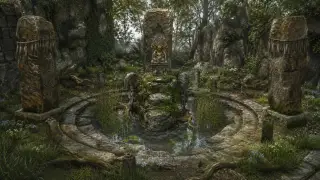
History
The Sea Grove of Obad-Hai is an old druid circle dedicated to Obad-Hai, the Shalm of the Outlands. He is honored by hunters, druids, and all those who live close to the wild. He is also associated with summer, growth, and the turning of the natural world. His symbol is the oak leaf and acorn.
While the people of Saltmarsh predominantly worship Procan, god of seas, storms, and navigation, Obad-Hai has long been revered by the druids, hunters, trappers, farmers, and woodland folk of the region. His worship remains strongest among those tied to the Dreadwood, the Silverstand, the marshlands, and the older rural traditions that predate the rise of Saltmarsh as a fishing and trading town.
The Sea Grove was first raised centuries ago by the druids of Tideholm, the lost coastal settlement that once stood west of the Kingfisher River. The grove was created as a place of balance between sea, marsh, river, and forest. Here, the druids made offerings to Obad-Hai, blessed hunters and gatherers, and sought to keep harmony between the settled folk and the wild land around them.
After the fall of Tideholm, the grove endured for a time under the care of its last known keeper, Lorys, an elf druid of the Silverstand. Lorys watched over the old rites and helped guard the ancient wards tied to the cursed cairns and the sealed entrance to the Endless Nadir.
Then Lorys vanished.
Some say he was cursed. Others whisper that something from the Endless Nadir reached up from below and took revenge upon the druids who had sealed it away. Whatever the truth, the Sea Grove was abandoned soon after. The stones became overgrown, the shrine fell into neglect, and the pond grew dark beneath reeds, moss, and fallen leaves.
For centuries, only a few hunters, trappers, and wandering druids remembered the grove.
Several decades ago, Ferrin Kastilar was sent by the druids of the Silverstand to restore the Sea Grove and tend the neglected shrine. When he arrived, he found the grove nearly swallowed by nature and in the pond, a large old bullfrog watching him with strangely knowing eyes.
Ferrin now tends the grove as its guardian. Though the Sea Grove is not as popular or frequently visited as the temple of Procan, hunters, farmers, trappers, swamp folk, and those who still honor the old ways come here to leave offerings, ask for blessings, and seek quiet counsel.
To most visitors, the Sea Grove is a peaceful shrine to the wild.
Tideholm and the Endless Nadir
Centuries before Saltmarsh rose on the eastern bank of the Kingfisher River, an older coastal settlement stood to the west. Its true name is lost to time, though fragments preserved by the druids and elves remember it as Tideholm.
Tideholm was a sacred settlement of druids of Obad-Hai. Its people lived between sea, river, and marsh, tending the coast and watching the wild lands that stretched toward the Drowned Forest.
In time, the druids of Tideholm discovered something beneath the village: an ancient descent into the Endless Nadir, an underwater abyss haunted by aboleths and things older than mortal memory. Through this hidden entrance, the settlement had already begun to suffer subtle corruption. Dreams turned strange. Fish were born malformed. Lights moved beneath black water. Voices whispered from wells, tidal pools, and flooded caves.
By the time the druids understood the truth, it was too late to save Tideholm.
The last keepers of the settlement gathered their strength and sealed the entrance beneath the village. They succeeded, but the act awakened something in the depths. A terrible storm rose over Javan Bay. Black rain fell. Waves battered the coast and surged inland. Tideholm was destroyed, its stones scattered and its name swallowed by time.
Most of the druids died in the storm or in the rites that followed. Those who survived fled east and inland, returning to the Dreadwood and the Silverstand. They vowed never to return to the ruins.
The two ancient cairns west of the Kingfisher River were sealed soon after. Once honorable tombs of Tideholm’s elder druids, they had been touched by the same darkness that seeped from the Endless Nadir. The surviving druids bound them with wards, abandoned them, and left the marsh to swallow the dead.
Today, the ruins along the coast are considered little more than old stones by the folk of Saltmarsh. Few remember the name Tideholm, or the history buried beneath the moss, brine, and sea wind. The only feature still widely known is the Tower of Zenopus, whose silhouette can be seen from the road and the harbor on clear days.