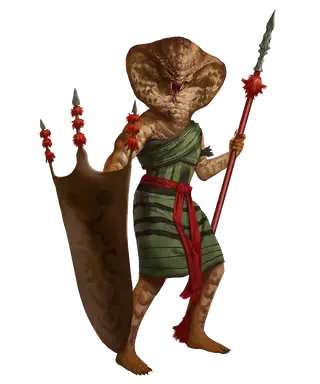
With humanoid figures and serpentine heads, nagaji are heralds, companions, and servitors of nagas. They hold a deep reverence for holy areas and spiritual truths, an aspect many others find as intimidating as a nagaji's appearance.
If you want a character who combines the crushing strength and the sinuous mystery of a serpent, you should play a nagaji.
You might…
Adhere to strong beliefs and traditions about your place in the universe.
Have deep reserves of patience for tasks others might find boring.
Others probably…
Find your unblinking eyes and serpentine features intimidating.
Are awed by your connection and dedication to holy natural places.
Physical description
Nagaji are prone to sharp differences in appearance. Some have tails alongside legs, some have sharp claws on their hands and feet, and some are so unique from their kin that they're mistaken for lamias rather than nagaji. The most common nagaji features are a serpentine head and a humanoid body. They usually have the unblinking eyes of a snake, though other peoples often claim a nagaji's gaze is far more intense. Scales cover nagaji bodies, with patterns that resemble those of snakes or nagas. Depending on their heritage, a nagaji's neck might be as long as a swan's or as short as a human's, and many have a frill of skin or scales down their back. Nagaji tend to possess crushing strength, but how it manifests can vary; some have bulky figures, while others have the slender yet powerful musculature of a snake.
Society
Nagaji communities widely vary, from ancient empires to tiny fishing villages. They tend to be isolated from other peoples, more as a matter of convenience than choice; nagaji have different physical needs than most ancestries, so even when integrated into mixed communities, they tend to live with other nagaji. Everything from marriage traditions, religion, social roles, valued arts, and methods of governance differs in specific nagaji communities. Within these communities, however, nagaji often have very strict and traditional views on these topics. Multiple instances of wars between nagaji have come about due to one group of nagaji finding another's practices unacceptable. This perspective applies to relations with other peoples as well. For instance, most nagaji consider themselves rivals and enemies of garudas due to their historical legends, even if the nagaji involved have never even seen a garuda.
As nagas are usually matriarchal, nagaji have a strong respect for women in leadership positions. Not all nagaji follow suit with matriarchal societies, but they tend to trace lineage through the mother, and almost no nagaji societies are strictly patriarchal.
Nagaji names vary depending on what region of the world they occupy, but they tend to possess short vowels when they have any at all. Nagaji usually name themselves or allow groups of siblings to name each other as children, a tradition that often sees nagaji eagerly shedding these names for new ones when they reach adulthood.
Example names: Adesha, Kaya, Onok, Tasi, Ulu.
Beliefs
Nagaji are most commonly neutral but otherwise don't have any strong pull toward specific alignments. The presence of a naga can sway nagaji toward that naga's ethos, but a nagaji's view on life tends to be determined by the culture to which they belong.
Those who do not worship their tribe's naga god are often met with strong negative reactions.
Popular Edicts
Honour your naga god.
Stick to your tribe's traditions.
Protect sacred grounds.
Popular Anathema
Worshipping another god.
Breaking tradition.
Stats
Legacy.
No backlinks