Tengus are a gregarious and resourceful people that have spread far and wide from their ancestral home in the Greenhorn Fields, collecting and combining whatever innovations and traditions they happen across with those from their own long history.
Tengus are survivalists and conversationalists, with a knack for living in urban environments. They accumulate knowledge, tools, and companions, adding them to their collection as they travel.
If you want to play a character hailing from a rich history of artisanship and tradition, but who happily picks up new practices, companions, words, and items as needed, you should play a tengu.
You might…
Voraciously absorb the practices of those around you, sometimes even forgetting where they came from.
Be willing to take on any task or job, no matter what others think.
Others probably…
Look to you as a source of eclectic skills and knowledge, especially relating to languages.
Have trouble reading your expressions or regard you with suspicion and superstition.
Physical description
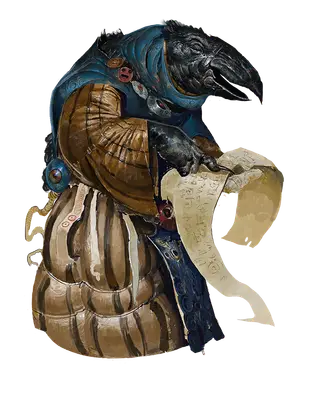
Tengus have many avian characteristics. Their faces are tipped with sharp beaks and their scaled forearms and lower legs end in talons. As closed footwear tends to fit poorly unless custom made, many tengus wear open sandals or simply go barefoot. Tengus are rarely more than 5 feet tall, and they are even lighter than their smaller frames would suggest, as they have hollow bones. A small number of tengus have vestigial wings incapable of true flight.
Tengus hatch from eggs and are featherless for their first year of life, during which they rarely leave home. They soon grow a downy gray coat, which is replaced by a dark covering of adult feathers by the time they come of age at around 15 years. Tengus use their shed feathers in a variety of tools, from simple writing quills to magical fans to focus their ancestral magic. Many tengus modify their appearance by dyeing patterns into their feathers or talons, which amplifies their body language and has the added benefit of aiding other humanoids in understanding their expressions.
Society
Tengus are extremely social, banding together in extended communities with many families living in adjacent houses and sharing the work of the household. In cities, a community may also contain members of other ancestries. Tengu children raised in the same unit consider each other siblings, usually forgetting which of them share a biological connection.
The greatest divide in tengu society is between tengus remaining in their ancestral home and those who have dispersed across the world. Tengus refer to these two groups as those “in the roost” and those “migrating,” respectively. Roosted tengus tend to be more traditionalist and conservative and are especially concerned with preserving their culture in the face of years of erosion from oppression. Migrating tengus, on the other hand, voraciously absorb the culture of the various nations and settlements that they now call home.
Though roosted tengus tend toward more traditional names with the hard consonants often seen in the Tengu language, migrating tengus’ tendency to readily absorb and repurpose the culture of those around them has led to names that combine elements of whatever languages suited the namer’s fancy.
Example names: Arkkak, Dorodara, Marrak, Pularrka, Tak-Tak.
Beliefs
Tengus often follow the faith of the region in which they were raised, and worship Kaelen alongside it.
Tengus are far more concerned with the balance between traditionalism and adaptability than they are with good and evil, with lawful tengus more common among the roosted and chaotic tengus more common among the migratory.
Popular Edicts
Find and protect your own flock.
Learn something new from each culture or region you visit.
Master the various terrains you visit in your travels.
Popular Anathema
Betray or otherwise disregard your community.
Refuse an opportunity to learn something new.
Stats
Legacy.
No backlinks