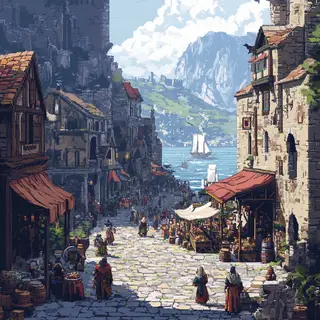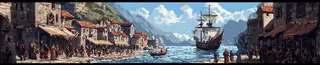
1. The Harbor District (Trade & Naval Powerhouse)
Already discussed in detail, but key locations within it could include:
Grand Exchange Docks – Where high-value goods are auctioned directly from incoming ships.
Harbormaster’s Guildhall – Overseeing customs, tariffs, and Ashmuth’s naval interests.
Privateer’s Quarter – A rowdy sector filled with mercenary captains, smugglers, and shipwrights.
2. The Trade District (Merchant & Economic Heart)
The beating heart of Ashmuth’s commerce and finance, home to:
The Golden Bazaar – A labyrinth of high-end shops selling exotic goods, jewelry, and rare artifacts.
The Contract Halls – Where deals, business partnerships, and trade agreements are negotiated.
The Counting Houses – Private banks and moneylenders controlling the city’s wealth.
Guild Row – Headquarters for the city’s most powerful trade guilds.
Culture:
Only full citizens and high-tier merchants may own property here.
Foreign traders are welcome but must abide by Ashmuth’s strict trade laws.
3. The Obsidian Court (Government & Aristocracy)
The political and administrative center, where the ruling elite governs behind masks.
Home to:
The Obsidian Gates – The ruling palace of the Oselle dynasty.
The Inner Parliament – Where Ashmuth’s masked high citizens debate policy.
The Hall of Masks – A sacred archive of past rulers and their legacies.
Culture:
Only high citizens and the royal household may enter.
Guards and officials are anonymous, always wearing masks and dark robes.
Secrets are currency here—political games are won with cunning, not brute force.
4. The Artisan’s Quarter (Crafts & Industry)
The workshop district, where Ashmuth’s famed jewelers, smiths, and artisans craft their wares.
Key locations:
The Emberforge – A massive forge where master metalsmiths refine Ashmuth’s prized metals.
The Gemcutter’s Guild – Specialists who transform raw gemstones into works of art.
The Jewelers’ Pavilion – An exclusive showroom where the wealthiest patrons commission pieces.
Culture:
Only citizens or approved foreign craftsmen may own workshops.
The district is highly competitive, with guild rivalries and espionage being common.
5. The Resident’s Ward (Lower-Class & Labor Districts)
Home to residents, unskilled laborers, and temporary workers, who keep the city running.
Includes:
The Tenements – Cramped but orderly apartment blocks.
The Common Markets – Daily food and textile markets catering to locals.
The Foreigner’s Quarter – Where long-term visitors and non-citizens may reside.
Culture:
No land ownership – residents must renew their residency contracts each quarter.
Heavily monitored by guild enforcers to prevent unauthorized business.
6. The Night Veil (Underworld & Black Market)
A shadowy, unmarked district where smugglers, spies, and outcasts operate beyond Ashmuth’s rigid trade laws.
Key locations:
The Silent Exchange – A hidden black market auction house for contraband.
The Veiled Coin – A den of gamblers, informants, and underground dealmakers.
The House of Forgotten Names – A place where identities can be changed for a price.
Culture:
Exists in a legal gray area – authorities allow it to function as long as it doesn’t interfere with state interests.
Many powerful figures have ties to this district, using it to handle delicate affairs discreetly.
7. The Ashen Heights (Noble & Wealthy District)
The home of Ashmuth’s wealthiest citizens, built upon hills overlooking the city.
Features:
The Ivory Promenade – A street lined with lavish estates and gardens.
The Gilded Court – A private club where high citizens negotiate deals over fine wine.
The Tower of Ledgers – The city's largest private banking institution.
Culture:
Only high citizens may own property here.
Status is everything—who you know is as important as what you own.
Final Thoughts:
Each district serves a distinct role in Ashmuth’s society, reinforcing the structured and mercantile nature of the city.