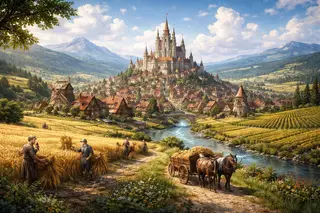
Bera was the first promise Llithe ever kept.
Set upon the richest soil in the west, where the wind carried the scent of wheat and warm earth, the capital rose not from conquest but from cultivation. It is said that the High Matron’s wings once shadowed these plains, and where her shadow passed, grain grew twice as tall.
Bera became known as the Capital of Harvest, though the title barely captured its spirit. The markets were not merely places of trade. They were celebrations of abundance. Long tables spilled into cobbled streets. Spice merchants displayed colors brighter than banners. Bakers rose before dawn, their ovens perfuming entire districts. Butchers, vintners, apiarists, herb keepers, seed collectors, dairy farmers, fishermen from Nexus Bay. If Llithe produced it, Bera refined it.
There is an old saying among travelers:
If you cannot find it in Bera, it does not grow in Llithe.
Communal festivals marked every turning season. Lanterns hung from balconies during harvest months. Choirs sang hymns to the High Matron beneath carved draconic reliefs coiled around grain motifs. Even the architecture reflected devotion. Rounded arches. Warm stone. Dragon wing patterns etched above granaries. Soft lines. Golden light at dusk.
Bera was welcoming, but not naive.
Its laws were measured. Its courts were public. Its justice was firm yet tempered by mercy. Early Bera became a beacon not because it was powerful, but because it was steady. When settlers arrived hungry and uncertain, Bera fed them. When disputes arose, Bera settled them. When the Highlands and Xemascus struggled to establish themselves, Bera sent wagons before they were asked twice.
It was the hearthfire of Llithe.
Then came Kingdom Come.
The war did not simply scar Bera. It hollowed it.
Siege towers stood where festival stages once did. Markets became ration lines. Fields outside the walls were trampled by cavalry and soaked in blood meant for the soil. Streets that once echoed with trade and laughter rang with steel and spellfire.
When the Berathian crown fell, something unseen fell with it.
The city did not burn to ash. It did not collapse into ruin. It endured.
And that endurance became its burden.
After the war, many left. Not because Bera could not sustain them, but because it reminded them. Still, Bera is the most populated in all of Llithe. Every stone carried memory. Every courtyard whispered of banners torn down. Even rebuilt districts seemed to stand too straight, too deliberate, as if ashamed of their former softness.
It became an omen of former glory.
Still grand. Still fortified. Still vital. But no longer warm in the same way.
Now Bera thrives in a different manner.
Caravans line its outer roads. Storehouses rise where noble gardens once stood. Trade routes converge within its walls like veins feeding the rest of Llithe. Grain flows outward. Steel flows inward. Contracts are signed in bulk. Schedules matter more than songs.
Its population remains vast. Civilization continues. Children still play in plazas. Festivals are still held, though smaller and more restrained. The temples of the High Matron still stand, their draconic effigies polished daily.
But the spirit has shifted.
Where once Bera was the beating heart of Llithe, it is now its engine.
Efficient. Necessary. Resilient.
And though rebuilt and restructured, those who remember Berathian rule speak quietly of a different Bera. One that felt alive rather than operational.
Nothing has truly replaced that feeling.