Description
Not long after breaching the gravity well of their homestar, the Choran pick up a powerful, perfectly regular signal—a narrowband pulse repeating every 16.6 minutes, far too stable to be natural.
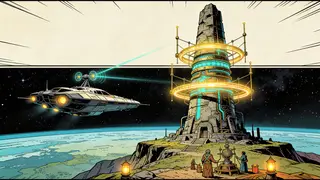
Following the beacon through deep space, their survey vessels arrive at a remote system whose dominant orbital feature is a colossal broadcast tower anchored to an otherwise modest world. The locals have no star‑faring capability but possess millennia‑old ritual and technical traditions centered on this structure, which they call a Metronome. To them, its 16.6‑minute “heartbeat” is not just a signal; it is the rhythm of their calendars, trade, and religion.
The Choran quickly realize the Metronome has been running continuously for several thousand years, predating their own expansion era. The inhabitants, proud of their stewardship, offer to teach selected Choran envoys how to maintain and tune the tower—passing on both practical maintenance lore and a thick layering of rites, taboos, and drift‑measuring practices that will eventually cohere, centuries later, into the Chronologist Guild’s foundational techniques.
Significance
From the Choran point of view, this day marks three revelations at once:
They are not the first civilization to standardize time on a galactic scale.
Timekeeping can be externalized into massive, semi‑mystical infrastructure.
Whoever originally built the Metronome network is older, stranger, and more technologically subtle than any contemporary power.
In later ages, Chronologist histories will cite 13 Stasis 7021 as the moment “the galaxy’s heartbeat was first heard by those who would one day guard it,” and Metronome‑keeper lineages among that world’s inhabitants enjoy a special prestige inside the Guild’s mythic genealogy.
Aftermath
Consequences and outcomes resulting from the event.