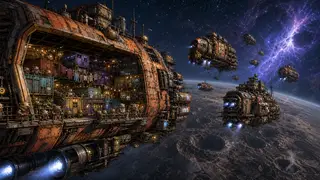
GD‑19.3.18 Parallax 9 – The Burrowfleets of Dopvyn
When Cavern‑Cities Learned to Travel
Scale Hegemony Withdrawal and Cavern Cities
As the Xoz-Roq begins its deliberate withdrawal from the Inner Sphere—pulling Choran temple fleets and Gargo martial formations back toward Xoz‑Roq and Outer Sphere strongholds—entire swathes of territory are left in a state of controlled collapse.
On Dopvyn, a world honeycombed with Schupliji cavern‑cities and industrial burrows, this retreat manifests as shuttered Hegemony offices, abandoned temple outposts, stalled Metronome audits, and roofs over mines that suddenly no longer have buyers.
Schupliji communities, used to tunneling around other peoples’ infrastructure, now see the ceiling coming down on their own: Workers lose contracts tied directly to Hegemony logistics. Refugees from surrounding systems stream into Dopvyn’s caves. Salvage crews realize that if they stay, they’ll be trapped between greedy warlords and decaying routes.
Their answer is not to flee one by one, but to move entire cavern‑cities at once.
Organizing the First Burrowfleets
Schupliji elders, quartermasters, and “deck‑mothers” on Dopvyn begin convening in communal chambers lit by flickering industrial strips and fungus lanterns.
They identify what they have that the Hegemony no longer cares about but cannot easily reclaim:
Bulk haulers used for ore and slag transport.
Habitat barges and processing platforms that can be repurposed as living space.
Cavern‑city populations with strong communal habits and portable shrines.
The plan they hatch is simple and wildly ambitious: Retrofit bulk haulers and barges with additional life‑support, bunks, and communal spaces. Lash multiple vessels into Burrowfleets, convoy formations that can carry entire cavern‑communities—workers, families, and salvage gear—out of collapse zones.
On GD‑19.3.18 Parallax 9, the first of these convoys rolls out of Dopvyn’s gravity wells: hulls patched with mismatched plating, cargo decks crammed with makeshift housing, Schupliji music spilling through corridor speaker systems.
Turning Cargo Decks into Neighborhoods
Burrowfleets are defined less by ship class and more by culture of use.
Schupliji evac crews quickly earn a reputation for being able to turn any cargo deck into a temporary neighborhood overnight:
Layout and Space Use
Stacks of shipping containers become modular apartment blocks. Crane rails support communal cooking stations and hanging gardens of fungus and hardy vines. Maintenance catwalks double as play corridors and market rows.
Social Fabric
Deck‑mothers and block elders assign bunks, schedule shared meals, and designate quiet hours and song hours. Refugees from multiple ancestries are folded into cavern‑style communal routines: everyone sweeps, everyone listens when alarms sound.
Cheerful Evac Specialists
Despite the circumstances, Schupliji crews cultivate optimism and practical humor, offering stories, food, and makeshift festivals to keep spirits up. Outside observers describe Burrowfleets as “cheerful evac trains”—chaotic, crowded, but surprisingly functional and emotionally resilient.
This approach lets them keep convoys stable even as they pull workers, refugees, and salvage crews from multiple failing Hegemony holdings into the Outer Sphere.
Role in the Scale Migration
While the Choran and Gargo frame the Scale Migration in terms of Metronome retuning and martial repositioning, Schupliji narratives center on the Burrowfleets of Dopvyn:
To them, it is the day they stopped being local tunnel folk and became interstellar burrowers, moving entire communities along Rift routes.
Burrowfleets ferry people and portable industry from dropped Inner Sphere nodes to Outer Sphere burrow‑ports, frontier stations, and new cavern‑colonies.
They also salvage Hegemony infrastructure along the way—stripped temple docks, idle processing platforms, and abandoned maintenance rigs—establishing a pattern of evacuate + salvage + re‑root.
This earns Schupliji a lasting reputation as evac specialists: if a system’s first instinct in crisis is “call a Burrowfleet,” that’s because of Dopvyn’s example.
Significance
Humanitarian and Logistics Play: PCs can interact with Burrowfleets as mobile refugee hubs, negotiating passage, coordinating multi‑system evacuations, or solving resource allocation problems on cramped decks. Social scenes might revolve around deck councils, allocation meetings, or the challenge of keeping disparate evacuees peaceful under stress.
Economic and Salvage Texture: Burrowfleets often combine evac with salvage contracts, giving them complex relationships with guilds, princes, and later corporate powers. PCs can ride with them to reach otherwise inaccessible collapse zones or salvage Hegemony tech in a more humane context.
Cultural Identity: Schupliji from Dopvyn or later Burrowfleet traditions are comfortable living in improvised spaces, viewing cramped, multi‑species decks as normal rather than exceptional. Their cheerful, practical approach to disaster gives you useful NPC dispositions for dark situations.
Aftermath
Schupliji in later eras are often found on convoys, station decks, and mobile platforms rather than only on planets. They have reputations as crisis‑ready logistics crews; factions expect them to be able to improvise safe living spaces on short notice.
This Event marks the moment Schupliji communities respond to the Scale Hegemony’s withdrawal by lifting entire cavern‑cities into the void: retrofitting bulk haulers and habitat barges into Burrowfleets that carry workers, refugees, and salvage crews into the Outer Sphere, establishing their reputation as cheerful evac specialists who can make any deck feel like home.
GD‑19.3.18 Parallax 9