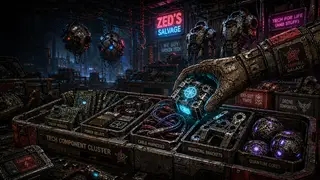
Ask any Starfall scavenger what they really haul back from a good tech run, and they won’t say “guns” or “drones.” They’ll say “blocks.” Tech Component Clusters—“T‑blocks,” “clip packs,” “salv bundles”—are how scrapyards, guild shops, and Commission depots standardize the chaos of melted boards and stripped chassis into something tradeable.
When a Wingbot, turret, or exosuit gets broken down on a bench, the exotic bits get tagged separately: Laser Emitters here, Nanite Reservoirs there, Optics stacks over in the “eyes” bin. Everything else—good heat sinks, intact bus lines, modular housings, power regulators, standard interface chips—gets sorted, tested, and packed into Tech Component Clusters. Each cluster is a little cube or tray of mixed‑grade hardware guaranteed to meet a guild’s minimum standard for voltage tolerances and structural integrity.
To a shipyard engineer staring down a maintenance backlog, a stack of T‑blocks is a promise: yes, you can fix it, and you don’t have to wait for fresh Commission stock to arrive through Rift‑torn shipping lanes.
Implications
Workshop Currency – In many Inner Sphere repair bays and Frontier settlements, Tech Component Clusters double as workshop scrip: paid out to freelancers instead of Yoms, accepted by machinists and hackers as near‑universal barter for labor or small jobs.
Emergency Repair Kits – Crews pack a few clusters into field repair kits; when something breaks in vacuum or under fire, a T‑block gives them enough compatible parts to jury‑rig a fix without matching exact model numbers.
Training & Apprenticeship – Guilds use clusters in apprentice exercises: handing students a bin of mixed T‑blocks and assigning “build a functioning comm, sensor, or drone chassis from nothing but cluster stock.” Those who can do it graduate quickly.
Modular Architecture – Some factions design equipment specifically around cluster dimensions, so an entire panel can be replaced by slamming in a standardized T‑block, making Tech repair more like swapping batteries than micro‑soldering.
Rift‑Risk Mitigation – Chronologist teams and station custodians prefer using T‑blocks over custom runs because standardized, vetted components are less likely to behave oddly near Metronomes or in Rift‑touched areas, reducing the chance of weird resonances.
Societal Impact
The existence of a standardized Tech salvage unit changes how economies and cultures think about technology. Instead of seeing a broken drone as a total loss, people see “four or five good blocks” walking around, waiting to be reclaimed. On the Frontier, stranded crews sometimes calculate the viability of a settlement not in credits or Yoms, but in how many T‑blocks’ worth of Tech they can pull out of local wreckage.
For the Commission and its corporate partners, Tech Component Clusters are a double‑edged tool. On one hand, they keep the maintenance machine running: clusters ensure obsolete models can still be patched together, and standardized scrap fits neatly into logistic spreadsheets. On the other hand, every T‑block that leaves official channels—pilfered from stations, stripped off retired drones, skimmed off reclamation yards—feeds local autonomy. A town with a hidden stock of clusters can keep its infrastructure alive long after the Commission cuts them off.
Black‑market guilds love T‑blocks because they’re hard to track. Specialized components have serials, firmware signatures, sometimes even embedded ownership tags. A bin of generic Tech Component Clusters is just parts—who can say which wreck they came from? The Ebon Syndicate, wildcat miners, even rogue Chronologists quietly skim cluster stockpiles to build gear that doesn’t show up in any official manifest.
At the cultural level, Tech Component Clusters reinforce Starfall’s core theme: everything is salvage, and survival is built from the ruins of older machines. A character with a satchel of T‑blocks might be poor in coin, but rich in potential.