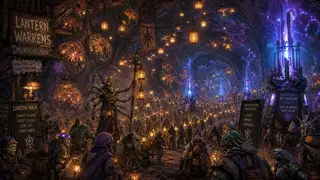
GD‑31.7.37 Silence 19 – Relief in the Lantern Warrens of Murschluven
When the Caves Took the Galaxy In
RiftStorm Cataclysm and Burrow‑Cities
During the RiftStorm Cataclysm, hidden and unstable Riftdrives begin failing catastrophically, dragging ships and whole worlds into lethal Rift eddies or shredding them across time.
Outer and rim systems are hit especially hard:
Stable Metronome pulses vanish.
Established routes collapse.
Emergency evac plans often assume safe orbital stations that simply no longer exist.
On Dopvyn and neighboring rim worlds, Schuplij burrow‑cities—long viewed as out‑of‑sight labor hubs and cultural pockets—suddenly become the only places still standing beneath the chaos.
Above ground infrastructure buckles; belowground, the caves endure.
Murschluven: A Cave Network Becomes a Warren
One of the largest interconnected cave systems beneath Dopvyn and adjacent crust segments is the network that will later be called Murschluven.
Initially a patchwork of mining galleries, communal caverns, and fungus farms, Murschluven transforms as:
Planetary authorities and refugees pour downward, fleeing Rift lightning storms and orbital debris. Entire districts are redirected into cavern mouths, sometimes with little more than an order: “Down. Now.” Schupliji elders realize they are hosting not just neighbors, but multi‑world populations with nowhere else to go.
Murschluven shifts from burrow‑city to Lantern Warrens—a layered emergency refuge for thousands.
Lantern Lines and Rift‑Beacons
Facing darkness, panic, and limited power, Schupliji logistics teams rig lantern lines—continuous strings of light sources along major tunnel spines:
Lanterns, glowstone clusters, re‑wired ship panels, and fungus biolights hung in sequence, creating visible paths of safety.
Color‑coded sections (warm hues for living areas, cold hues for work corridors, urgent pulsing tones for medical or hazard zones).
Along key choke points and cavern hubs, they install emergency Rift‑beacons:
Jury‑rigged devices that monitor for Rift anomalies, track time drift, and provide minimal navigation data for any continued traffic to and from the surface.
Beacons double as rally points—places where announcements, aid distribution, and route changes are communicated.
Together, lantern lines and beacons turn Murschluven into a map you can walk, even amid chaos.
Honeycomb Caverns and Lantern Walks
To house evacuees, Schupliji carve and reinforce honeycomb caverns: Chambers stacked vertically and horizontally, each sub‑cavern assigned to particular groups—families, evac crews, salvage teams, med wards. Reinforced with pillars, bracing, and fungal growth to resist quakes and pressure changes.
But simply stacking people is not enough. Panic, grief, and cramped conditions threaten to make the warrens lethal.
So Schupliji institute “lantern walks”: Regular, rhythmically scheduled walks along lantern lines, guided by volunteers and coordinators. Evacuees are brought out of caverns to move, breathe, and see others, breaking isolation spirals and preventing static fear. Songs, call‑and‑response chants, and short rituals are woven into these walks to give structure and shared meaning.
Lantern walks become the emotional backbone of the Warrens—keeping people from freezing in place or turning on each other when news from the surface is consistently bad.
Significance
Dungeon and Exploration Site: The Lantern Warrens of Murschluven make an excellent adventure location: layered caverns, old emergency infrastructure, half‑operational Rift‑beacons, and forgotten honeycomb neighborhoods. PCs can navigate old lantern routes, uncover sealed caverns, or encounter remnants of Storm‑era populations or tech.
Psychological and Social Play: Scenes in the Warrens can explore crowd management, trauma, and community building, not just monsters. NPCs from Murschluven might show particular resilience or fragility around confined spaces and emergency lights.
Logistics and Coordination Themes: PCs can learn or invoke “lantern walk” practices when managing modern evacuations, using them as templates to prevent panic and maintain cohesion.
Schupliji Reputation: Cavern Relief Specialists
Stories from the Lantern Warrens spread: Refugees from multiple ancestries recount how Schupliji could turn any tunnel into shelter, any dim corridor into a guided path. Reports emphasize their cheerful resilience—small jokes, shared food, and persistent organization in the face of cosmic disaster.
Over time, this cements Schupliji reputations as cavern relief specialists: Factions experiencing tunnel catastrophes, underground station failures, or subterranean wars look to Schuplij traditions for answers. Later Burrowfleet and yard logistics protocols reference Lantern Warrens practices explicitly—lantern lines, group walks, honeycomb caverns as social, not just spatial, structures.
Murschluven itself becomes a symbol: a place where the galaxy’s trauma was held gently in stone and light.
This effort captures Schupliji at their most quietly heroic: turning burrow‑cities into stacked refugee warrens, rigging lantern lines and Rift‑beacons, and running endless lantern walks so panicked masses survive the RiftStorm Cataclysm without freezing or devouring themselves in the dark—leaving behind tunnels that still remember how to hold a galaxy’s fear.