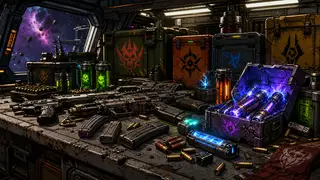
Fuel for Violence and Survival
"Ammunition" encompasses any expendable component that allows a weapon to deliver force at range, from physical projectiles and rockets to energy charges, chemical tanks, and exotic magitech rounds. Ammunition interacts directly with core Starfinder 2e weapon rules, including magazines, batteries, usage, reload, and special ammunition traits, and this article frames those systems in Starfall’s gritty, survival-focused context.
In general firearms and projectile weapons, a single round of ammunition consists of a projectile (bullet, dart, flechette, bolt) plus a casing, propellant, and primer that together form a complete cartridge ready to be fired. In Starfall terms, ammunition also includes battery charges, chemical tanks, and single-use missiles, since all are consumed or depleted to create the weapon’s effect on the target.
Projectile Ammunition
Projectile ammunition refers to physical rounds that are loaded into a weapon’s magazine, usually in groups of 10 per purchase unit. These projectiles can represent bullets, flechettes, bolts, or darts depending on the weapon, but mechanically they are treated the same: the weapon’s entry defines the damage die, traits, and magazine capacity, while the ammunition entry tracks only name, quantity, price, and Bulk.
Energy Charges and Batteries
Energy weapons and some powered melee weapons draw ammunition from batteries measured in charges rather than discrete cartridges. Each shot or period of activation consumes a set number of battery charges based on the weapon’s usage value, and batteries can be recharged or swapped; most standard batteries hold around 20 charges before higher-capacity options become available.
Chemical Tanks and Chems
Some Starfall weapons, particularly flamethrowers, spray weapons, and industrial tools repurposed for combat, use chemicals stored in tanks that function like non‑rechargeable batteries. These chem tanks have a capacity and usage profile similar to batteries, but once expended, they must be replaced rather than recharged, reinforcing Starfall’s emphasis on supply chains and logistics.
Missiles and Rockets
Missiles—including arrows, mini‑rockets, explosive shells, and other single‑shot projectiles—are loaded and fired one at a time and often have properties such as explode or special critical effects. Many launchers provide a quick reload‑style property, letting a user draw and fire a missile in a single action, which is crucial when dealing with low‑capacity but high‑impact weapons like sniper rifles or rocket tubes.
Capacity, Usage, and Magazines
Every ranged weapon has values for capacity and usage that describe how much ammunition it can hold and how quickly it burns through that resource. For projectile weapons, capacity reflects magazine size, while for energy and chem weapons, it describes the number of charges in the weapon’s installed power source.
Rounds-Based Capacity
Projectiles are typically stored in magazines whose base capacities scale by weapon type: small arms often hold around 8 rounds, longarms around 16, heavy weapons around 32, and sniper weapons may be limited to 2 rounds to balance their high damage and range. At higher item levels, some weapons can upgrade their capacity by approximately 50 percent, representing extended magazines or refined internal design.
Battery and Chem Capacity
Battery‑powered weapons list a capacity (number of charges) and usage (charges consumed per attack or per day of activation), and these values can improve when the weapon reaches certain item levels, often doubling from 20 to 40 and later to 80 as it begins to require higher‑grade batteries. Chem‑based weapons follow similar logic but require complete replacement of the tank once it is empty, making them resource‑intensive in protracted engagements.
Reload and Action Economy
Reload is the measure of how many actions it takes to ready a weapon to fire again once its current piece of ammunition or magazine has been expended. Reloading or drawing ammunition requires a free hand and usually involves Interact actions, which may need to be chained together for weapons with higher reload values.
In practice, a weapon with Reload 0 folds drawing ammo and firing into a single Strike, while Reload 1 or higher requires explicit actions to insert new cartridges, swap magazines, or feed in missiles. This makes ammunition management not only a supply concern but a critical part of action economy, especially for sniper and launcher weapons with small magazines.
Special and Magical Ammunition
Certain ammunition types are alchemical or magical consumables that add extra damage, conditions, or utility effects beyond the base weapon’s profile. These items are purchased or crafted as ammunition for a specific weapon or category (any, arrows, bolts, bullets, etc.), and the weapon’s fundamental runes still determine attack modifiers and base damage while the ammunition contributes additional effects.
Alchemical Ammunition
Alchemical ammunition uses reservoirs of chemical reagents that activate on impact, often dealing persistent or splash damage in elemental types such as acid, cold, electricity, fire, or poison. Each damage type uses a distinct formula and adds a trait matching that energy type, creating specialized rounds like incendiary bullets or toxin‑tipped darts.
Magical Ammunition
Magic ammunition stat blocks specify compatible ammunition types and may require activation before firing, especially when delivering complex effects like spells, beacons, or summoned hazards. When magic ammunition lacks an explicit Activate entry it triggers automatically when launched, but versions that do require activation must be fired before the end of the turn or lose their active effect while remaining physically intact.
Magic ammunition is consumed regardless of whether an attack hits, and its special effect does not stack with weapon property runes unless specifically stated, preventing excessive stacking of additional elemental or control effects.
Ammunition Pricing and Logistics
Projectile ammunition is priced by the bundle, with a standard rate of 10 projectiles per Cinder after errata revisions. Specialized ammunition—alchemical, magical, or precious‑material rounds—costs significantly more and is usually bought or crafted in small batches.
This means basic ammo is rarely the limiting factor in well‑supplied Inner Sphere or Accord‑controlled regions, but scarcity can be a central tension on the Frontier or in Rift‑damaged systems where supply lines are tenuous. GMs can reflect economic pressure by manipulating access to higher‑tier ammo, forcing crews to choose between spending Yoms on survival packs or on specialized munitions that might end a threat more quickly.
Within Starfall Galaxy’s economy, ammunition is an immediate expression of resource allocation, with factions emphasizing different doctrines—precision sniper cartridges, swarm‑suppressing flechette drums, or battery‑efficient stun weapons—based on their access to Yoms, industry, and Rift‑safe logistics. Guilds and black markets compete to control the flow of high‑tier ammunition such as magitech rounds or experimental Rift‑tainted cartridges, giving GMs ready hooks for heists, blockades, and sabotage missions.
Implications
Mining & Salvage: Chem tanks and explosive rounds clear rubble, open hulls, and carve passages through Rift‑fused structures.
Industrial Work: Low‑charge batteries power welders, cutters, and survey tools long before they see combat use.
Signals & Flares: Specialized ammo doubles as illumination, encoded flares, or holographic signal beacons for operations in vacuum or Rift storms.
Security & Crowd Control: Incapacitant or nonlethal rounds, along with low‑setting energy weapons, let authorities “solve” problems without spraying lethal fire in delicate habitats.
Scientific Probes: Sensor‑stacked rockets and beacon rounds mark Rift anomalies or plant telemetry nodes in unreachable terrain.
Societal Impact
Starfall’s economy is built on tangible survival goods; ammunition sits right next to Dei survival packs on the ledger.
Doctrine & Identity: Factions broadcast their values through ammo choice—precision marksman doctrines, saturation fire, shock‑and‑awe explosives, or nonlethal suppression.
Class & Access: Inner Sphere elites burn through smart rounds and magitech bullets in training exercises; Frontier enclaves count every standard cartridge out loud.
Black Markets: Smuggling rings move pallets of ammo and chem tanks as often as food; counterfeit rounds and degraded batteries are common hazards.
Rift Arms Races: Any new ammunition tech—Rift‑stable batteries, anomalous payloads—becomes a flashpoint. Chronologists, guilds, and warlords all want their hands on the next generation of “impossible” munitions or want it buried.