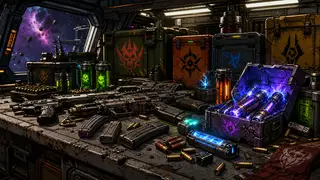
Power Blocks of a Dying Galaxy
In Starfall Galaxy, nobody wastes a battery. Every Commercial cell is a tiny promise of light in the dark; every Elite block is a political asset people quietly kill for. Bullets and rockets are visceral, but batteries decide who can see, breathe, and shoot after the first firefight is over.
Chronologists count time in Yoms; engineers count survival in how many charges are left in the rack. Flair aside, a crew’s “ammo state” is as much about battery depth as it is about magazines—because when the power dies, so does the ship, the medbay, and the shield grid.
Commercial & Tactical Batteries
Commercial batteries are everywhere: emergency lights, comms, sidearms, survey gear. They’re cheap enough to stock in bulk but small enough that nobody ever feels like they have quite enough on the Frontier.
Tactical batteries double that capacity and are the “standard issue” cells for patrol rifles, squad support weapons, and field omnitools in most Inner Sphere security forces.
In stable systems, technicians toss drained commercial cells into charge banks overnight. In Rift‑scarred burgs, people mark them with paint and log every cycle in guild ledgers, terrified of battery fatigue and quiet failure.
Advanced, Superior, and Elite
Advanced batteries power heavy weapons, industrial tools, and mid‑range armor systems—fewer swaps in the middle of a firefight or a repair job.
Superior batteries cross the line into strategic assets: 60 charges in a single light‑Bulk block, ideal for long‑range rifles, mech harnesses, or emergency environmental suites where “recharge later” is a fantasy.
Elite batteries are rare, tightly tracked. A handful of Elite cells can keep a remote listening post, Rift lab, or stealth corvette running for an entire operation if used carefully.
Faction quartermasters treat crates of Superior and Elite batteries like gold: serialized, sealed, and accompanied by reputation checks and Favor expenditures before anyone walks off with them.
Implications
Exploration & Survey: Power for scanners, mapping drones, geologic samplers, and radiation meters on new worlds. Long‑range expeditions budget batteries like they budget oxygen.
Life Support & Shelter: Backup environmental units in shelters and escape pods rely on Commercial and Tactical cells to maintain heat, filtration, and minimal lighting. Refugees stuck between resupply see batteries as literal life—no battery, no air.
Medical & Cybernetics: Portable medkits, auto‑sutures, limb actuation rigs, and emergency surgical lights all chew through low‑grade batteries. Improvised cybernetics often use scavenged Commercial cells, making their users dependent on whatever trickle of power they can find.
Industry & Salvage: Cutting torches, welders, and industrial exosuits run off Advanced or better batteries in isolated yards. Salvagers harvest spent batteries for partial charge and rare high‑capacity cells salvaged from pre‑Cataclysm wrecks.
Infosphere & Comms: Relay nodes, field repeaters, and secure data caches in dead systems use Superior/Elite batteries to broadcast intermittent beacons over months or years when no stable grid exists.
Societal Impact
Economy & Yoms: In Accord‑aligned regions, commercial and tactical batteries are folded into Dei survival pack logistics, ensuring a basic “energy floor” for citizens. On the Frontier, Yoms and Cinders buy food first and batteries second; this stratification shows in which districts are lit and which are permanently dark.
Class Divide: Inner Sphere elites enjoy private reserves of high‑grade batteries for personal armor, powered suits, and custom weapons; they treat power as a comfort, not a constraint. Outer Sphere denizens and Rift‑burg refugees count every charge and run equipment in strict rotations—only one section of a station lit at a time, only one heavy tool in use.
Strategic Chokepoints: Seizing a battery depot can cripple a planet’s defenses without firing a shot; suddenly guns, shields, and engines all share a single failure point. Chronologist and guild‑protected metronome stations often double as power‑regulation hubs, turning those facilities into primary targets in any conflict.
Cultural Practices: Some communities ritualize “the last bar” on a power pack, holding vigils or making offerings before a critical device is shut down. Black market “battery laundering” networks rebadge low‑grade cells as elite, leading to catastrophic failures in combat or Rift‑space.