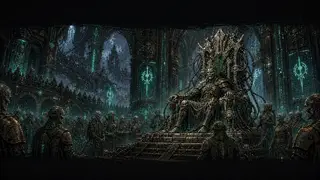
The Noāxol are a fallen Inner Sphere necro‑imperium whose undead bureaucracy once ruled from the Babluse home system and still haunts the politics, trade, and death economies of the Starfall Galaxy. What survives today are splinter corpse‑emirates, bone‑vault principalities, and corpse fleets that claim continuity with the “Corpse Empire” shattered by an Inner Sphere coalition at the height of the Principality’s power.
Noāxol, the Corpse Empire
Vaelen chronicles record Noāxol as an Inner Sphere “Corpse Empire,” an undead great power only toppled when rival states set aside their wars long enough to annihilate its core worlds. Babluse oral history insists that long before Noāxol turned outward, its first and worst atrocities were committed at home—pressing living Babluse into undeath as a “terrible mercy” during a man‑made cataclysm that boiled their seas and stripped their skies.
On the husk of the Babluse homeworld, self‑determined corpsefolk created by tightly guarded rites became the majority population, while the living were herded into sealed “Halls of the Living” and bunker‑cities under the gaze of necro‑engineers and corpse‑emirs. Even now, those Babluse who escape into the wider galaxy carry the brand of “children of a Corpse Empire,” walking reminders that Noāxol devours its own before it reaches for strangers.
Origin and Cataclysm
When the Cataclysm wrecked the Babluse system—Rift scars in orbit, seas flash‑boiled, atmosphere shredded—necro‑engineers offered survival at a cost: transition into curated undeath via experimental rites. The first of the Taq “corpse‑emperors” rose from this disaster, claiming absolute authority over both the living vault‑cities and the growing legions of corpsefolk fiefs orbiting the dead world.
For the living Babluse, undeath became “editing rights” on existence: first life was the rough cut, second life the archival edition, supposedly perfected under Noāxol’s necro‑bureaucracy. That promise hid the reality that the Corpse Empire owned the studios, controlled the bone‑vaults, and could recut or erase any citizen’s legacy if it served imperial doctrine.
Government and Necro‑Bureaucracy
Noāxol’s state is a layered necro‑bureaucracy: a Taq corpse‑emperor at the apex, below them corpse‑emirs and genealogist‑clerks who manage lineages, death‑rights, and the assignment of bodies. Intelligent undead control industry, governance, and ritual; the living are categorized as reproductive stock, entertainment assets, or temporary specialists on track for “promotion” to curated corpsehood.
Living districts—Halls of the Living, atmosphere‑rationed ecumenopoleis beneath shattered skies—function as both breeding pens and theater, every gesture captured for audiences who no longer sleep or age. Writs of Second Life are contracts as much as sacraments, binding a citizen’s eventual corpse to specific duties, aesthetics, and permitted memories.
Society and Culture Among the Dead
Within Noāxol, undeath is normalized; horror attaches not to corpses walking, but to losing authorship of your second life to imperial producers, censors, and genealogists. Popular Noāxolite media—bone‑etched dramas, necro‑casts of battlefield kills, curated “life reels” from Halls of the Living—are traded across the Inner Sphere as morbid prestige entertainment.
Babluse culture persists inside this machine as a mixture of bunker gallows humor, ritual contract law, and obsessive self‑documentation, all expressed in the high tongue Nedxen with its hard consonant clusters and spell‑diagram logic. Outside the empire, “death‑diplomats” and necro‑engineers from Babluse space are sought after precisely because they bring an almost optimistic, pragmatic perspective on undeath into otherwise horror‑coded situations.
Strategic Position in the Inner Sphere
The Corpse Empire’s heartland lies in the Inner Sphere’s scarred clusters, amid Rift‑storm belts and ruin‑rings that still bear the signatures of Cataclysm and coalition reprisal strikes. Even shattered, Noāxol’s bone‑vault worlds and necro‑stations sit astride valuable transit routes, controlling graveyards of derelict fleets that are as much resource caches as memorials.
The same Rift instability that made the Babluse prized as Navigators—reading planar bleed and spellwork as pressure in their skulls—also turned Noāxolite corpse fleets into notorious risk‑takers, willing to gamble centuries of relative time on a single strategic strike. Chronologist Guild logbooks quietly flag “Corpse Caliphate remnant zones” as regions where navigation may be complicated by unregistered necro‑beacons and unauthorized Metronome interference.
Water remembers its path. So do we.
Imperial Taq Continuity
The Taq Continuity is the tight circle of corpse‑emirs, archivists, and ritual staff who still recognize a central corpse‑emperor as the only legitimate sovereign of Noāxol. They control key Writs of Second Life, imperial registries, and whatever remains of the old capital’s bone‑vaults, using those levers to demand loyalty from far‑flung principalities.
They present themselves as stabilizers in a time of remnant chaos, offering recognition and legal continuity to compliant emirates in exchange for tithe fleets and ritual obedience. PCs dealing with the Continuity are dealing with “the Empire as it insists it still is,” even if that claim is more archival than material.
Bone‑Vault League
The Bone‑Vault League is an informal coalition of powerful corpse‑emirs who rule their own necro‑worlds and orbital ossuaries as quasi‑independent states, only paying lip service to the emperor. Each principalities’ strength lies in its own legions of intelligent undead, local death‑rights, and tightly guarded necromantic rites that let them outproduce rivals in curated corpsefolk.
League emirs cooperate when it suits them—mutual defense, corpse‑fleet campaigns, or suppressing living revolts—but they are just as likely to sabotage each other’s genealogical records or poach specialists from rival bone‑vaults. For PCs, this bloc is where you find warlords, patron‑states, and “friendly” undead regimes willing to cut deals in exchange for burial rights, slaves, or forbidden tech.
Genealogist Synod
The Genealogist Synod is the loose but formidable fraternity of genealogist‑clerks who maintain Noāxol’s lineage ledgers, death‑rights registries, and Second Life contracts. They decide which memories carry forward, which aesthetics are permitted, and who is even eligible for curated undeath, effectively controlling social mobility across both lives.
While nominally servants of the emperor and the emirs, the Synod’s control over records lets them quietly erase enemies, reinvent allies, or manufacture “proof” of ancient obligations. PCs might encounter Synod agents as quiet power‑brokers, archivist‑priests, or whistleblowers trying to smuggle censored life reels out of the empire.
Corpse Fleet Compact
The Corpse Fleet Compact is a fraternity of admirals and necro‑captains whose roaming armadas serve as the empire’s long‑range claws—and increasingly as its own political actor. These fleets offer “security assistance” to threatened clusters in exchange for burial monopolies and salvage rights, building pocket powerbases far from any bone‑vault’s direct oversight.
Some Compact fleets remain staunch imperialists, others are de facto pirate kingdoms, but all share an interest in keeping the corpse‑economy flowing and ensuring a steady supply of fresh dead. PCs negotiating with a Compact admiral are really negotiating with a mobile city‑state whose loyalty to any emperor or emir is contingent on profit and ritual privilege.
Halls‑of‑the‑Living Underground
Inside the atmosphere‑rationed Halls of the Living—bunker‑cities where Babluse and other living subjects are penned—resistance cells and black‑market networks form a shadow faction of their own. Some cells just want out, coordinating escapes to the Outer Sphere; others aim to sabotage necro‑infrastructure, falsify Second Life contracts, or awaken sympathetic corpsefolk to the horror of their curated existence.
This “Living Underground” lacks formal representation in Noāxol’s necro‑bureaucracy but exerts pressure through sabotage, information leaks, and occasional alliances with external factions like the Ebon Syndicate or Azure Archivists. PCs from or allied with these groups are perfectly positioned for espionage‑, jailbreak‑, and terror‑adjacent plots behind the Corpse Empire’s bone‑white façade.
Current Projects
The Living Under Glass: Halls of the Living
Living Babluse and other subject peoples are concentrated into “Halls of the Living” and atmosphere‑rationed ecumenopoleis, where they function as reproductive stock, novelty value, and live‑content generators for undead audiences. These districts are tightly monitored by local clerks and security organs, and every inhabitant is expected—implicitly or explicitly—to transition into curated corpsehood under terms defined by their Writ of Second Life.
Remnants and Continuity Claims
As a fallen necro‑imperium, Noāxol now exists as a patchwork of splinter corpse‑emirates, bone‑vault principalities, and roaming corpse fleets that each claim to be the true heirs of the Corpse Empire. Coalition reprisals annihilated many core worlds, but the necro‑bureaucratic structures proved hard to fully destroy, leaving a landscape of competing archives and authorities that still haunt Inner Sphere politics and death economies.
Organizational Structure
Noāxol is organized as a rigid necro‑hierarchy: a single Taq corpse‑emperor at the top, layers of corpse‑emirs ruling bone‑vault domains beneath, and a vast lattice of genealogist‑clerks and necro‑engineers managing every body, soul, and contract. Around this core sits a mix of living “Halls of the Living” districts and semi‑autonomous corpse fleets and principalities that now function as splinter remnant states.
Apex Authority: The Taq Corpse‑Emperor
The Taq corpse‑emperor is the nominal sovereign of all Noāxol, claiming absolute authority over both living vault‑cities and the legions of corpsefolk created during and after the Babluse Cataclysm. In practice, the emperor’s will is expressed through edicts encoded in Writs of Second Life and necro‑bureaucratic directives that determine how citizens will be edited, deployed, or erased across multiple lifetimes.
Provincial Rule: Corpse‑Emirs and Bone‑Vault Principalities
Beneath the emperor, corpse‑emirs rule individual systems, orbital bone‑vaults, and ecumenopoleis as feudal‑bureaucratic lords, each responsible for maintaining quotas of undead labor, military strength, and recorded lineages. These domains—“bone‑vault principalities”—now form the bulk of Noāxol’s surviving power, acting as semi‑independent successor states that still claim loyalty to the imperial line while pursuing their own necropolitical agendas.
Administrative Core: Genealogist‑Clerks and Necro‑Engineers
Genealogist‑clerks form the backbone of the necro‑bureaucracy, tracking every birth, death, undeath, and lineage right, and deciding which memories, aesthetics, and duties a citizen carries into their second life. Necro‑engineers sit beside them as the technical caste, designing and operating the experimental rites, body‑assignment systems, and infrastructure that keep intelligent undead as the dominant workforce and ruling class.
Military and Security Arms
Corpse Fleets
Noāxol’s expeditionary and enforcement arm is its corpse fleets: necro‑crewed armadas drawn from bone‑vault domains, commanded by high‑ranking corpse‑emirs or their appointed admirals. Even after the empire’s shattering, these fleets operate as mobile power blocks that can offer “security assistance” to outer clusters in exchange for burial rights, salvage monopolies, and political concessions.
Power Centers
Paxima, the throne‑world of Noāxol is the ruined Babluse homeworld itself: a husk planet of Rift‑scarred skies, boiled seas, and necropolis ecumenopoleis where intelligent undead outnumber the living by orders of magnitude. It is less a capital city and more a planet‑sized stage set, where the Taq corpse‑emperor and their necro‑bureaucracy rule from bone‑vault citadels while the living are kept under glass in tightly controlled “Halls of the Living.