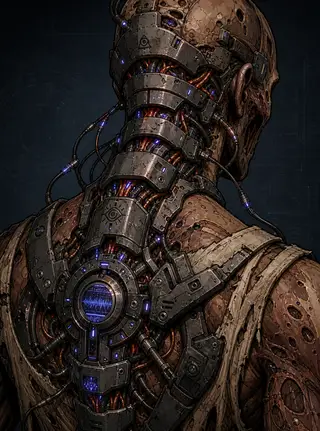
Contract-Bound Resurrection Harness
The Lazarus Yoke is installed on heavy laborers, security crews, and expendable contract staff, the Yoke quietly rides their nervous system, stabilizing their cybernetics and recording their habits—every repetitive dockside task, every loader route, every emergency drill—into a compact firmware gospel of how they work.
When a laborer dies “in the line of duty,” the Yoke’s black nanites stitch the body back together just enough, burn the nerves into circuitry, and hand the controls to a stripped‑down operating script that cares only about quotas, safety margins, and contract clauses.
In practice, the worker comes back as a void‑healing, undead shell that thinks in checklists and hazard flags, walking their old routes with a Cybernetic Zombie’s inexhaustible focus while their true self watches from inside the backup, waiting for their contract to end.
Implication
Post‑Mortem Labor Continuity
For shipyards, Rift‑lane gatehouses, and industrial tori, the Lazarus Yoke ensures that crucial roles—dock overseers, hullwalkers, critical techs—keep “showing up” even after fatal accidents, preventing downtime and renegotiation chaos in the aftermath of disasters
Training and Skill Preservation
Because the Yoke builds operating instructions from lived routine, retired Lazarus units can be used as walking documentation: apprentices shadow them to learn optimal loader paths, lockout/tagout rituals, or Rift‑hazard responses, effectively inheriting the dead’s know‑how without needing living mentors.
Insurance and Liability Instruments
Commission‑era insurers and Syndicate brokers quietly bundle Lazarus Yokes into high‑risk labor contracts, arguing that “post‑mortem productivity” offsets hazard premiums; some charters even stipulate that a laborer’s heirs get better payouts if the Yoke successfully reanimates and completes the term.
Social Impact
On paper, the Lazarus Yoke is sold as a worker‑protection device—“Your skills won’t be lost in an accident; your family will still see your contract fulfilled”—but in practice it turns bodies into contingent assets, blurring the line between employee and equipment.
Void‑rights advocates and corpsefolk activists point out that Lazarus Thralls spend their most loyal years literally dead, with their autonomy deferred until their labor is fully extracted—a form of post‑mortem indenture that’s disturbingly close to how Cybernetic Zombies are treated.
Religions and prefectures argue fiercely over the ethics of exporting consciousness backups into undead chassis: some call it a mercy (better than mindless zombies), others call it metaphysical fraud—an attempt to both claim the soul has departed and still bill its labor.
Chronologist white papers quietly note that Lazarus Yokes complicate incident timelines: if a worker dies, then rises under a contract script, when did their personhood end and asset status begin—and which timestamp does the Guild record as “the moment of loss”?
The Lazarus Yoke distills Starfall’s survival calculus into hardware, turning nervous systems into contract engines and proving that in a galaxy built on Rift storms, even death can be just another line item in a labor agreement.