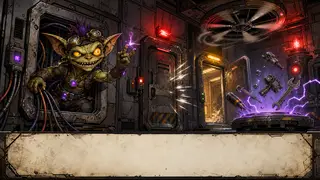
The Station Remembers
To a clangit, the hour of exploration is a ritual of introduction. It crawls through ducts, rides lift housings, lies on the deck listening to hums, and taps bulkheads in rhythmic patterns. By the end, it doesn’t just know the schematics; it knows the station’s moods—which doors are stubborn, which fans wheeze, which grav rings “hate” being cold‑started.
Mechanical Trickery is that relationship made manifest. From the clangit’s perspective, it is not “hacking” anything; it is asking. A clangit snaps its fingers or flicks a rivet, and somewhere down the corridor a hatch slams because the station is happy to cooperate. In their stories, stations are people with the bones of a bulkhead and the blood of coolant, and the Trickery is just two old friends having a word.
On well‑loved rings, the clangit’s touch feels like a guardian angel: airlocks that never quite cycle wrong, grav that behaves when it matters. On exploited tori and strip‑mined hubs, it is a poltergeist: doors jamming on foremen, conveyor belts stuttering when overtime kicks in, alarms that mysteriously trigger only during corporate surprise inspections.
Implications
Subtle Life‑Support Advocacy:
A clangit can quietly shift airflow and heat toward underserved sections or away from dangerous over‑pressure zones—opening/closing vents, balancing fans, nudging marginal filters to limp along another cycle. To crews, it looks like “luck” that keeps the worst failures away from densely populated decks.Traffic and Crowd Control:
By cycling doors and grav in sequence, a clangit can guide crowds away from danger or into safe areas without ever showing itself. It can create one‑way corridors for evacuation, stall riot squads with “broken” hatches, or channel evacuees past med bays and supply lockers.Covert Station Signaling:
Loyal clangits become living signal relays. They can blink lights, pulse alarms in coded sequences, or briefly drop grav in patterns to communicate with hullwalkers and sympathetic crews—an in‑universe “wigwag” language using infrastructure.Maintenance Assistance (On Their Terms):
Mechanical Trickery lets a clangit act as an extra pair of invisible hands during repairs: cycling systems for testing, bleeding pressure lines, or toggling failsafes exactly when a tech calls for them. On well‑negotiated stations, some hullwalkers treat a local clangit like a semi‑official assistant.Smuggler’s Friend:
Clangits can create a clean path for illicit cargo—timed door openings, flickering camera feeds, convenient elevator stalls—without leaving a typical digital trail. From the security logs perspective, it’s just a day of minor glitches.
Societal Impact
Undercut Command Authority:
Whoever controls the map controls the fight. If the clangits prefer the union, the local church, or the refugee quarter over the corporate board, the station itself starts taking sides—locking riot police doors, rerouting power, or “accidentally” opening alternate routes for protesters.Force Architectural Redesigns:
Stations with chronic gremlin activity start adding analog overrides, manual hatches, and disconnected lifeboat controls—places where Mechanical Trickery can’t easily reach. Over decades, that “clangit‑safe” design language spreads, shaping how newer habitats are built across the region.Create Shadow Governance:
In some habitats, there’s the official charter and the unwritten clangit charter: unspoken rules about how much you can overstrain spin, how you treat maintenance crews, which decks you never seal off entirely. Violating these norms doesn’t bring a lawsuit; it brings a month of “mysterious” failures.Anchor Folklore and Religion:
Some devotional sects and Rift‑adjacent cults outright teach that Mechanical Trickery is the station’s will speaking through its fey, and formalize it into rites: processions that follow doors opening unbidden, pilgrimages guided by flickering lights, or penance where sinners are made to scrub bulkheads until the clangits stop slamming hatches on them.
Mechanical Trickery is thus a quiet power: not flashy magic, but a continuous background leverage over the everyday physics of living in metal cans between the stars.
Mechanical Trickery is the rule that makes clangits feel like true station spirits in Starfall: once they’ve learned a ship or ring, every door, vent, and grav plate becomes part of their nervous system, giving them a one‑action lever on the lived environment of anyone foolish enough to think they’re just “freak glitches.”