Commerce in Khorvaire
Commerce in Khorvaire is not a single market. It is a layered system of local trade, guild regulation, state authority, and dragonmarked monopoly — all operating simultaneously, overlapping in practice, and sometimes conflicting in law. A prudent buyer learns which layer governs a given transaction before attempting it.
Most goods move through ordinary channels: farm to mill, mill to baker, workshop to stall, dock to warehouse. The supply chain is unglamorous but remarkably efficient for a continent that was at war with itself for a century — and it functions largely because the dragonmarked houses kept commercial infrastructure running through every year of the Last War, serving all belligerents simultaneously and profiting handsomely from both sides.
"Commerce is not what happens in the market square. Commerce is what happens between the market squares. The routes, the contracts, the insurance, the trust — that is the economy. The stall is just where the customer sees it." — Guildmaster Haldren Osk, Sharn Merchants' Guild
Magic as Infrastructure
Magewrights are not adventuring spellcasters. They are a working class of minor mages trained in limited suites of effects tied to specific trades: maintenance, illumination, sanitation, minor warding, message relay, basic restoratives. Their value lies in consistency, not breadth. Magewright labour is the invisible foundation of urban life, and most citizens interact with arcane services daily without registering them as magical — the same way they do not think of a bridge as engineering.
Dragonshards underpin a significant portion of industrial and commercial magic. They function as both supply and constraint: when shard availability is stable, arcane services are affordable and reliable. When it tightens — through transport disruption, regional hoarding, or the complications of frontier prospecting — prices rise across multiple sectors simultaneously. House Tharashk has recently expanded heavily into dragonshard prospecting, making the youngest of the dragonmarked houses an increasingly important figure in the broader economy.
The Houses
The dragonmarked houses are the barons of industry and commerce throughout Khorvaire and beyond. Their influence transcends political boundaries; not technically citizens of any nation, the houses remained largely neutral during the Last War, selling their services to all sides and emerging from the conflict stronger than ever, with the divided nations now dependent on them in ways that unified Galifar once kept in check.
Their premiums buy not just a service, but the administrative apparatus behind it: trained personnel, established routes, quality control, enforceable contracts, and the political insulation that comes from being too important to antagonise.
The major House roles in goods and services are distinct and well-established. Orien manages the lightning rail and land caravans — the backbone of overland freight. Lyrandar operates sailing vessels and, increasingly, airships; its growing reach threatens to displace Orien's dominance of long-distance travel. Cannith dominates manufacturing, both mystical and mundane, with forgeholds that produce standardised goods and components to registered schema; independent artisans often train at Cannith academies and adhere to Cannith standards regardless. Kundarak, drawing on the precious metal reserves of the Mror Holds, dominates Khorvaire's banking industry, provides sealed storage and a system of extradimensional vaults, and issues letters of credit that serve as liquid currency for large transactions — each of which must be notarised with a Sivis arcane mark. Sivis handles the rest of the information economy: speaking stone networks, licensed scribes, notaries, interpreters, cartographers, and barristers. Jorasco runs houses of healing across the continent, employing both magical and mundane techniques; the guild ran medics in every nation's army during the war and remains the primary institutional source of potions of healing. Ghallanda certifies hospitality and provisioning standards: not every inn is run by Ghallanda, but the blink-dog seal in the corner of a sign assures customers that the establishment meets health and quality standards — and that someone with professional liability checked first.
Guilds and independent firms provide cheaper alternatives for work that doesn't require continental reach — and in most cities, that is the majority of commercial activity. A Sharn baker does not need House Ghallanda to sell bread. What guilds lack is long-distance reach, cross-border enforcement, and the houses' capacity to retaliate through legal and economic pressure when agreements are violated. For local transactions, this rarely matters. For anything that crosses a border, it matters enormously.
"The houses sell trust as much as they sell their goods and services." — Unsigned, Korranberg Chronicle economic supplement
Currency
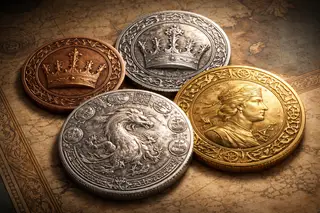
When Galifar collapsed, each of the Five Nations began minting its own currency, alongside the dwarven bankers of the Mror Holds. The designs vary — Brelish lions, Karrnathi skulls, Thranish flames — but the weights and denominations set by Galifar have been maintained across all mints, preserving a reliable standard for commerce across Khorvaire. For large transactions, merchants and nobles use letters of credit that draw on the reserves of the Mror banks, handled through House Kundarak.
Denomination | Common Name | Typical Use |
|---|---|---|
Copper | Crown | Petty transactions, street purchases, tipping. "In Galifar, even the beggars have crowns." |
Silver | Sovereign | Daily trade, meals, routine goods. An unskilled labourer can expect to earn one sovereign for a day's work. |
Gold | Galifar | Professional services, durable goods, arcane labour. Bears the image of Galifar I. |
Platinum | Dragon | Wealth transfer, major contracts. Worth one hundred sovereigns; the average peasant may never see one. |
Regional coinage also circulates alongside the standard four: the double crown of Breland (2 cp) and the silver throne of Cyre (5 sp) among others, though Cyre's mints are silent now.
Wages and Purchasing Power
Pricing that ignores wages produces unreliable logic.
Tier | Examples | Purchasing Character |
|---|---|---|
Unskilled Labour | Field workers, dockworkers | Subsistence with limited discretionary spending. Copper and silver economy. |
Skilled Trades | Carpenters, smiths, magewright assistants | Routine purchases plus occasional major expenses. Silver and occasional gold. |
Professionals | Licensed magewrights, house guild members, officers, merchants | Regular access to specialised services. Gold economy. |
Nobility & Stakeholders | Landed gentry, house scions, senior officials | Access defined by policy and preference rather than coin. |
The gap between tiers is not merely numerical. A dockworker in Sharn's Cliffside district and a Cannith artificer in the upper wards live in the same city the way two fish live in the same ocean — technically accurate and practically meaningless.
Price Tiers
Tier | Character | Examples |
|---|---|---|
Cheap | Routine; purchased without planning | Street food, common ale, basic supplies, local transit |
Moderate | Requires budgeting; purchased with intent | Quality meals, standard lodging, common tools, guild services |
Expensive | Significant purchase; saving or trade-offs required | Masterwork equipment, house services, long-distance travel, professional healing |
Luxury | Status purchase; rarely justified by utility alone | Enchanted items, Siberys shard components, airship passage, bespoke artifice |
The distinction between "expensive" and "luxury" is often less about the object and more about the buyer. A healing potion is expensive to a labourer and routine to a house scion. The potion has not changed. The economy around it has.
"There are two economies in every Khorvairian city. In one, people buy what they need. In the other, people buy what they want to be seen buying. The houses service both, and they charge accordingly." — Haldren Osk, private correspondence
Regional Variation
Markets are regional and stratified. A commodity common in Sharn may be scarce in a frontier settlement; a service routine in Fairhaven may be unavailable in the deep Eldeen Reaches. Proximity to trade routes, urban density, house enclave presence, and local regulation all determine what is available, at what price, and under whose authority.
The Last War amplified these disparities sharply. Cities on intact lightning rail lines recovered faster than those whose connections were severed — House Orien's ongoing struggle to rebuild the rail line across the Mournland stands as the starkest example of how the war's geography continues to shape commerce years after the treaty. Nations with stable dragonshard supply rebuilt their arcane infrastructure first. Communities along the Mournland border operate with supply chains that are fragile, improvised, and vulnerable in ways that urban Khorvairians rarely consider.
Even in major cities, recovery is uneven. The ink on the Treaty of Thronehold is barely dry, and the normalisation of trade relations between former belligerents is incomplete. A luxury item or a spell component may simply be unavailable, or obtainable only through the black market. This is not exceptional — it is the ordinary texture of post-war commerce.