Peoples of Eberron
What you are matters less than where you're from — until it doesn't
OVERHEARD AT THE DRUNKEN DRAGON, UPPER DURA, SHARN
"You want to know what Eberron's people are like? Buy a drink for the dwarf at the end of the bar — the one with the Brelish accent and the royal army tattoo. Then buy one for the dwarf next to her — the Mror one with the iron tooth and the dragonshard necklace. Ask them both what it means to be a dwarf. Then come back and tell me the answer, because I've been listening to them argue about it for three hours."
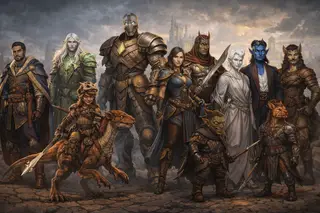
In the Five Nations, what you are matters less than where you are from. A dwarf who grew up in Sharn speaks Brelish Common with a Brelish accent, drinks Brelish ale, follows Brelish law, and holds opinions about Brelish politics. Put her in a room with a dwarf from the Mror Holds and they will share a silhouette and not much else — different language, different values, different relationship to clan, to stone, to money, to the dead. The Mror dwarf will find more common ground with a Karrnathi human than with her Brelish counterpart. National culture, in Khorvaire, runs deeper than blood.
This is the first thing to understand about the peoples of Eberron: the categories are real, the biology is real, the ancestral traditions are real — but for most citizens of the Five Nations, daily identity is shaped by the nation that raised them, the trade they practice, and the war they survived. That said, ancestry still matters. It matters in the Mror Holds, where clan lineage determines political standing. It matters in Aerenal, where elven identity is inseparable from millennia of ancestor worship. It matters in Darguun, where goblinoid heritage carries the weight of an empire that predates human settlement by thousands of years. And it matters in the streets of Sharn, where a warforged looking for work or a changeling looking for housing will discover that legal equality and social acceptance are not the same thing.
What follows is what a reasonably informed citizen of the Five Nations knows — or thinks they know — about the peoples they share the continent with.
"Dwarves are stoic. Elves are wise. Gnomes are cunning. And humans? They can't make up their mind, so they try to be all of these things at once." — Kessler, bard of Sharn
Humans
See: Humans of Khorvaire
Humans are the majority population of the Five Nations and the dominant political force on the continent. They founded the Kingdom of Galifar, administered its provinces, fought its wars, and broke it apart. Four of the five surviving nations are ruled by human monarchs or human-led governments. The Dragonmarked Houses of Cannith, Deneith, Orien, and Vadalis are human lines. The institutions that define modern Khorvaire — its legal systems, economic structures, military traditions, calendar — are substantially human creations built on the bones of the Dhakaani civilisation that preceded them, a fact that humans rarely dwell on and goblinoids rarely forget.
Humans are not native to Khorvaire. They came from Sarlona roughly three thousand years ago — first as pirates and renegades following the explorer Lhazaar, later as refugees fleeing the wars that would eventually produce the Unity of Riedra. They were colonisers from the start, displacing goblinoid populations, enslaving them at scale, and building cities on Dhakaani foundations, sometimes literally. Galifar abolished slavery and gave goblins citizenship, but the displacement was already done. Human cultures across the Five Nations are regionally distinct in ways that hardened during the Last War into something approaching ethnic distinction — accents, customs, dietary habits, and loyalties carved deep enough to outlast the treaty that ended the fighting.
Elves
See: Elves of Eberron
Elves in Eberron are at least three distinct peoples, and the differences between them are significant enough that using "elf" as a single category is roughly as useful as using "human" to describe both a Thranish templar and a Lhazaar pirate prince.
The Aereni are the elves of Aerenal, ancient and insular, organised around a tradition of positive-energy necromancy that maintains the Undying Court — a council of deathless ancestors who continue to advise, govern, and receive worship from the living. An Aereni is not considered adult until they have passed their first century. The Tairnadal are warrior elves who seized southeastern Khorvaire during the Last War and declared it Valenar, their culture revolving around the belief that ancestral hero-spirits can be kept alive only through descendants who live lives worthy of them — fighting well is a religious obligation conducted on horseback at speed. The Khorvairian elves live in the Five Nations, often for generations, and carry the Mark of Shadow through Houses Phiarlan and Thuranni — both deeply involved in entertainment, artistry, and espionage, and locked in a schism that neither discusses publicly.
Dwarves
See: Dwarves of Khorvaire
Dwarves are native to the Ironroot Mountains and the Mror Holds — a confederation of clans that operates as an independent nation. Mror culture is clan-based, mercantile, and shaped by stone and money. House Kundarak bears the Mark of Warding and runs the most trusted banking and security operations on the continent. In recent decades, deep excavations beneath the Holds broke into vast subterranean complexes of pre-Dhakaani origin, warped by the influence of the daelkyr Dyrrn the Corruptor. What the clans found down there has not been fully disclosed, but the effects are visible: new alloys with inexplicable properties, shifting clan politics, and a general wariness about deep mining that was not there a generation ago. Dwarves in the Five Nations are common enough to be unremarkable — they work trades, serve in militaries, and identify primarily by nationality.
Halflings
Halflings occupy two worlds that share a name and almost nothing else. The Talenta halflings are the nomadic clans of the Talenta Plains — riding clawfoot raptors, fastieth runners, and glidewing pterosaurs with a skill that makes Five Nations cavalry look ponderous. Their culture is oral, communal, and firmly disinterested in being modernised. Urban halflings in the Five Nations have been settled for generations and bear little cultural resemblance to their Talenta cousins. Two dragonmarked Houses are halfling lines: House Jorasco (Mark of Healing, the continent's medical network) and House Ghallanda (Mark of Hospitality, the inn and food-service industries) — ensuring that the most common professional interactions most Khorvairians have with halflings involve being healed or being fed.
Gnomes
See: Gnomes of Khorvaire
Gnomes are concentrated in Zilargo, a small nation on Khorvaire's southern coast that has maintained its independence through intelligence control. The Trust — a secret agency that monitors, manipulates, and occasionally eliminates threats to Zil stability — is not officially acknowledged, but everyone knows it exists. Gnomish culture values information, subtlety, and layered communication; a conversation with a Zil gnome operates on at least two levels. House Sivis bears the Mark of Scribing and operates the speaking-stone network, notarial services, and legal authentication systems that modern Khorvaire depends on. Zilargo is also a leader in elemental binding, illusion magic, and arcane research — the gnomes developed modern binding techniques by studying ancient Sul'at League devices recovered from Xen'drik.
Half-Elves
See: Khoravar
Half-elves in Khorvaire prefer the term Khoravar, and the preference matters — "half-elf" defines them by what they are between, while the Khoravar insist they are their own people. They exist throughout the Five Nations, products of human-elf unions common enough for long enough that half-elf communities are self-sustaining. Two dragonmarked Houses are Khoravar lines: House Lyrandar (Mark of Storm, air and sea transport) and House Medani (Mark of Detection, risk assessment and security). The Khoravar identity is a relatively recent cultural project — a deliberate act of community-building by half-elves who decided that being defined by other peoples' categories was no longer acceptable.
Changelings
See: Changelings
"I will protect your children if they follow my path. Let them wander the world. None will know them. They will have no kingdom but the road, and no enemy will find them. They may be shunned by all, but they will never be destroyed." — The Traveler's promise to the first changelings
Changelings are shapeshifters who can alter their physical appearance at will — face, build, colouring, apparent sex. Their culture is organised around the management of identity: a persona is a crafted identity with history and depth that a changeling inhabits fully; a mask is casual, created for a moment and possibly never used again. Passers live full-time as a single identity, often as members of other races. Becomers actively seek to live many lives. Reality seekers prefer their natural form. The Children of Jes are nomadic clans who follow the Traveler, using secret tattoos and scars to identify one another. In Droaam, the city of Lost is said to be a living changeling settlement that can move and change its own shape. The fundamental challenge of changeling existence is trust — in a world where Sivis authentication exists precisely because people need to verify identity, a people who can be anyone raise questions that no amount of legal protection fully resolves.
Goblinoids
Goblins, hobgoblins, and bugbears were here first. The goblinoid peoples — collectively called the dar — ruled Khorvaire under the Empire of Dhakaan for over five thousand years before the daelkyr invasion shattered them. The Uul Dhakaan, the Dream of Dhakaan, was an epic feat of bardic magic that gave the dar a shared psychic framework and cultural unity across the continent — and the daelkyr's psychic contagion, the Kapaa'vola, severed the surface dar from that dream and scattered what remained.
Today, four goblinoid cultures coexist: city goblins are citizens of the Five Nations; the Ghaal'dar are the tribal confederation that seized Darguun during the Last War under the strategist Lhesh Haruuc; the Marguul bugbears hold the Seawall Mountains; and deep underground, the Heirs of Dhakaan — the Kech — have preserved the old empire's martial traditions, its values of muut (duty) and atcha (honour), and its dirge-singers, waiting to rise and retake their ancestral home. The chot'uul guardians maintain the Dream itself, and the imperial throne within it remains empty — for now.
Dragonborn
Dragonborn are uncommon in the Five Nations. Their primary communities are in Q'barra, where they predate human colonisation by a margin that makes the question of who the "settlers" are politically uncomfortable. They claim to have immigrated centuries ago from Argonnessen at the behest of draconic creators. In Xen'drik, dragonborn have guarded the Ring of Storms for over sixty thousand years, living in small fragmented towns built around biological engines called bolatashi that produce building materials from bone and scale.
Drow
See: Drow of Xen'drik
Most Khorvairians have never met a drow. Three distinct drow cultures formed after the fall of the giants — all originally created by the Sul'at League, which bound planar magic to elven slaves. The Vulkoori are hunters and druids dedicated to the scorpion god Vulkoor. The Sulatar cling to the elemental traditions of the Sul'at, maintaining obsidian cities and fire magic. The Umbragen descended into Khyber and have been fighting aberrations ever since, drawing on a shadow-force they call the Umbra.
Shifters
See: Shifters
Shifters carry lycanthropic heritage — or are a natural strain of humanoid from which lycanthropes are the aberrant offshoot, depending on who you ask. The Lycanthropic Purge, launched by the Church of the Silver Flame in the ninth century YK, is the defining event of shifter history: a decades-long campaign against lycanthropy whose later years, driven by the extremist Pure Flame sect, did not distinguish between actual werewolves and people who merely shared distant biological kinship. The trauma is woven into shifter culture as a foundational narrative. Shifters today are concentrated in the Eldeen Reaches and the Towering Wood. Their spiritual life centres on the Moonspeakers — a druidic tradition tied to totem spirits like Grandmother Wolf, Cousin Bear, and Grandfather Rat. Most shifters are wary of the Silver Flame, for reasons the Church has never adequately addressed.
Kalashtar
See: Kalashtar
"I am kalashtar, born of two worlds. Over a thousand years ago, my ancestor bound her bloodline to the spirit Kashtai, and I am a child of that union. Kashtai moves within me. Her memories come to me in dreams, and at times her voice whispers in the silence of my mind." — Eberron: Rising from the Last War
The kalashtar are formed from the merger of human lineages with rebel quori spirits from Dal Quor. The bond is hereditary — every kalashtar carries a fragment of the original spirit, granting psionic ability and connecting them to a conflict most people do not know is happening. They follow the Path of Light, a philosophical tradition built to resist the Dreaming Dark — the dominant quori faction that controls Dal Quor and, through the Inspired of Riedra, extends its influence into the Material Plane. Most kalashtar in Khorvaire live in small enclaves: the Overlook district in Sharn, Whitewalls in Fairhaven. Services at kalashtar shrines are conducted telepathically, using crystals that amplify psychic abilities — to an outsider, a service appears silent and tranquil despite being an ecstatic experience for the faithful.
Orcs and Orc-kin
See: Orcs and Orc-kin
The Gatekeeper druids are an orcish tradition that predates every human institution on Khorvaire. Thousands of years before humans arrived, orc druids of the Shadow Marches held the line against the daelkyr invasion — developing the primal magic and sealing rituals that drove the alien lords back into Khyber. They did this with the guidance of Vvaraak, a dragon who taught druidic magic to the orcs in defiance of the Conclave of Argonnessen. Every person on the continent who is not currently living under daelkyr rule owes that fact, at least in part, to orcish druids who fought a war against alien gods and won. This is not common knowledge. It should be.
House Tharashk, which bears the Mark of Finding, is an orc-kin institution — one of the few dragonmarked Houses not dominated by a single traditionally "civilised" ancestry. The Ghaash'kala orcs of the Demon Wastes follow a different path entirely — devout servants of the binding flame they call Kalok Shash, spending their lives battling fiends and keeping the Wastes contained.
Planetouched
See: Planetouched
Tieflings, aasimar, and other planetouched individuals exist in Khorvaire without forming a coherent community. They are rare enough to be notable and common enough to be recognised — products of ancient pacts, planar accidents, manifest zone influence on family lines, or causes nobody has identified. The Venomous Demesne in Droaam is a community of tiefling and human refugees from Ohr Kaluun in Sarlona, maintaining insular pact-binding traditions for roughly sixteen hundred years. In cosmopolitan Sharn, a tiefling is unusual but unremarkable; in a rural Karrnathi village, the same tiefling will attract suspicion.
Warforged
See: Warforged
EDITORIAL — THE VOICE OF THRANE
"Against all logic and reason, people in Breland continue to argue that the warforged — creations of House Cannith, lest we forget — are living people with souls, deserving of the same rights as the rest of us."
Warforged are a people with no past and a future everyone else is trying to write for them. Created in House Cannith's creation forges as soldiers for the Last War — the technology ultimately derived from quori constructs recovered in Xen'drik — none are older than about thirty years. None have known childhood. All were born into a world that told them their purpose was to fight. The Treaty of Thronehold made them legally free and ordered the creation forges dismantled. It did not provide a manual for being a person.
Monstrous Races of Droaam
See: Droaam; Monstrous Peoples
OVERHEARD — GRAYWALL MARKET SQUARE
"A medusa petrified my neighbour last week. Not as a punishment — the poor bastard was bleeding out from a bar fight and the healer was three hours away. She turned him to stone to stop the bleeding, and they thawed him out when the hag medic arrived. Saved his life."
Eleven years ago, the three Daughters of Sora Kell — legends out of children's nightmares, hags of power far beyond their kind — seized the lands west of the Graywall Mountains and declared the nation of Droaam. The other nations of Khorvaire refused to recognise it. The Treaty of Thronehold does not acknowledge it. Legally, the territory is still part of Breland. In practice, Droaam is a nation, and it is stronger than ever — its cities growing, its armies disciplined, and its people discovering that the supernatural abilities the Five Nations call monstrous are, in the right hands, simply tools.
Droaam is home to ogres, trolls, harpies, medusas, minotaurs, gnolls, hill giants, gargoyles, goblins, kobolds, orcs, tieflings, changelings, lycanthropes, and other peoples who were unwelcome in the civilised east. In the old days, these groups lived in transient communities ruled by the strongest among them, constantly warring. The Daughters used force and persuasion to end this — recognising the most powerful existing warlords as rulers of their domains, appointing oni and other intelligent creatures as governors elsewhere, and deploying Maenya's Fist (an army of war trolls and skullcrusher ogres, smarter and more capable than their common cousins) to crush anyone who refused to cooperate. The Znir Pact gnolls serve as Droaam's peacekeepers and mercenaries, their word as unbreakable as a Deneith contract, fighting with absolute professionalism — including the rule that a gnoll wounded by another gnoll in opposing service immediately withdraws, regardless of the injury's severity.
What makes Droaam remarkable is how its citizens use their supernatural abilities as civic infrastructure. Harpies call the hour, summon workers, control crowds, and entertain — their songs are a joyful act, a communion with the Fury and a work of art woven together. Medusas serve as architects, judges, and spiritual leaders; a medusa can use the Medusa's Kiss ritual to undo petrification, allowing their gaze to be used for preservation rather than punishment — freezing a dying ally until a healer arrives. Gargoyles serve as couriers, scouts, and sentinels, and a gargoyle courier service has even found a niche in Sharn. Ogre labourers put their strength to practical use in cities across the continent. Trolls — specifically the war trolls trained by Sora Maenya — form the backbone of Droaam's military. And the Daughters keep their people fed with troll sausage, a grim but effective solution to the logistical problem of feeding a nation of creatures with wildly different dietary needs: troll flesh regenerates, the trolls survive the harvesting, and the sausage is sustaining if not appetising. Most citizens of the Five Nations find this revolting. Most citizens of Droaam find the Five Nations' squeamishness about it baffling.
The relationship between Droaam and the wider continent runs through House Tharashk, which brokered the alliance that gave the Daughters access to trade networks and gave Tharashk access to Droaam's rich mineral resources and monstrous labour pool. Through Tharashk, ogre labourers have appeared in Fairhaven and Wroat, gargoyle couriers deliver messages in Sharn, and Znir gnoll mercenaries serve clients across the Five Nations. The presence of Droaamish citizens in eastern cities is still uncommon enough to draw stares, but it is growing less remarkable every year.
Most citizens of the Five Nations are convinced that Droaam cannot last — that these monsters will turn on each other, that the Daughters are figures of legend who cannot possibly govern a real nation, that the whole thing is temporary. After eleven years, Droaam is stronger than it has ever been. The Daughters' true motives — whether they are driven by a thirst for power, by Sora Teraza's prophetic visions, or by something stranger — remain an open question. Most of Droaam worships the Dark Six, and medusa priests of the Six are spiritual leaders in many communities, but other religious traditions flourish as well. The most important warlords include Cairngorm the gargoyle lord of Grimstone Keep, Rhesh Turakbar the minotaur warlord who raids into Breland in the name of his fiendish patron, the Dark Pack alliance of lycanthropes and worgs led by the elf werewolf Zaeurl, and Kethelrax the Cunning, a kobold lord whose claim to the city of Shaarat Kol has given goblins and kobolds — the most oppressed underclass in old Droaam — their first taste of territory and self-governance.
"Today may be difficult, and tomorrow may be harder still. But you are building something that has never existed before — and when it is done, the east will look upon what you have made and know that they were wrong about all of us." — Sora Katra, address to the citizens of Graywall