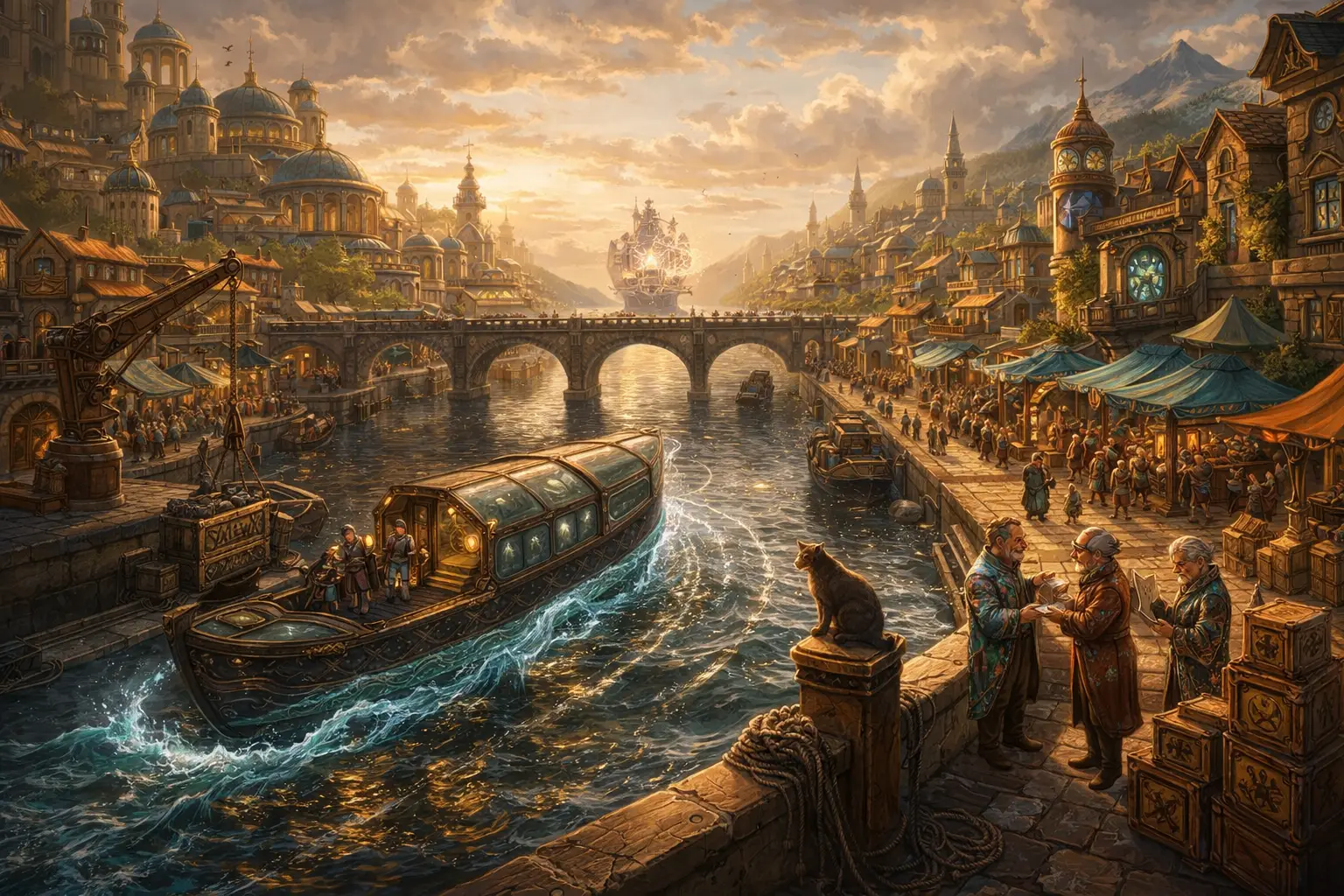
Politics of Zilargo
Overheard at a café in Korranberg, between a Brelish diplomat and her Zil counterpart:
"How do your elections actually work? I mean — with the Trust watching everything, doesn't that compromise the process?"
"What a fascinating question. The elections are genuine. The campaigns are genuine. The debates are genuine. The Trust merely ensures that the process is not disrupted by violence, fraud, or foreign interference. Nothing could be more democratic."
"And what if a candidate says something the Trust doesn't like?"
(long pause)
"The Trust doesn't have opinions. The Trust has responsibilities."
The Governing Structure
Zilargo's political system is democratic in its bones and conspiratorial in its nervous system — a distinction that confuses outsiders, who tend to assume one cancels out the other. In practice, the two are inseparable. The visible government consists of elected councils and a national Triumvirate; the invisible government consists of the Trust, which enforces the law, protects the state, and — critically — answers to the Triumvirate rather than operating independently. The question that hangs over every conversation about Zil politics is not whether the system is democratic, but whether democracy still means the same thing when the secret police can read your mail.
The answer, from the Zil perspective, is yes. They built this system, they maintain it, and they are profoundly satisfied with the results. The streets are safe. The elections are competitive. The crime rate is the lowest in Khorvaire. If the cost is that the Trust knows what you had for breakfast, most Zil consider that a bargain.
The Triumvirate
The Triumvirate is the supreme governing body of Zilargo, composed of three representatives — one from each of the ruling cities of Korranberg, Trolanport, and Zolanberg. Each city elects a Council of Nine, and each Council sends one member to sit on the Triumvirate. In practice, the selection of the Triumvir from each council is shaped by intricate webs of favor-trading, family alliance, and competitive scheming that can take years to resolve, but the process is genuine and the outcomes are not predetermined — at least not by anyone outside the councils themselves.
The Triumvirate sets national policy, manages foreign affairs, oversees the economy, and establishes the broad legal framework within which the nation operates. It also sets the boundaries within which the Trust operates — though few outside the Triumvirate know precisely where those boundaries lie, and the Trust is not in the habit of publishing its charter.
The old grand ducal titles from the Galifar era still technically exist. The heirs of the three founding noble families — the ir'Korrans, ir'Trolans, and ir'Zolans — compete cheerfully for the ceremonial title of grand duke each year through elaborate duels and games, hold extravagant coronations, then repeat the process twelve months later. These families are among the most powerful in Zilargo, but the title of grand duke is considered little more than a toy, and the actual authority has always rested with the elected offices. In the wake of the Treaty of Thronehold, the grand ducal titles are even more symbolic than before.
"In Breland, they argue about whether the monarchy should end. In Zilargo, we ended our monarchy centuries ago and kept the coronation as a party game." — Tallian Talius Lyrris, Korranberg political commentator
The Councils of Nine
Each of the three major cities maintains a Council of Nine — the elected legislative body that governs local affairs and sends its representative to the Triumvirate. Council seats are filled through elections that are, by any external measure, genuinely competitive. Candidates campaign, debate, make promises, and call in favors from allied houses and families. The elections themselves are free from violence and outright fraud — the Trust ensures this — but the campaigns leading up to them are dense with the kind of intrigue that defines Zil public life: whisper campaigns, carefully timed revelations of embarrassing information, alliances forged and broken over the course of a single dinner party, and favors exchanged across generations.
Council members serve as the legislative authority for their city, establishing local ordinances, managing public works, overseeing trade regulation, and allocating funds for education and cultural institutions. The councils are also responsible for managing relations with the dragonmarked houses that operate within their cities — a significant responsibility in Korranberg, where House Sivis maintains its ancestral citadel, and in Trolanport, where dozens of international trading concerns do daily business.
The practical dynamic on any given council is shaped less by formal faction and more by family interest. Zil houses pursue their own agendas through their council representatives, and a councilor who fails to advance their house's interests while in office may find their political career abruptly shortened — not by the Trust, but by a more capable relative who outmaneuvers them in the next cycle.
Houses, Families, and Political Power
Zil political power does not flow through noble titles or military rank — it flows through houses and families. Zil society is organized into major houses (such as Korran, Sivis, Lyrris, Davandi, Nezzelech, Santiar, and Dalian), each composed of multiple families. A gnome's three names — personal, family, house — are a public declaration of where they stand in this web, and the introduction alone tells an informed listener nearly everything they need to know about that person's allegiances, resources, and ambitions.
Houses compete fiercely for influence over the councils, control of economic sectors, and access to the kind of information that translates into political leverage. These competitions are waged through intrigue, not violence — a house that resorts to crime loses the game and attracts the Trust's attention, while a house that outmaneuvers its rivals through cunning, negotiation, or well-timed information is celebrated for playing well. The result is a political culture in which the most powerful people in the nation are not necessarily those who hold elected office, but those who can shape what the officeholders know and believe.
House Sivis occupies a unique position. As the dragonmarked house headquartered in Korranberg, it operates under the Korth Edicts that restrict dragonmarked houses from holding political office or owning land. In practice, Sivis heirs are deeply embedded in Zil political life through the house's communication monopoly, its notarial authority, and the simple fact that nearly every significant legal document in the nation passes through Sivis hands. The house maintains a scrupulous public posture of neutrality — and the relationship between House Sivis and the Trust, two organizations whose interests overlap in the domain of information, is a question that makes diplomats from every nation quietly nervous.
NOTICE — posted in every Zil council chamber
Councilors are reminded that all proceedings are recorded by Sivis scribes in accordance with Triumvirate Transparency Ordinance 7.14. Unofficial minutes, personal notes, and whispered asides are not covered by this ordinance and may be shared at the discretion of the individual.
(The Trust reminds councilors that "discretion" is always appreciated.)
Law and Enforcement
Zilargo adheres to the Galifar Code of Justice — the same legal framework used across the Thronehold nations. Murder, theft, assault, and all other major crimes recognized under the Code are crimes in Zilargo. The laws are not unusual. What is unusual — and what defines the Zil experience of governance — is how those laws are enforced.
The Trust is the sole law enforcement apparatus of the nation. There is no city watch in Zilargo, no constabulary, no public guard force. The Trust handles everything, from petty disputes to matters of national security, and it does so through a layered system that begins with surveillance and ends — when necessary — with assassination.
The first layer is observation. Estimates suggest a third of the population works for the Trust in some capacity, primarily as informants who pass along interesting observations through dead drops and message spells. Combined with divination magic, this creates an intelligence network of extraordinary density. The second layer is intervention. When the Trust identifies a potential problem, it acts preemptively — often before a crime has been committed. The preferred first step is a whispered warning, sometimes delivered by ghost sound in the dark: "I wouldn't do that." The Trust might impose a fine, engineer the public exposure of a scheme, or arrange a quiet exile. The gnomes do not believe in imprisonment; there are no Zil prisons in the conventional sense. The third layer, used only when all else fails, is elimination — carried out with precision, without public spectacle, and almost always without the target seeing it coming.
There is no due process. No trial. No right of appeal. The only force policing the Trust is the Trust itself. This is the aspect of Zil governance that outsiders find most horrifying, and the aspect that the Zil themselves find most natural — because they believe the Trust uses its unchecked power for the genuine good of the nation, and so far, that belief has not been seriously challenged from within.
For outsiders — adventurers, diplomats, merchants — the practical consequence is straightforward. Violence in Zilargo draws immediate and potentially lethal attention from the Trust. Intrigue does not. If you want to accomplish something in Zilargo, you must play the game by Zil rules: with words, with wit, and with the understanding that someone is always listening.
"In Sharn, if you get in a bar fight, you might spend a night in the garrison. In Trolanport, if you get in a bar fight, you might spend eternity in a very shallow hole. The Zil don't give second warnings for violence. They barely give first ones." — Captain Harren Dalsk, Brelish merchant marine
Political Tensions
Zilargo's political tensions are quieter than Breland's — there is no succession crisis, no populist movement, no contested frontier — but they are no less real for being conducted in whispers rather than speeches.
The relationship between the Trust and the Triumvirate is the deepest structural question in Zil politics. The Trust nominally answers to the Triumvirate, but few outside the Triumvirate know exactly how much control the elected government actually exercises over its intelligence apparatus. Some scholars — particularly those at the Library of Korranberg who study governance — have noted that the Trust predates the current Triumvirate by centuries, and that its institutional memory and operational independence may exceed the practical authority of any sitting Triumvir. The Zil do not discuss this tension publicly, because discussing it publicly would attract the Trust's attention — a circular problem that is itself a demonstration of the issue.
House Sivis presents a related pressure point. The Korth Edicts prohibit dragonmarked houses from holding political office, but Sivis's control of communications infrastructure gives it enormous informal influence over Zil politics. The house maintains its reputation for neutrality with almost religious devotion, but neutrality is itself a form of power when you are the channel through which all information flows.
Relations with Darguun remain the most significant external tension. The Ghaal'dar goblinoid tribes of the Seawall Mountains raided Zil settlements for centuries before Haruuc Sharaat'kor united them and founded Darguun, and the Trust treats the border as an active security concern. The Triumvirate's official position is one of cautious engagement, but the Trust operates on the assumption that Haruuc's death could destabilize the entire region overnight.
The elemental binding industry generates political friction between houses that profit from binding and the growing Power of Purity movement that opposes it on moral grounds. The Triumvirate has not taken an official position, which in Zil politics means the issue is being quietly fought out through house-level intrigue — with the Trust watching to ensure the competition does not escalate into something that threatens national stability.
And always, underneath everything: the question of how the Zil relate to the wider world in the postwar era. Zilargo emerged from the Last War stronger than it entered, with deeper intelligence networks, a robust economy, and a formal alliance with the most powerful nation on the continent. But the Trust's domestic model — total surveillance, preemptive enforcement, a population that genuinely trusts its secret police — does not export well. The other nations of Khorvaire regard Zilargo with a complicated mixture of reliance, condescension, and unease, and the Triumvirate's challenge is to ensure that the world continues to see the friendly librarians rather than the apparatus behind them.
From the editorial page of the Korranberg Chronicle, Eyre 998 YK: "Some say the Trust is the true government of Zilargo. This is incorrect. The Triumvirate governs. The councils legislate. The people vote. The Trust merely ensures that the process of governance is never interrupted by anything so vulgar as crime, chaos, or inconvenient truth."