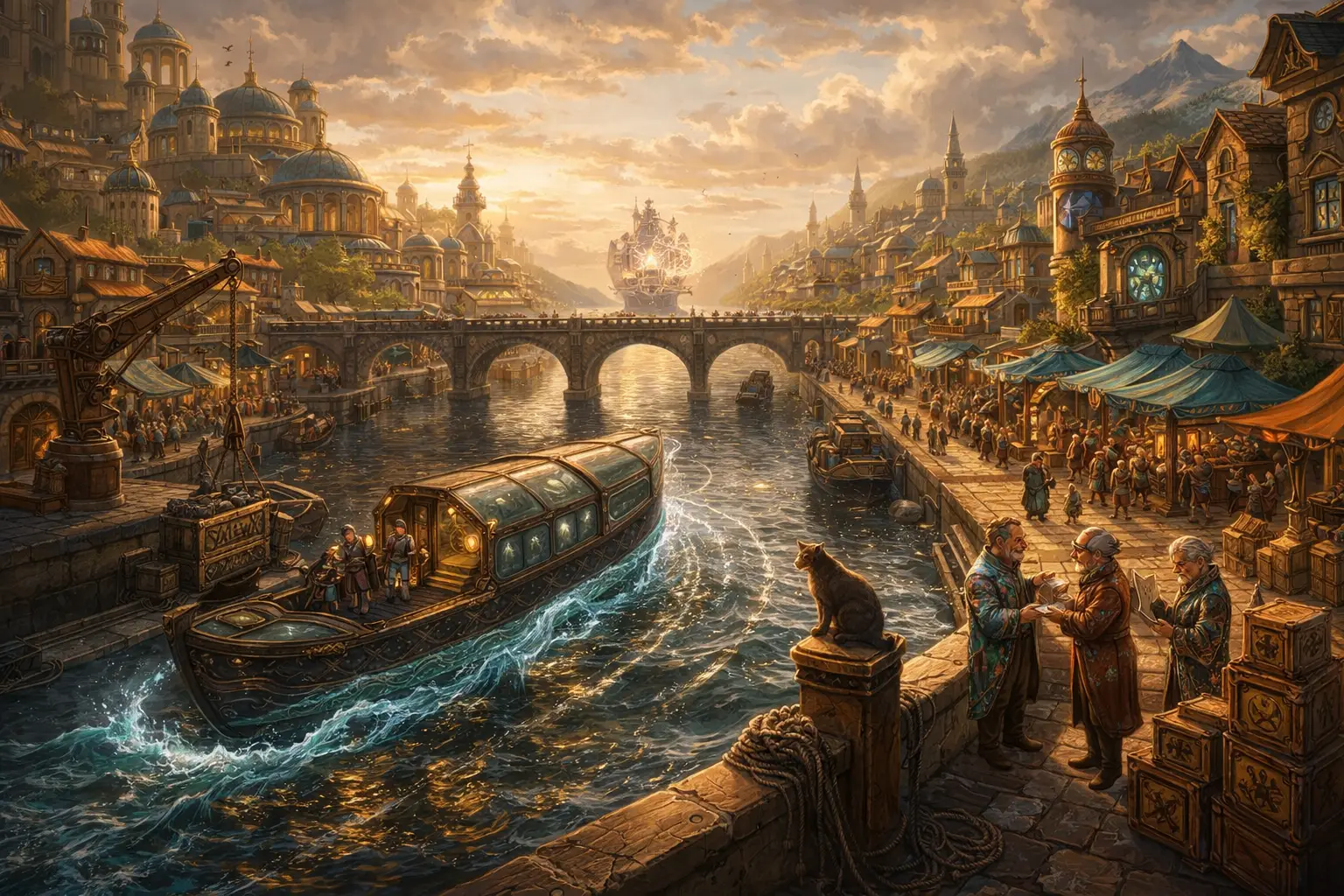
Military and Security of Zilargo
FROM THE PRIVATE CORRESPONDENCE OF BRIGADIER KELLAS IR'TARN, BRELISH SOUTHERN COMMAND, TO THE KING'S CITADEL — WROAT
Re: Assessment of Zil Military Capability
I will be blunt: Zilargo does not have a military in any sense we would recognize. No standing army. No general staff. No fortresses worth the name. If I were ordered to invade tomorrow, my scouts could reach Trolanport inside a week.
I would not, however, recommend the attempt.
Every road would be watched before we set foot on it. Every village we passed through would know our names, our numbers, and our supply schedule. Our speaking stones would carry false orders. Our water would taste slightly wrong. Our scouts would follow maps that led nowhere. And when we finally reached the capital, half my officers would have received private messages offering them better terms for switching sides — and at least two of them would be considering it.
The Zil do not fight wars. They make wars unnecessary — or, failing that, unwinnable.
Zilargo has no army. This fact confounds military strategists from the Five Nations, who are accustomed to measuring national security in battalions, fortresses, and floating citadels. The gnomes have never invested in the kind of conventional military power that defines Breland, Karrnath, or Aundair — and they have never needed to. Where Breland builds machines and Karrnath raises the dead, Zilargo survives by knowing everything, saying the right thing to the right person, and ensuring that its enemies destroy themselves before they reach the border.
This is not a metaphor. It is a national security doctrine, and it has worked for over a thousand years.
The Trust as Security Apparatus
The Trust is Zilargo's army, police force, intelligence service, and border patrol — all functions collapsed into a single institution that reports to the Triumvirate and operates with no external oversight. There is no city watch in Zilargo, no constabulary, no garrison of soldiers in chain mail standing at the gates. There is only the Trust, and the Trust is everywhere.
Domestically, the Trust functions as described in the Politics article — a surveillance network built on an estimated one-third of the population serving as informants, reinforced by divination magic and a culture that considers the exchange of information a patriotic duty. The escalation ladder runs from observation to whispered warning to fine to exile to assassination, with the overwhelming majority of cases resolved at the first or second step. The Trust does not like killing. It is simply very good at it, and everyone knows this, which is the point.
What distinguishes the Trust from other intelligence agencies is the seamlessness of its integration into civilian life. There is no visible security presence in Zil cities — no guards patrolling the streets, no checkpoints, no walls. The streets are clean and safe because the gnome sitting at the café across from you is quietly noting the six strangers who arrived on this morning's ship. The barmaid is memorizing your conversation. The child playing in the square noticed the knife under your cloak and told her mother, who passed a note at the temple. By the time a potential threat materializes, the Trust has already decided how to handle it — and the answer is almost never violence, because violence is loud, messy, and draws attention that the Zil would prefer to avoid.
The soldiers of Zilargo — such as they are — include rogues, bards, wizards, and artificers. Melee combat specialists are vanishingly rare. The Zil do not build warriors; they build spies, illusionists, alchemists, and people who can talk their way out of any problem and into any locked room.
"A gnome may be no match for Valenar blood rider in a fair fight. But the gnomes of Zilargo seldom fight fair." — common saying among Brelish military advisors
The Trust Abroad
Few outside Zilargo realize the extent to which the Trust operates beyond the nation's borders. The Zil maxim holds that five words can defeat a thousand swords — the trick is saying the right five words to the proper people — and the Trust's foreign operations are built on exactly this principle. Rather than projecting military force, the Trust projects information: gathering secrets from every nation in Khorvaire and deploying them at precisely the moments when they will have the most effect.
The Trust's preferred foreign method is indirect manipulation — revealing a piece of intelligence to destabilize a rival's plans, engineering the exposure of a scandal to derail an inconvenient policy, or simply ensuring that a friendly official receives the information they need to make a decision that happens to benefit Zilargo. Direct action — assassination, sabotage — is rarer abroad than at home, because the Trust lacks the dense informant network that makes domestic operations so reliable. But the capability exists, and the Trust maintains elite operatives in foreign cities who can act when indirect methods fail.
The Zilargo embassy in Sharn is the most significant Trust station outside the homeland. Almost every member of the staff has a secret secondary role, from the ambassador to the lowliest servant. The gnomes pay for Brelish services with gold, gemstones, ships, and intelligence, and throughout the Last War the information gathered by Zil spies was invaluable to the Brelish war effort. Today, Khorvaire is at peace — but the Trust intends to be prepared for the next war long before it occurs.
KORRANBERG CHRONICLE — opinion column, Eyre 998 YK
"THE INVISIBLE SHIELD"
By Tallian Talius Lyrris
A Karrnathi colleague asked me recently whether Zilargo was concerned about its lack of military strength. I told him we were terribly concerned, and that we hoped our friends in the Five Nations would continue to protect us from any threats, as they always had. He seemed satisfied by this answer.
I did not mention that we had protected ourselves from every threat for a thousand years before Galifar existed, and that we had done so without a single fortress, a single battalion, or a single floating citadel. Some conversations are more productive when they end with the other person feeling reassured.
Alchemical and Elemental Warfare
What Zilargo lacks in conventional military power, it compensates for in unconventional capability. During the Last War, the gnomes committed few troops to Breland's cause — but the alchemical and elemental weapons they supplied were devastatingly effective. Zil workshops produced incendiaries, corrosive compounds, elemental munitions, and experimental substances that gave Brelish forces a significant battlefield edge on multiple fronts. The nation's alchemists are capable of producing weapons of extraordinary lethality, and their expertise with poisons is widely regarded as the finest in Khorvaire — a reputation the Zil neither confirm nor deny.
The elemental binding industry also has military applications. Bound elementals power the airships and galleons that form the backbone of modern naval warfare, and the gnomes' monopoly on binding technology gives them leverage over every nation that depends on those vessels. A Zilargo that chose to withhold binding services — or worse, to sabotage existing bindings — could cripple the military logistics of half the continent. The Trust is aware of this leverage and guards it accordingly.
The Shimmerwood itself provides a degree of natural defense. The forest is dense with Thelanian manifest zones that produce disorienting effects on those unfamiliar with the terrain — shifting paths, illusory sounds, and the occasional wandering fey creature that may or may not be working for the Trust. During the Last War, Aundair launched a covert strike into the Shimmerwood targeting a facility producing alchemical weapons for Breland; the attacking force made it up the Glamerwind River but mistook the feyspire of Pylas Pyrial for their target, a navigational error that the Shimmerwood's nature may have encouraged.
The Darguun Border
Zilargo's most persistent conventional security concern is the Seawall Mountain frontier with Darguun. The Ghaal'dar goblinoid tribes raided Zil settlements for centuries before Haruuc Sharaat'kor united them and seized Cyran territory to found his nation, and the border remains a point of tension. The Marguul bugbears of the southern Seawall Mountains are particularly dangerous — infamous raiders who worship the Mockery and recognize no authority they cannot physically overpower.
The Treaty of Thronehold formalized the border, but the Trust does not treat the arrangement as permanent. Haruuc's grip on Darguun is personal rather than institutional, and the Trust operates on the assumption that his death could shatter the Ghaal'dar alliance and send raiding parties back across the mountains. The gnomes maintain their border security the same way they maintain everything else — through intelligence, preemption, and the careful cultivation of contacts within Darguun who can provide advance warning of trouble. If the border ever does collapse, the Zil response will not be an army marching south. It will be a series of very quiet conversations with the right Darguul warlords, followed by a series of very unfortunate accidents befalling the wrong ones.
"You don't invade Zilargo. You don't attack Zilargo. You don't threaten Zilargo. You visit Zilargo, you have a lovely time, you buy some excellent brandy, and you go home. And if you're very lucky, you never find out what would have happened if you'd tried anything else." — attributed to a retired Dark Lantern, name withheld