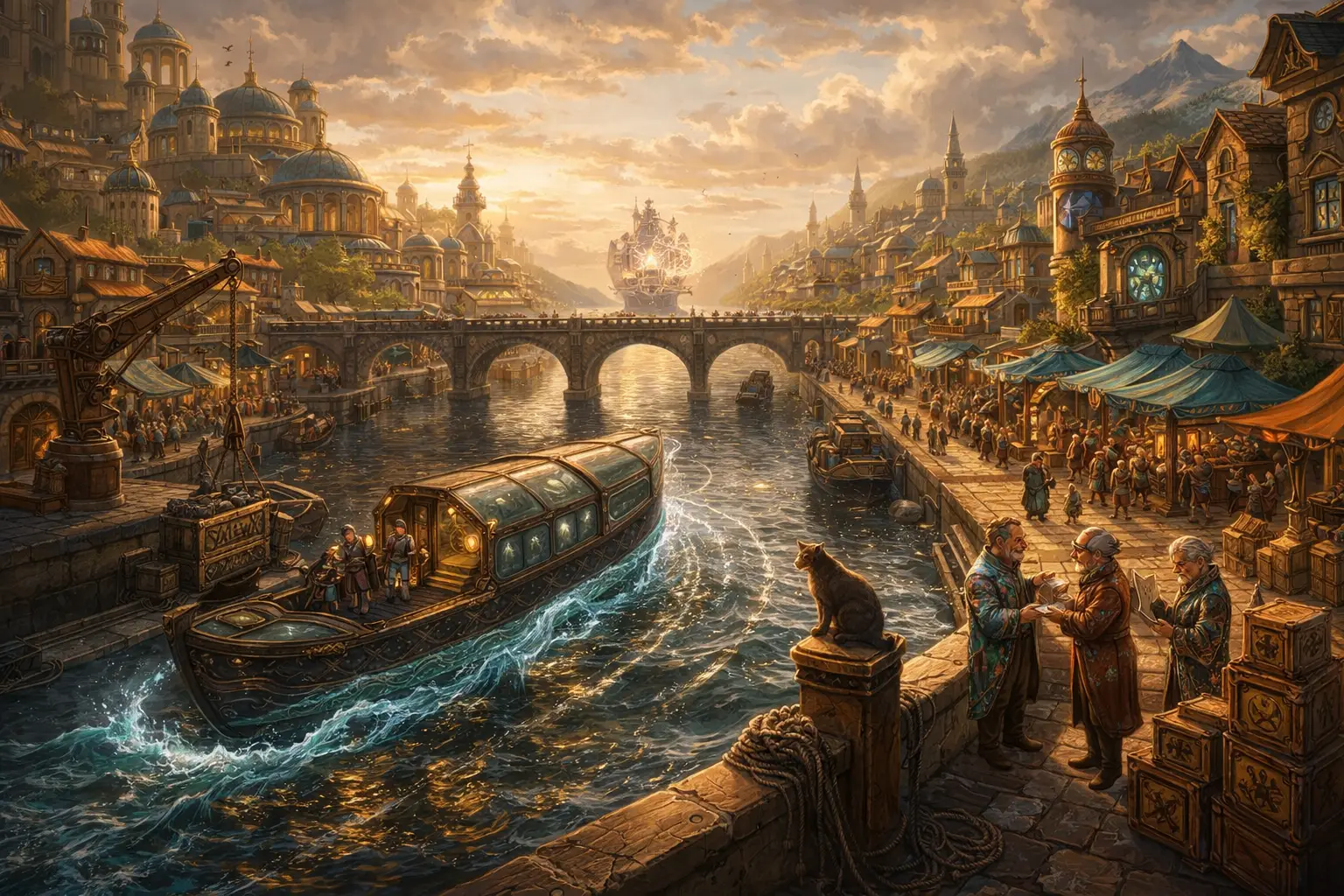
Economy & Industry of Zilargo
"You want to understand Zilargo's economy? Look at your hands. The ring on your finger was cut by a Zil gem-smith. The letter in your pocket was notarized by a Sivis scribe. The ship that brought you here has a bound elemental in its hull that a gnome trapped in a Khyber dragonshard. And the person who told you where to find the best price for all three? Also a gnome. The Zil don't need to own the world. They just need to be the ones you call when you want something done properly." — Kesslan Dravago, Brelish trade factor, Trolanport
The Economic Base
Zilargo punches far above its weight. A compact nation with a modest population, it nevertheless occupies a position of outsized economic influence in postwar Khorvaire — not because it produces in volume like Breland, but because it produces things that no one else can make and knows things that no one else has figured out. If Breland is the continent's factory floor, Zilargo is its workshop, its library, and its alchemist's bench.
The nation's economy rests on three pillars: elemental binding, alchemy, and gemstone extraction. Around these core industries orbits a constellation of supporting trades — shipbuilding in Trolanport, scholarship and publishing in Korranberg, arcane sound and entertainment in Thurimbar, and the vast information services provided by House Sivis. Zil trade goods flow outward to every corner of the continent, and Zil merchants pay for the raw materials they import — particularly Brelish ore and Mror metals — with gold, gemstones, finished ships, and the one currency that is uniquely their own: information.
There is very little crime in Zilargo's economy, at least in the conventional sense. The Trust ensures that fraud, theft, and contract violations are addressed long before they mature. But the space between legality and ethics is wide enough for any number of gnome houses to maneuver — and the intrigues that define Zil commercial life are as intricate and ruthless as anything in the markets of Sharn, conducted entirely within the law and entirely without mercy.
Elemental Binding
Zilargo's elemental binding industry is the crown jewel of the national economy, a closely guarded monopoly that gives the gnomes leverage over every nation and dragonmarked house in Khorvaire. The Zil developed their binding techniques by studying ancient Sul'at League devices recovered from Xen'drik expeditions — and they have never shared the full process with anyone.
Elemental binding is the art of trapping an elemental spirit within a Khyber dragonshard and channeling its energy through an arcane matrix embedded in a vessel or device. The process requires precision engineering, rare materials, and arcane expertise that takes years to master. The resulting devices are the backbone of Khorvaire's transportation network: elemental galleons use bound water or air elementals for propulsion, and the components for House Lyrandar's airships — the most prestigious vehicles in the world — rely on Zil binding work. Without Zilargo, the airships don't fly.
Six major gnome families control the binding industry, each maintaining proprietary techniques and competing fiercely for contracts. The Zil consider their binding secrets an essential national resource, and the Trust treats any attempt to smuggle binding knowledge out of the country as a matter of national security. The gnomes do not train outsiders in binding techniques willingly; a non-gnome who seeks to learn the craft will find doors closing at every turn, and the Trust watching with professional interest.
House Cannith has long coveted the binding monopoly and continues to invest in research aimed at replicating or superseding Zil techniques. The gnomes are acutely aware of this threat. If Cannith ever fully masters elemental binding, it would shatter one of Zilargo's most vital economic advantages — and the Zil have both sticks and carrots to prevent that outcome. They can threaten an embargo on binding components, offer better terms to keep Cannith cooperative, or deploy the Trust's other currency: embarrassing secrets about Cannith leadership, deployed at precisely the right moment to derail an inconvenient research program.
The growing Power of Purity movement — an alliance of Zil reformers, Lorghalan gnomes, and Ashbound druids who oppose the binding of sentient elementals on moral grounds — represents an internal challenge to the industry. The movement has grown bolder since the Treaty of Thronehold, and its adherents have conducted sabotage operations against binding workshops and elemental vessels. The Triumvirate has not taken an official position, but the Trust monitors the movement carefully.
NOTICE — posted at all Zil binding workshops
By order of the Triumvirate, access to elemental containment facilities is restricted to bonded guild members with current certification. Unauthorized presence in a binding chamber during active procedures is a violation of National Industrial Security Ordinance 12.3 and will be addressed accordingly.
(The Trust does not issue second notices.)
Alchemy
Zil alchemy is the second pillar of the national economy, and during the Last War it was arguably the first. The gnomes committed few troops to Breland's cause, but the alchemical and elemental weapons they supplied were devastatingly effective — compounds that could dissolve fortifications, incendiaries that burned with an intensity conventional water could not quench, and experimental substances that pushed the boundary between chemistry and magic. The Zil have always had an affinity for poisons, and their pharmaceutical and toxicological expertise is widely regarded as the finest in Khorvaire — a reputation that gnome merchants cultivate without ever quite confirming.
In peacetime, the alchemical industry has pivoted toward civilian applications: refined pharmaceuticals, industrial solvents, exotic dyes, preservation compounds, alchemical lighting, and the kind of specialty substances that arrive in small, expensive bottles with very specific instructions. Zil alchemists also supply components for the elemental binding process, creating a tight integration between the nation's two primary industries.
Zolanberg, in the Seawall Mountains, is the center of the alchemical trade, though workshops operate in all three major cities. The Library of Korranberg maintains extensive alchemical archives, and some of its college programs are dedicated to experimental alchemy — research that occasionally produces results the Triumvirate would prefer not to discuss publicly.
"A Zil alchemist can cure your headache, preserve your meat for a year, dissolve the lock on your rival's warehouse, and poison your wine — all with the same compound, depending on the dose. That's not a joke. I watched it happen." — Sergeant Haldan ir'Deln, Brelish 12th Logistics
Gemstones and Mining
The Seawall Mountains yield sapphires, rubies, emeralds, and a range of rarer stones, and Zil gem-cutting is widely regarded as the finest in Khorvaire. Zolanberg sits at the heart of this industry — the city's elevated position in the mountains is no accident, and a vast web of gem mines surrounds it. House Kundarak protects Zolanberg's gem inventory in a massive vault, and House Tharashk's Prospectors' Guild operates a significant dragonshard-prospecting operation in the region, recently expanding its facilities.
Gemstones serve as both an export commodity and a form of currency in Zil international trade. Where other nations pay for imports with galifars or letters of credit, the Zil frequently settle accounts with cut stones — a practice that gives their merchants an advantage, since the value of a gemstone is only as certain as the expertise of the person appraising it, and no one appraises gems better than the gnomes who cut them.
The mining industry also provides a significant share of the Khyber dragonshards essential for elemental binding. Securing a reliable supply of these deep-earth crystals is a constant concern; several Zil families are known to fund expeditions to Khyber itself, to Q'barra's dragonshard fields, and to the ruins of Xen'drik in search of new deposits.
Shipbuilding and Maritime Trade
Trolanport is the center of Zilargo's shipbuilding industry and the nation's primary trade nexus, with scores of vessels making port daily. The city's crisscrossing canals and partially flooded streets give it a waterborne character — much of the commerce is conducted from boats, and warehouses line the canal edges where goods are loaded and unloaded directly from the water.
Zil-built ships are prized throughout Khorvaire for their craftsmanship, and the nation's yards produce vessels ranging from small coastal traders to the elemental galleons that carry cargo across the Thunder Sea. The integration of the shipbuilding and elemental binding industries means that Trolanport's yards can produce a complete elemental vessel from keel to bound elemental under one roof — a capability no other nation can match.
Zilargo's maritime reach extends well beyond its own waters. Zil merchant vessels trade with Sharn, Stormreach, the Lhazaar Principalities, and ports along the southern Khorvairian coast. The gnomes have long been accomplished sailors, and their navigational expertise — enhanced by House Sivis communication and the natural Zil talent for gathering information about weather, currents, and port conditions — makes them formidable competitors in the shipping trade.
The House Network
No discussion of Zilargo's economy is complete without House Sivis, the dragonmarked house headquartered in Korranberg. Sivis carries the Mark of Scribing and provides the communication infrastructure that the entire continent depends on — speaking stones, message stations, notarization, translation, mediation, and legal advocacy. Over a dozen Sivis message stations operate in Sharn alone, and the house's network extends to every major city in Khorvaire.
Sivis maintains a scrupulous reputation for neutrality and confidentiality. Its services only function if clients trust that their communications will not be shared. How this squares with the house's Zil origins and the Trust's appetite for information is a question that every foreign diplomat has considered and none has been able to answer with certainty.
The other dragonmarked houses maintain significant presences in Zilargo. House Kundarak secures the nation's gemstone vaults and provides banking services. House Tharashk runs dragonshard prospecting operations in the Seawall Mountains. House Cannith maintains workshops — carefully watched by the Trust — and House Lyrandar depends on Zil binding work for its airship fleet. The relationship between the houses and the Triumvirate is managed with the same intricate balance of cooperation and leverage that characterizes all Zil dealings: the gnomes need the houses' services, the houses need the gnomes' products, and both sides know exactly how much the other can afford to lose.
The Breland-Zilargo Trade Axis
The alliance with Breland, formalized in 962 YK, is the single most important economic relationship in Zilargo's foreign trade. Zil artificers and engineers produce goods in Brelish factories; Brelish refineries sell ore to Zilargo; Zil alchemical products and bound elemental components flow northward while raw materials flow south. Zilargo pays for Brelish services with gold, gemstones, ships, and intelligence — a currency that Breland's Dark Lanterns value as highly as any metal.
The economic interdependence runs deep enough that neither nation can easily disentangle from the other. Breland needs Zil binding technology, alchemical supplies, and intelligence. Zilargo needs Brelish industrial capacity, raw materials, and military protection. The relationship is managed carefully on both sides — cooperation built on mutual necessity and lubricated by the understanding that each partner knows rather more about the other's secrets than either would prefer.
From the Trolanport Commercial Register, Olarune 998 YK: "Auction results — Lot 14: One (1) matched set of Fernian fire-rubies, clarity grade Superior, certified by the Zolanberg Gemcutters' Guild. Sold to a representative of House Lyrandar for 4,200 galifars. Lot 15: One (1) sealed crate, contents undisclosed, certified by the office of the Triumvirate. Sold to an anonymous bidder via Sivis intermediary for 11,600 galifars. The Register does not speculate on the contents of sealed lots. The Register does note that anonymous bidders have historically excellent taste."