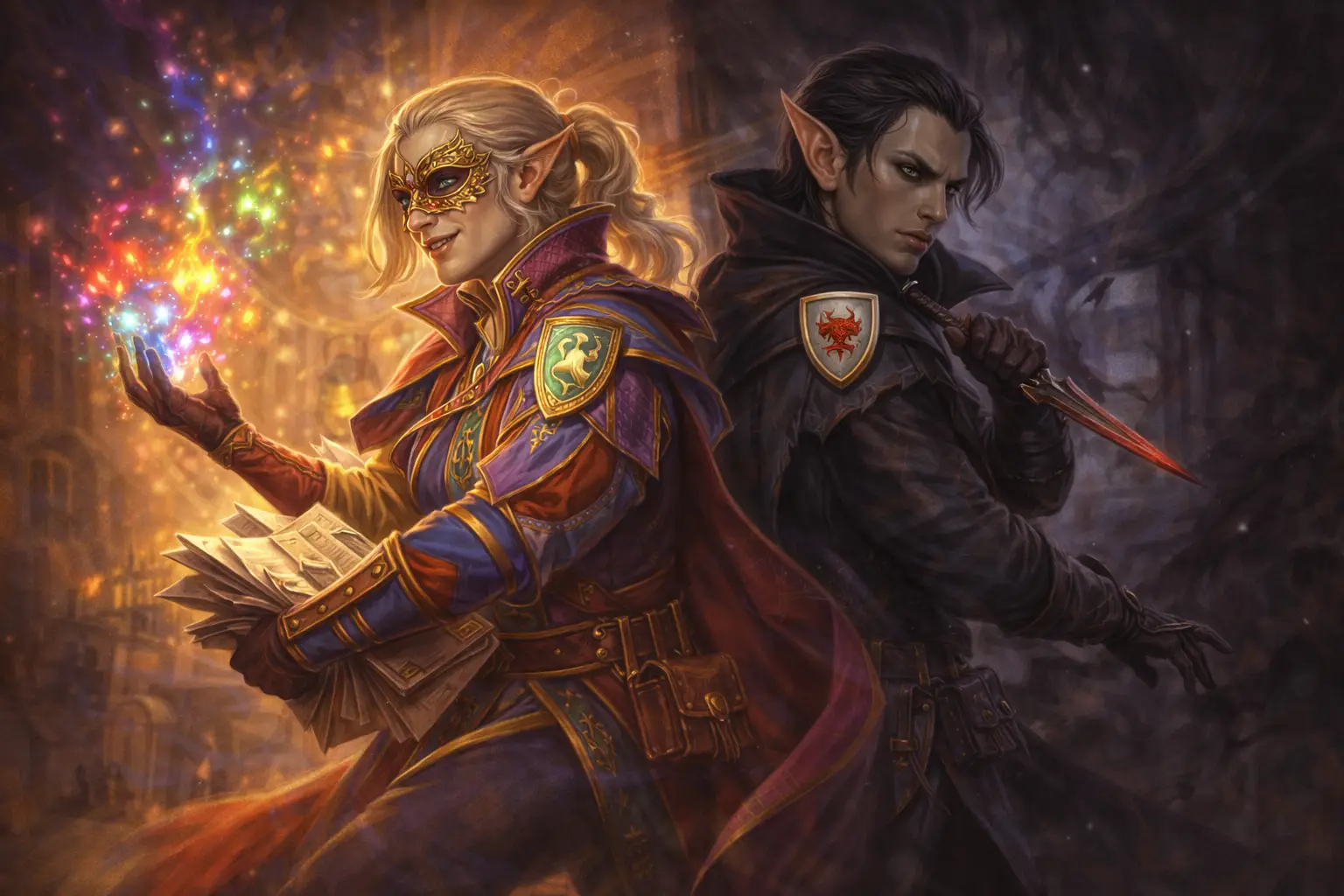
Houses Phiarlan & Thuranni
"If you attend the Tain Gala, Celyria will show you her latest acquisition — a Phiarlan hydra. The base of this wonder is a cube of black stone. A four-headed hydra is engraved on its top, and the mouth of each hydra is a spherical depression that can hold a polished globe of wood embedded with a tiny dragonshard. Each of these 'marbles' holds a performance by one of Phiarlan's finest musicians. But the hydra has a fifth head, sculpted from copper and wood, rising up from the base. When you activate the hydra, it draws out the sound of the performance held within one of the marbles and projects it through the sculpted head, as clear as if you were there. So come to the Tain gala, and hear the hydra sing!"
Mark: Shadow | Race: Elf | Symbols: The Hydra (Phiarlan), The Displacer Beast (Thuranni) | Leaders: Baron Elvinor Elorrenthi d'Phiarlan; Baron Elar d'Thuranni | Headquarters: The Demesne of Shadow, Sharn (Phiarlan); Regalport, Lhazaar Principalities (Thuranni) | Guilds: Entertainers and Artisans Guild; Serpentine Table (Phiarlan); Shadow Network (Thuranni)
To most of Khorvaire, House Phiarlan is the house of performers. Its Demesnes — scattered across the Five Nations — are the foremost centers of the arts in the known world, each devoted to a different tradition: the written word, movement arts, music, material arts, and the arts of illusion, puppetry, oratory, and acting. When you attend a professional Phiarlan theater, the stage has a shadow weaver — a podium that allows an operator with the Mark of Shadow to cast major image, creating images, sounds, even smells. A shadow orchestra can produce elaborate lighting, weather effects, fire, explosions, or monsters charging across the stage. In the finest Phiarlan theaters, an embedded focus item creates an effect similar to hallucinatory terrain within the building itself. The audience is not merely watching a play. They are inside it.
But beneath the stages and galleries runs an older and quieter operation. Known to few outside the nobility and merchant aristocracy, Phiarlan has always maintained an elite force of spies and intelligence operatives — the Serpentine Table. Only clients of sufficient standing ever learn these services exist. As a normal person on the street, you cannot simply walk into a Phiarlan enclave and hire a spy. You go there to see a show, to take a class, to hire a musician for your daughter's wedding. If the house decides you need its other services, it will reach out to you.
House Thuranni is the younger house, born from catastrophe. Where Phiarlan cultivates patience and the long view, Thuranni operates with sharper edges. Its public face remains entertainment — the Shadow Network controls performance spaces throughout Karrnath and maintains the True Shaper's Demesne in Atur — but its secret reputation rests on assassination, wetwork, and the discreet elimination of problems other houses decline to touch. Ultimately, Thuranni operates like organized crime. You may know they do bad things, but can you actually catch them doing them? And as the captain of the local city watch, do you really want to make a personal enemy of a family of professional assassins?
Baron Elvinor Elorrenthi d'Phiarlan leads Phiarlan from the Demesne of Shadow in Sharn. Baron Elar d'Thuranni rules from Regalport, always accompanied by a shadowy pair widely rumored to be embodiments of shadow itself. As a rule, Phiarlan elves make the better spies. Thuranni agents make the better assassins. The two houses maintain a surface peace, but the rivalries run deep and are not forgotten.
"Sometimes that deception eases your burdens, letting you forget your troubles for a moment. But I can also ease your burdens by ending your life." — Lady Elara d'Thuranni, shadow dancer
Origins & Lineage
The traditions of House Phiarlan are older than any human civilization.
In the Age of Giants, the word phiarlan was a job, not a family name. Roughly translated, it means "spirit keeper" — not spirit as in ghost, but morale, or hope. The phiarlans were traveling bards who moved across Xen'drik during the elf rebellion, evading giant patrols and serving as a bridge between scattered elf communities. They carried news and trade goods, but also stories and songs. They learned the artistic traditions of each subculture and shared them with others, seeking to strengthen bonds between peoples who had little else holding them together. They set the uprising in motion, coordinated actions across the continent, maintained the morale of the rebels, and resolved disputes that could have fractured the elf alliance. The iconic phiarlan was a true Bard, wielding arcane magic — using illusions to confound enemies and inspire allies. They also used those gifts to spy on the giants, slipping invisibly through Sul'at strongholds or blending in with Cul'sir laborers. The legendary Elorrenthi was so skilled in her craft that she earned the patronage of the titan Haskar, moving freely throughout the Group of Eleven while gathering intelligence from within its heart.
When the visionary Aeren foresaw the cataclysm coming to Xen'drik, five phiarlans answered the call to spread the word and guide as many elves as possible to a hidden harbor: Tialaen, Elorrenthi, Shol, Thuranni, and Paelion. Together with their families and followers, they coordinated the flight from the dying continent.
Once the elves reached Aerenal, the alliance scattered into factions — the Tairnadal in the north, the Line of Vol in the south, and the alliance that would produce the Undying Court at the center. The phiarlans chose not to claim territory. Instead, they continued their ancient work: traveling between communities, sharing news and stories, and trading secrets between faction leaders in the belief that transparency was the best tool against division.
The appearance of the Mark of Shadow had less dramatic impact in Aerenal than most dragonmarks had among the humans of Khorvaire. The phiarlans were already bards who wove illusions into their performances; the mark did not change the nature of their work so much as distribute its gifts more widely through the bloodline. Where a phiarlan might once have spent a century training to master illusion magic, now half of all heirs could cast without training. The mark was a remarkable accelerant, not a transformation.
What the marks brought was suspicion. The Undying Court viewed the Mark of Shadow — like the Vol line's Mark of Death — as an unsettling challenge to their self-conception as the pinnacle of elven achievement. It was the Paelions who discovered Vol's secret alliance with rogue dragons, breeding experiments designed to amplify the Mark of Death into something far more dangerous. When they revealed this to the Sibling Kings, it gave the Court the excuse they needed to act. The phiarlans tried to intervene and mediate, but the Undying Court and its Argonnessen allies would not be dissuaded. In the aftermath of Vol's destruction, the leaders of the five phiarlan families gathered around their Serpentine Table and made a collective decision: they could not remain in a homeland that feared their mark. They left Aerenal for Khorvaire.
A House in the Making
The Phiarlan exiles arrived first in Korranberg, where House Sivis welcomed them warmly. The gnomes were eager to study a new dragonmark and delighted by the entertainment. The two peoples shared a facility with illusion magic, and it was at this time that the house adopted the Thurimbar Rod. But the elves saw greater opportunity among the young human nations. They raised capital in Korranberg selling Aereni artifacts, then invested it to create a theater and academy in what would become Wroat — the precursor to the modern Demesne of Motion.
Their first great setback came in –2190 YK. Breggor Firstking of Wroat took offense at a Phiarlan dramatization of the siege of Shaarat and razed the first Demesne. The elves fled, but wherever they went they shared tales of Breggor's cruelty and revealed his secret shames. Within House Phiarlan, it is commonly accepted that the assassin Rol Paelion ended Breggor's reign personally — though the public play, The Beggar King, merely depicts a guilt-wracked king throwing himself from the tallest tower.
House Sivis helped Phiarlan regroup, drawing it into alliance with Cannith and Deneith. The Carnival of Shadows launched as a traveling show, carrying Phiarlan entertainment into every corner of Khorvaire. During the War of the Mark, Phiarlan played a minimal role in direct combat — but its wide web of performers served as an invaluable intelligence source. It was at this time that the house formally established the Serpentine Table as a dedicated corps of spies.
House Phiarlan worked closely with Galifar Wynarn during his campaign of unification. The Paelion and Thuranni families urged Galifar to use their heirs as assassins; Galifar refused, warning the house that if he ever discovered it had assassinated a head of state, he would do everything in his power to see Phiarlan destroyed. This edict has constrained the house ever since. Queen Hala ir'Wynarn later created the Citadel partly as a response to what she saw as Phiarlan's corrupting influence on the crown.
The Shadow Schism
The founding of House Thuranni is an event Phiarlan elders do not discuss openly and Thuranni does not apologize for.
The tension between the Paelion and Thuranni families predates the founding of House Phiarlan on Khorvaire. Thuranni had always maintained that the Paelions made a catastrophic error in exposing Vol's experiments to the Sibling Kings. The Paelions argued the opposite. Both lines specialized in assassination. Their coexistence within a single house was never comfortable.
The Last War exacerbated these tensions. With the house selling services to every nation simultaneously, leaders accused one another of playing favorites, feeding intelligence to preferred clients, and undermining the house's neutrality.
In 972 YK, Lord Elar Thuranni d'Phiarlan slew Lord Tolar Paelion d'Phiarlan and his family. Thuranni heirs across Khorvaire struck in a coordinated assault, murdering nearly a fifth of their own house. Elar claimed the Paelions had been preparing a strike of their own — planning to assassinate every monarch of the Five Nations and every leader of the dragonmarked houses, including their Phiarlan cousins. Baron Elvinor declared the entire Thuranni line excoriate. Elar defied the judgment, declared Thuranni a separate house, and a number of lesser Phiarlan families chose his side.
Elvinor considered war. The Lords Seneschal counseled against it — no one wished to start a war against the line that specialized in assassination. Elar subsequently presented secret evidence to the Twelve purporting to justify the massacre. That evidence has never been made public. It was enough to quell the Twelve's rage — though not Phiarlan's.
The schism divided territory as well as bloodlines. Phiarlan retained the west. Thuranni established its sphere in the east — Karrnath, Lhazaar, and the territories it had already controlled.
FROM THE SHARN INQUISITIVE, RHAAN 998 YK: "Twenty-six years after the Shadow Schism, relations between the houses remain cordial in the halls and glacial in the corridors. At the most recent Tain Gala, a Phiarlan cellist and a Thuranni vocalist shared a stage for the first time since the split. The audience wept. The performers did not look at each other."
The Mark of Shadow
The Mark of Shadow lets its bearer weave illusions and sculpt shadows, making it easy to avoid detection. At its most basic, the mark provides facility with disguise, minor illusion, and movement through darkness. At greater manifestations, bearers can produce extended invisibility, mislead observers with persistent illusory veils, or scry on distant locations. A rogue with the mark might describe their use of evasion as a cloak of shadow summoned through the dragonmark itself.
In a Phiarlan or Thuranni theater, the shadow weaver podium allows an operator to cast major image, creating anything from lighting effects to monsters on stage. Traveling companies of the Carnival of Shadows mount such focus items in wagons, allowing them to create an amazing set within minutes.
The mark's spells include disguise self, silent image, darkness, pass without trace, clairvoyance, major image, and at higher levels mislead and scrying. Phiarlan blood still runs among some Aereni elves, and the Mark of Shadow appears once or twice in each generation on Aerenal — those bearing it are invariably inducted into the Cairdal Blades, an espionage agency serving Aerenal's Sibling Kings.
Phiarlan's most recent commercial innovation is the crystal theater — a device using a small scrying crystal to project a live performance from one Demesne stage onto a distant screen. As the network expands, individual performers achieve continental reach.
Guild Operations
The Entertainers and Artisans Guild
The EAG trains and licenses musicians and artists across Khorvaire. Any quality tavern seeks a Phiarlan musician in residence, or at least one trained by the house. Most powerful nobles maintain a court musician who serves as both entertainer and — for those chosen few — a liaison to the Serpentine Table. House Ghallanda has arranged with both Phiarlan and Thuranni to employ guild-licensed entertainers at nearly every Gold Dragon Inn, giving the Serpentine Table a presence in communities far beyond the great cities.
Both houses have been accused of denying opportunities to changelings. In licensed companies, changelings are typically relegated to serving as understudies and stunt doubles for dragonmarked principals — though almost every company has at least one changeling actor, and they are extremely versatile. Changeling street performers in Tavick's Landing, while not as grand as the Carnival of Shadows, are remarkably capable.
The Serpentine Table (Phiarlan)
The Serpentine Table is an intelligence organization so well concealed that few people outside the house know it exists. Even many of its lower-level operatives are unaware of the full scope of their service — they collect and pass along information without understanding how it is used. The Demesnes are not merely performance spaces; they are intelligence hubs where nobles, diplomats, and patrons speak freely under what they believe to be neutral, apolitical roofs.
The Shadow Network (Thuranni)
House Thuranni does not separate its entertainment and espionage services the way Phiarlan does — all Thuranni agents at least dabble in covert work. The Shadow Network has grown to rival and in some domains eclipse the Serpentine Table. In espionage and undercover work, Thuranni agents have as good a reputation as their Phiarlan counterparts. In assassination, they have a distinct and dangerous edge. The Palace of Shadows in Atur hosts performances that push well beyond what is acceptable in refined Korth — graphic displays of the body in ecstasy and horror, leveraging Atur's necromantic traditions alongside the Mark of Shadow's capacity for illusion.
Political Relations
Both houses are bound by the Korth Edicts to formal neutrality. Both offered services to all sides during the Last War. In the wake of the war, many within both houses regard the Edicts as increasingly obsolete.
Phiarlan's relationships span the Five Nations. Its Demesnes bring it into contact with royal courts, noble houses, and merchant aristocracies across Breland, Aundair, Thrane, and beyond. Thuranni's strength lies in Karrnath and Lhazaar. Before the Schism, Karrnathi nobles relied heavily on the Serpentine Table; Thuranni's reach has never matched it in intelligence breadth. Regent Moranna's creation of the Dark Cabinet as Karrnath's national intelligence agency was partly a response to that limitation. Thuranni fills a different role — defined by lethality rather than subtlety.
In Karrnath, Thuranni assassins have effectively replaced the Order of the Emerald Claw as the crown's instrument for wetwork operations — alleged ties between the two organizations are apparently not a major concern of the Karrnathi throne.
Internal Politics
Phiarlan
The defining tension is how much should be acknowledged. Many senior members insist on the primacy of genuine artistic culture — the Demesnes are not merely cover, they argue, but the house's truest legacy. Those embedded in the Serpentine Table regard this as dangerously naive.
One question hangs over Phiarlan with particular weight. When the Day of Mourning consumed Cyre in 994 YK, every high-ranking member of House Phiarlan happened to be outside the nation. The house's headquarters had been in Cyre. Its principal Demesne survived intact. Whether this reflects foreknowledge or extraordinary coincidence, Phiarlan has never offered an explanation.
Thuranni
Baron Elar runs the house with a focus on operational loyalty and efficiency. The question of what his secret evidence actually contained — the evidence that justified the Shadow Schism to the Twelve — remains the house's deepest unresolved mystery.
Notable Holdings
House Phiarlan: The Demesne of Shadow in Sharn (seat of the house); additional Demesnes across Breland, Aundair, and Thrane devoted to written arts, movement, music, and material arts. The replacement Demesne of Shape in Thaliost — a deliberately provocative placement in deeply contested occupied territory. Hidden archives, illusion laboratories, and encrypted communication networks. The legendary Tyasha d'Phiarlan — an elven actress of over five hundred years whose performances at Sharn's Grand Stage command sold-out crowds — travels to performances by shadow walk and has been the subject of rumors for centuries. Some claim she died long ago and a changeling has taken her place; others that she is a vampire. The house maintains the legend carefully.
House Thuranni: Headquarters in Regalport. The True Shaper's Demesne and Palace of Shadows in Atur. Safehouses and staging points across Karrnath, Droaam, and Q'barra