Art & Culture of Aundair
"In Karrnath they toast their dead. In Breland they toast the common man. In Aundair we toast whatever we've done recently that was brilliant, and we expect there will be something new to toast by morning." — overheard at the Sapphire Flask, Fairhaven, 997 YK
The Standard
An apprentice at Arcanix once transformed a marble pillar into living wood over the course of an hour, then into flowing water, then back into stone — all without spilling a drop. The audience gave a standing ovation. The faculty panel gave her a passing mark and observed that the pacing was "slightly uneven in the third phase."
This is the thing to understand about Aundair. The standing ovation and the passing mark are not contradictory. They are complementary. The audience recognizes excellence. The faculty demands perfection. In Aundair, these are different things, and the gap between them is where the culture lives — in the restless, competitive, slightly exhausting conviction that everything you do should be done beautifully, and that beautiful is not the same as good enough. A Karrnathi soldier fights well or dies. A Brelish spy gets the job done. An Aundairian does both and makes it look effortless, because the appearance of effort is itself a failure of style.
The result is a nation where farms have clean lines and considered roof pitches, where even a barn will be noticed if it is not well-proportioned, where a village marketplace sharpens grace through rivalry as surely as any tower in Fairhaven. Aundairians value wit over strength, finesse over brute force, and the capacity to hold your ground in an argument over the capacity to throw a punch. They have been this way for so long that they genuinely do not notice how tiring other nations find it. They also, with great elegance and evident sincerity, will tell you that their people possess a dignity and decency beyond their neighbors. The elegance is real. The sincerity is real. The dignity is real. The fact that all of it is also a performance is the part they don't mention — not because they are dishonest, but because in Aundair, performing something well enough is being it.
"Regardless of your actual intelligence, as an Aundairian you're sure you're the smartest person in the room." — advice offered to travelers, origin uncertain
Magic as Art, Art as Magic
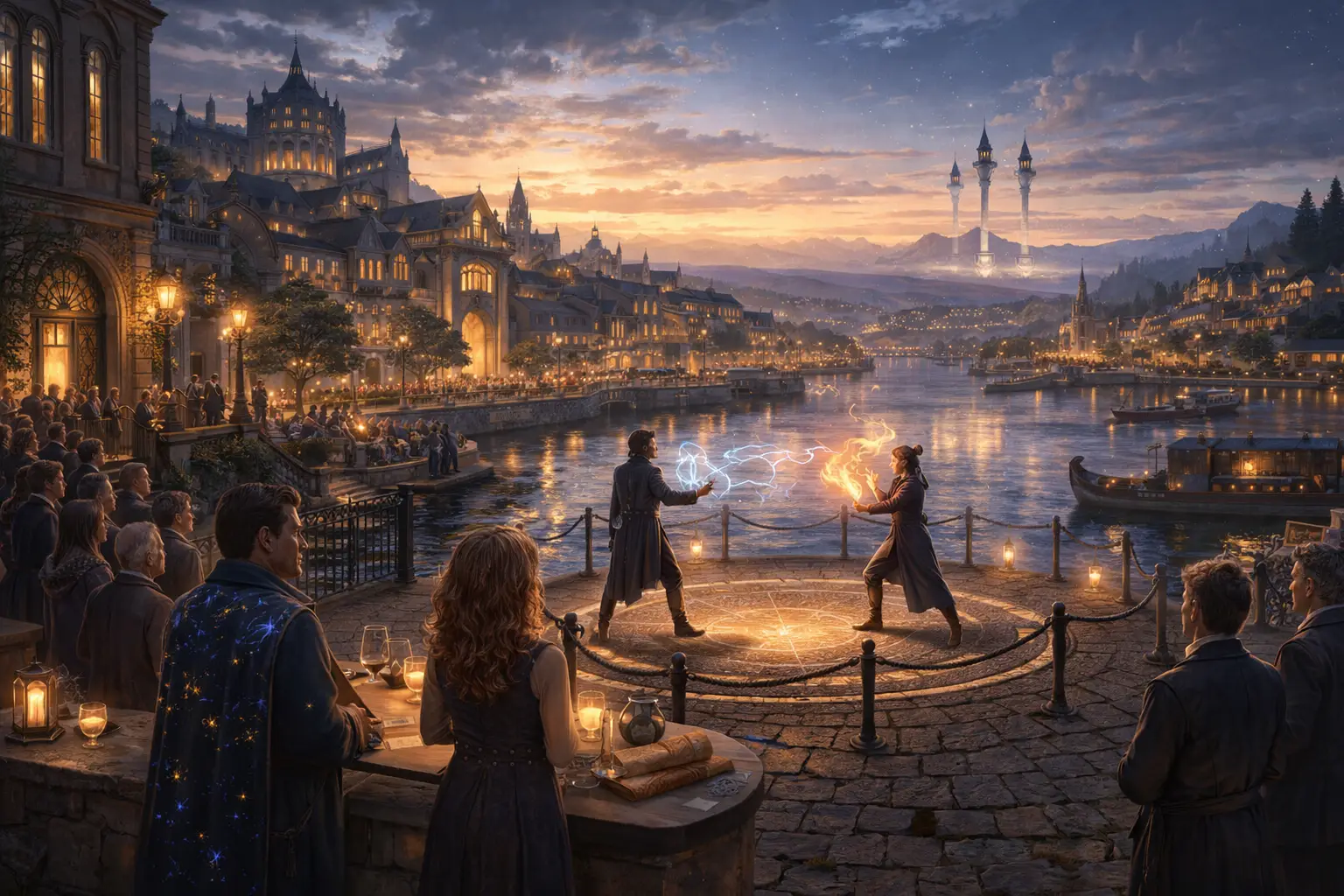
Spell dueling is Aundair's prestige art form the way theater is Breland's — the public spectacle where talent becomes reputation, where social standing is won or lost, and where a career can be made in a single evening. A formal duel is not a brawl. It is an expression of style and theory: control, precision, and elegance matter as much as raw power, and to "craft ugly magic" is a serious insult. High duels draw audiences, attract betting, and generate the reputational currency that shapes noble careers. Victory proves competence. How you win proves character.
The culture of competitive display extends well beyond pure spellcasting. The Passage Pistol — a hand crossbow developed for non-magical duelists — has become iconic of Aundairian martial culture, carried by officers and nobles who appreciate its elegance and its message: even without magic, I can still put you down with style. Among wizard circles, the preferred melee art is chain dancing — a flail technique built on dramatic flourishes, trips, and disarms, designed for showing off and embarrassing an opponent in equal measure. A chain dancer might conjure mage armor rather than wear a breastplate, carry three short rods as arcane foci in her belt, and draw faster than a Karrnathi knight can pull steel. The point is not merely to be armed. The point is to be interesting while armed.
New spell creation is a recognized form of cultural prestige, and the academic rivalry between the University of Wynarn in Fairhaven and the floating towers of Arcanix generates a genre of public rebuttals that blurs the line between intellectual dispute and theatrical performance. Arcanix is the most prestigious academy of magic in Khorvaire — most of its sages specialize in ritual magic and abstract theory, and don't have the full powers of battle mages, but they produce research that shapes the arcane science of the entire continent. The University of Wynarn draws students from across Khorvaire for a broader education, and the rivalry between the two institutions is the engine that drives Aundairian intellectual life, producing scholars who are brilliant, competitive, and constitutionally incapable of letting a colleague have the last word.
In the streets of Fairhaven, the magical culture filters into daily life in ways that visitors from other nations find both beautiful and slightly unnerving. Illusion-enhanced murals shift and move on civic buildings. Animated sculptures pose and gesture in noble estates. Street performers weave minor illusions depicting war heroes and famous duels. Dream parlors offer entirely illusory entertainment — experiences crafted from nothing but magic, consumed like a meal and remembered like a dream. The city's magical illumination is unmatched outside the capital, and even the theater productions use cantrips for sound and lighting as a baseline, with grander shows incorporating full illusions. Fairhaven does not merely display magic. Fairhaven is magic, worn casually, the way other cities wear stone.
KORRANBERG CHRONICLE — Rhaan 997 YK
"The Autumn Exhibitions at Arcanix featured a transmutation piece by Apprentice Velara ir'Ceroux that changed the molecular structure of a marble pillar over the course of an hour, reverting it to living wood and then to flowing water before returning it to stone — all without spilling a drop. The audience gave a standing ovation. The faculty panel gave her a passing mark and observed that the pacing was 'slightly uneven in the third phase.' This is Aundair in miniature: excellence applauded, perfection expected."
Dressed for the Duel
Fashion in Aundair conveys education, arcane affiliation, and intent — and an Aundairian who dresses carelessly is making a statement as loud as one who dresses well, because in a culture where presentation is mastery, the absence of effort is the presence of an insult.
Nobles favor tailored coats with arcane accessories — sigil rings keyed to arcane traditions, reactive cloaks that shift color or texture in response to the wearer's spellwork, enchanted embroidery indicating academic rank or institutional affiliation. Glamerweave is produced by Aundairian mage-tailors and widely considered the finest outside Zil gnome production: a court mage's cloak might display shifting constellations, a noble's gown might bloom with slowly opening flowers, and the illusions respond to movement with a fluidity that lesser producers cannot match.
Shiftweave — clothing that allows the wearer to shift between up to five embedded outfits with a command word — is increasingly popular, originally created by the changeling Children of Jes and now produced extensively in Aundair. A traveler with a single shiftweave coat can dress for court in the morning, fieldwork at noon, and a formal duel in the evening without changing garments. The practicality appeals to the Aundairian instinct that effort should be invisible.
Cosmetic transmutation is a growing specialty of Aundairian magewright beauticians. Changing hair or eye color to a natural shade runs about ten gold for a week's duration, with monthly and permanent options available at higher cost. Metallic hair colors are a recent Fairhaven fad. In the days before Galifar, the nobles of Thaliost adopted elf features as fashion statements — a practice that has seen a modest revival in certain circles. More exotic transformations — altering weight, height, or apparent species — are available from increasingly skilled practitioners, though duplicating another person's appearance crosses from fashion into the crime of malicious identity theft under the Code of Galifar.
The Fey in the Walls
Some Aundairian noble lines hold arcane pacts with Archfey patrons spanning generations — contracts passed from parent to child alongside the estate and the silverware. Only remarkable heirs develop into full warlocks, but the fey influence runs through Aundairian culture like a thread through cloth, visible in the love of illusion, the instinct for cleverness over force, and the patterns of folklore that emerge near manifest zones tied to Thelanis.
Rural communities near the old manifest zones maintain traditions — seasonal observances, folk stories, craft patterns featuring masked figures and moonlit forests and "guests from elsewhere" — that operate independently of formal academic culture and predate it by centuries. The boundary between craft tradition and fey influence is permeable, if rarely acknowledged in polite company. Wildnight (18–19 Sypheros) sees the cities give way to revelry, but those near Thelanian zones treat the night with more care: symbolic gifts left at crossroads, watchnight fires, rituals for which no one can quite name the origin.
The western communities that remain in Aundair — the farmlands nearest the Eldeen border — retain a character distinct from Fairhaven's towers, grounded in land and custom and a complicated relationship with both the crown that neglected them and the druidic world that took their neighbors away. The Whiteroof half-elves of Scions Sound preserve their own traditions entirely — river trade, private commerce, principled independence from noble culture and the formal arcane world. They are Aundairian by geography and temperament, and they would like to be left alone about it.
The Calendar of Brilliance
Aureon's Crown (26 Dravago) is Aundair's most significant annual occasion — a celebration of knowledge marked by evening feasts, public lectures by priests of Aureon, graduation ceremonies at Wynarn, and spell exhibitions at Arcanix that draw visitors from across Khorvaire. Spell duels on Aureon's Crown carry additional prestige; victory is noted in noble genealogies, and the winning duelists become celebrities for the season. The day belongs to Aureon, but the night belongs to the students, and the celebrations that follow the formal ceremonies are legendary for their enthusiasm and their casualties.
Sun's Blessing (15 Therendor) is observed as a day of reconciliation — rivals set aside disputes, courts suspend proceedings. In Aundair, the holiday carries a particular edge: the reconciliation is enthusiastically practiced among fellow Aundairians and conspicuously withheld from Thranes, who seized Thaliost during the Last War and hold it still. The annual Sun's Blessing toast in Fairhaven is, by tradition, "To peace — when we are ready for it," which tells you everything about where Aundair stands on the subject.
At the Table
Wine and cheese. That is the short answer. The vineyards of Bluevine produce wines exported at premium prices, and regional vintages are subjects of genuine connoisseurship — an Aundairian who cannot discuss the difference between a Bluevine white and a northern red with at least passable confidence has failed a basic social test. Aundairian cheeses vary by region and command respect across Khorvaire; the nation produces more varieties than any traveler could sample in a single visit, and the arguments about which is superior have outlasted the Last War and show no sign of concluding.
Aundairian cooking favors delicacy and presentation — the national instinct is always toward refinement, and an Aundairian chef perfects what already works and then perfects it again. Magewright chefs use culinary transmutation to heat, chill, and flavor food with arcane precision. Baked goods are a particular strength: the delicate pastries that Cyran cuisine adopted and made famous originated in Aundairian kitchens, and the Aundairians would like credit for that, thank you very much.
The meal is not merely nourishment. It is, like everything else in Aundair, a performance — and a competitive one. The host who serves a meal that fails to impress has failed publicly, and the guest who cannot appreciate what has been served has revealed themselves to be, in the most devastating Aundairian assessment, ordinary.
"An Aundairian will forgive you for being wrong. An Aundairian will forgive you for being rude. An Aundairian will never forgive you for being boring." — common saying in Fairhaven