Aundair
Capital: Fairhaven | Ruler: Queen Aurala ir'Wynarn | Government: Hereditary monarchy | Hallmarks: Cheese, education, fashion, grains, wine, arcane magic
"Every Aundairian I've ever met was absolutely certain they were the smartest person in the room. What troubles me is how often they were right." — attributed to a Brelish trade envoy, Passage, 997 YK
Of the Five Nations that survived the Last War, Aundair is the smallest and the most magical — and the one most certain that these two facts are not in tension. If Breland is the nation of spies and factories and Cyre the nation of artists and survivors, Aundair is the nation of wizards, vintners, and people who believe that any problem, from a Thrane siege to a disappointing cheese course, can be solved by applying superior intellect. It occupies the northwestern interior of Khorvaire, bordered by Karrnath to the east, the Eldeen Reaches to the west, Karrnath across the Bitter Sea to the northeast, and Thrane to the south — fertile farmlands between the great lakes and what was once the Towering Wood, crowned by the floating towers of Arcanix and lit by the arcane radiance of Fairhaven.
Governed from Fairhaven under a hereditary monarchy that holds closely to the old traditions of Galifar, Aundair has no parliament, no elected assembly, and no serious institutional check on royal authority beyond the political weight of the noble houses and the quiet leverage of the Arcane Congress. Magic permeates daily life here more deeply than anywhere else in Khorvaire — animated equipment works the fields, cleansing stones scrub village squares, everbright lanterns burn on even the most modest inn — and the nation produces more magewrights and wandslingers than any other country on the continent. This concentration of trained arcane labor is both an export commodity and the engine that keeps Aundair punching above its weight in every domain from agriculture to warfare.
The Aundairian Spirit
The national character runs on ambition, competition, and a bone-deep conviction that Aundairians are not merely cultured but properly cultured — a distinction they draw with surgical precision and very little modesty. Those who grow up in the countryside with many brothers and sisters learn from an early age to stand their ground; anyone who has worked an afternoon in a trading village's marketplace knows how much of Aundair's grace is sharpened by rivalry. Aundairians prefer finesse to brute force and appreciate cunning wordplay and fine fashions. Excellence is admired. Mediocrity is rarely excused. Even the farmers pressing cheese in the western counties carry themselves with a certain pointed dignity, as though excellence in any trade reflects on the whole kingdom.
Aundairians have long embraced noblesse oblige and chivalry as genuine ideals — tendencies attributed in part to the influence of Thelanis on the national temperament, though the cause is uncertain. Most citizens believe their nobility is noble in the full sense of the word, that their leaders will act in the country's best interest. This idealism does not extend to foreign nobles. Aundairians have long believed their people, both noble and common, possess a dignity and decency beyond their neighbors, and they will tell you so with great elegance and evident sincerity. The dark side is a certain insularity — a tendency to underestimate foreign ideas and dismiss perspectives that were not forged in the floating towers of Arcanix or the salons of Fairhaven. Aundairians are generous hosts and charming conversationalists right up to the moment they discover you disagree with them about something they consider settled.
"Aundair dares!" — national motto, found on regimental standards, university crests, and the occasional soldier tattoo
Crown and Congress
Queen Aurala ir'Wynarn assumed the throne in 980 YK, midway through the Last War, and has governed through the war's final years, the Mourning, the Treaty of Thronehold, and the tense postwar period with a consistency of purpose that even her detractors acknowledge. She commands the military, appoints officials to crown offices, and shapes diplomatic policy directly. The Wynarn bloodline carries the historical weight of Aureon's blessing — the foundational principle that Galifar I was guided by the god of law and knowledge and that his heirs inherit that mandate. Aurala holds that inheritance deliberately, positioning Aundair as the rightful cultural and political successor to the united kingdom. She genuinely believes she can still reunite the continent through a just war, and she has not relinquished that goal. Her critics view her patience as excessive caution; her supporters see it as discipline in service of a larger aim.
Noble ranks follow the standard Galifar structure — archdukes, dukes, counts, viscounts, and crown reeves — and accomplished arcane spellcasters carry magical titles alongside their landed rank: Alara ir'Lain, Countess of Askelios, Diviner of the Third Circle. Some noble lines hold arcane pacts with Archfey patrons that have persisted across generations; only the most remarkable heirs develop into true warlocks, but the pacts themselves are a source of considerable family prestige. Offices such as Warlord of the Realm are held at the queen's discretion — Darro ir'Lain, Duke of Passage, currently holds the title of Second Warlord of the Realm alongside his landed rank, but the warlord's office can be stripped at any time without touching his ducal position.
The Arcane Congress at Arcanix — Khorvaire's finest school of magic, established by Galifar I in 15 YK — advises the queen on all things arcane and wields enormous informal influence in any domain where magic and governance intersect, which in Aundair is nearly every domain. It is technically subordinate to the crown but functions as a quiet political force in its own right. During the Last War the Congress served as Aundair's military research arm, developing the war staff, the battle rod, and the wandslinger doctrine that transformed Aundairian military power. Under Aurala's Arcane Initiative, it continues to drive investment in both battle magic and civilian magical infrastructure — subsidized magewright training, practical enchantments for agriculture and industry, and weapons research whose specifics are not publicly disclosed.
The Royal Eyes of Aundair are the crown's intelligence service — originally established by the Princess Aundair herself at the dawn of Galifar as her personal corps of spies. Nearly every agent carries an arcane advantage, with particular expertise in divination magic. Where Breland's Dark Lanterns field rogues and Karrnath deploys warriors, the Royal Eyes are proper wizards. They operate across Khorvaire on wand-and-dagger missions as part of the postwar Shadow War between national intelligence services, and they are very good at what they do.
Aurala's marriage to Sasik of House Vadalis — who formally severed his claims to the Vadalis fortune as required by the Korth Edicts — has created persistent tension with the dragonmarked houses, who worry about informal Vadalis influence through the royal consort. The granting of Stormhome to House Lyrandar, a clear stretch of the same Edicts, compounds that anxiety. Every other house has noted both arrangements. Nobody, at present, has the political will to challenge either.
NOTICE TO ALL CITIZENS OF THE CROWN — Nymm, 998 YK
The Arcane Initiative Expansion Act extends subsidized magewright training to qualified residents of all districts. Applications shall be filed with the Office of the Second Warlord. Candidates demonstrating aptitude at the cantrip level or above shall receive preferential consideration. Excellence is the expectation; excellence shall be the result.
— public notice posted in Fairhaven and Passage
Faith and Culture
The Sovereign Host is the dominant faith, with particular devotion to Aureon, god of law and knowledge. The Church of the Silver Flame maintains a devoted and sometimes overzealous following — the most zealous Flame worshippers in all of Khorvaire may well be Aundairian, a legacy of the church saving the nation from lycanthropic devastation during the Silver Crusade of 830–882 YK. The extremist Pure Flame sect, which prefers punishment to mercy and rejects the faith's core principle of compassion, has its deepest roots here and its most visible presence in the occupied city of Thaliost. Faith is present throughout Aundairian public life, but unlike in Thrane, it is not trusted with governing authority.
Fashion matters here more than in any other nation. Glamorweave — clothing imbued with illusion magic — is produced by Aundairian mage-tailors and widely considered the finest outside Zil gnome production. A court mage might wear a cloak lined with shifting constellations; a noble's gown might display slowly blooming flowers. Cosmetic transmutation is a growing industry in Fairhaven — metallic hair colors are a recent fad, and more exotic transformations are available for those with the gold to pay. Even everyday dress is expected to show thought. A Fairhaven duelist might conjure mage armor rather than wear a breastplate, on the grounds that metal is for people who can't solve problems with their minds.
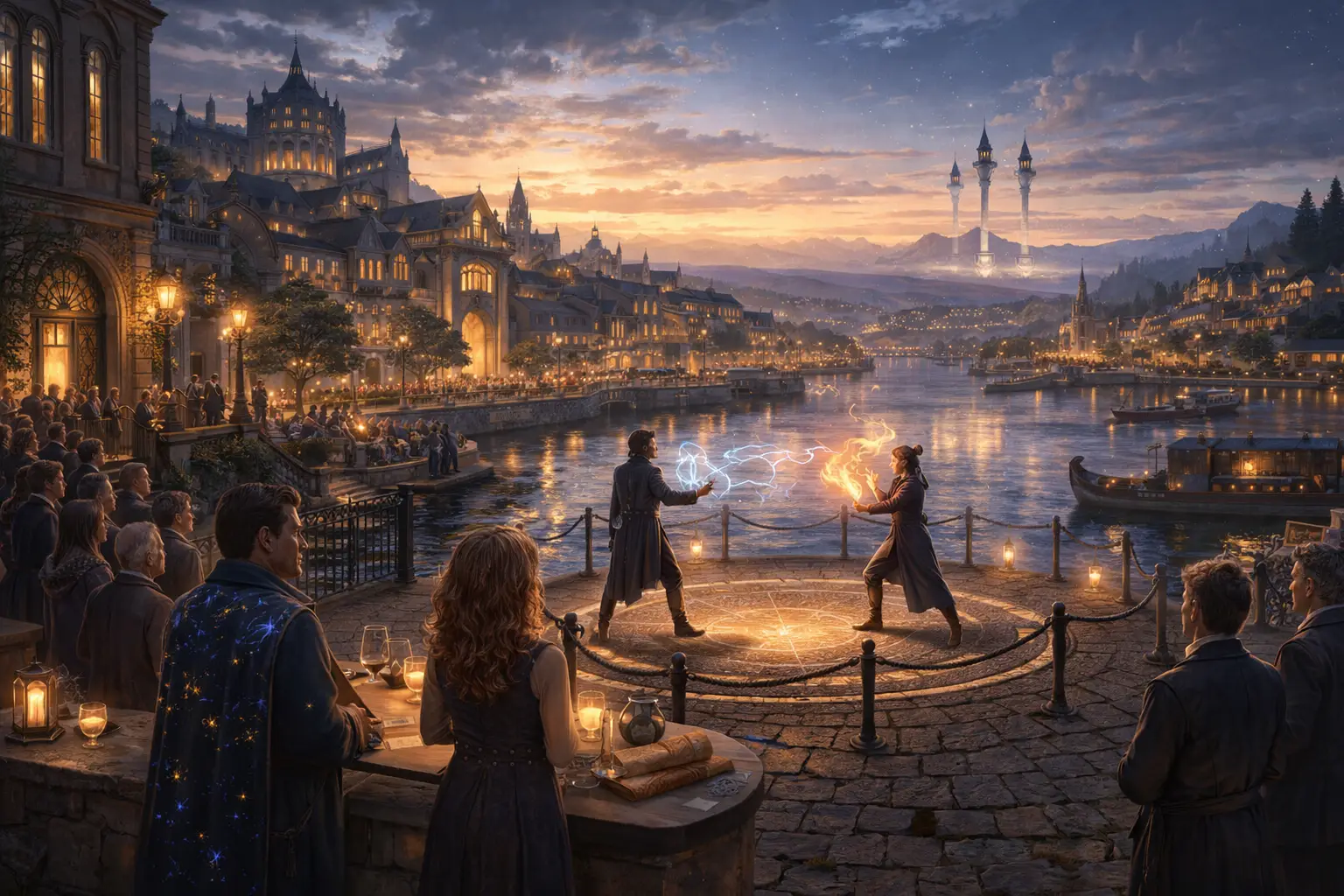
Spell dueling functions in Aundair the way theater does in Breland — the prestige art form, the public spectacle, the domain where talent translates directly into social standing. High duels draw audiences, attract betting, and make or break noble reputations. To "craft ugly magic" is a serious insult. The Passage Pistol — a hand crossbow developed for non-magical duelists — is still associated with the city and with Aundairian dueling culture broadly.
The food is refined: delicate pastries, fine cheeses that vary by region, and wines from the Bluevine vineyards exported at premium prices across the continent. Cyran cuisine before the Mourning explicitly drew on Aundairian baking, characterizing it as the source of their "delicate pastries" — a compliment that captures the national standard. Aureon's Crown (26 Dravago) is the kingdom's most significant annual occasion, a celebration of knowledge marked by graduation ceremonies at Wynarn and public spell exhibitions at Arcanix that draw visitors from across Khorvaire.
The Shape of the Nation
Fairhaven, the capital, is one of the most beautiful cities in Eberron — the City of Lights, where stunning displays of magical illumination enhance exquisite architecture and the University of Wynarn draws students from across Khorvaire. Nobles, entertainers, sages, and ambitious students from a dozen nations crowd its coffeehouses and salons. The archduke of Fairhaven holds permanent authority over the city, frozen in place when the Last War ended the old rotational system of Galifar's administration.
Arcanix is a modest farming village on Lake Galifar whose identity is entirely defined by the floating towers of the Arcane Congress rising above it. The village provides food for the towers; the towers provide Aundair its arcane edge. Apprentices from across Khorvaire come to study here — if you are a wizard, sage, or artificer, you may well have learned your craft in these towers.
Passage sits on the shores of Lake Galifar and serves as the operational heart of House Orien, housing the lightning rail's production and maintenance facilities at Journey's Home. Baron Kwanti d'Orien spends most of his time traveling western Khorvaire in his personal coach — the Silver Unicorn — raising funds to rebuild the rail across the Mournland. The Whiteroof half-elves of Scions Sound and the upper rivers maintain their own communities nearby, preserving old habits of river trade, smuggling, and private commerce that sit uneasily between the formal economy and the shadow one. The Cyran ambassador and her household currently reside in the House Cannith enclave in Passage — a diplomatic arrangement that says a great deal about how Aundair manages ambiguous situations.
Stormhome, an island city, is the seat of House Lyrandar. Lyrandar wizards continuously alter its weather, turning an otherwise bleak, storm-blasted location into the finest resort in Khorvaire. Beneath the resort veneer, spies, charlatans, sailors, and house agents all find a place here, and the island's isolation makes it ideal for conversations that cannot take place on the mainland.
The Starpeaks Observatory, commissioned in 512 YK, is now used by the Arcane Congress to study the moons, stars, and planar conjunctions from its remote mountain perch. And the Crying Fields along the Thrane border — farmlands permanently scarred by battlefield magic and haunted by restless spirits — are a visible, daily reminder that the war's costs have not been paid.
Postwar Pressures
Two unresolved territorial losses define Aundair's postwar political climate, and together they make Aundair the Five Nation that arguably carries the worst wounds from the Last War. Thaliost — an ancient Aundairian city of deep historical significance, the city that gave its name to the entire region before Galifar — was seized by Thrane during the war and remains under occupation. Archbishop Solgar Dariznu, himself Aundairian and the foremost leader of the Pure Flame, governs the city with a brutal hand. Most Aundairians have not accepted the Treaty's ratification of the occupation, and pressure on Aurala to act grows every year. A movement within Thaliost now openly discusses marching on Flamekeep to "liberate the Keeper" — though the Pure Flame lacks the resources to attempt it.
The Eldeen Reaches seceded in 958 YK after decades of noble neglect. The western farmers joined the druids of the Towering Wood when the crown failed to protect them, and the Treaty recognized the Reaches as sovereign. Most Aundairians call it treason. The Reachers call it survival. Noble families who lost western estates have never stopped demanding the crown do something about it. Karrnath, which supplied arms during the secession and profits from Eldeen grain trade, watches any reconquest talk with keen interest.
A third faction at court supports Aurala's own ambition: the throne of Galifar itself. These nobles argue that action on either the Reaches or Thaliost would expend resources better preserved for a larger realignment of Khorvairian power. Aurala has pursued patience and internal consolidation across all three fronts while covertly encouraging instability in neighboring nations — including supporting movements within Breland that might weaken the Brelish crown. Whether this constitutes sophisticated statecraft or dangerous delay is the defining argument of Aundairian political life.
External Relations
Relations with Thrane are defined by Thaliost. Aundairian wizards and eldritch knights who travel in Thrane receive a cold reception. Relations with Karrnath are diplomatically functional and trade is open — both nations maintain the closest adherence to Galifar's feudal traditions — though the destruction of the White Arch Bridge at the war's start severed the primary overland route and disputes over Bitter Sea fishing rights remain live. Relations with Breland improved toward the end of the war but Aundair quietly works to undermine the Brelish crown through covert support for parliamentary and populist movements. No Cyran ambassador maintains an embassy in Fairhaven. The dragonmarked houses with the strongest Aundairian presence are House Orien (Passage), House Lyrandar (Stormhome), House Cannith West (near Fairhaven, specializing in alchemy under Baron Jorlanna d'Cannith), and House Vadalis (complicated by the royal marriage).
The Aundairian Character
Regardless of their true intelligence, an Aundairian is certain they are the smartest person in the room. Two closely intertwined qualities define the Aundairian national temperament. The first is ambition — Aundairians are raised in a culture that expects excellence, rewards cleverness, and treats mediocrity as something between a character flaw and a personal insult. Competition begins early and never really stops; anyone who has worked an afternoon in a trading village's marketplace knows how much of Aundair's famous grace is sharpened by rivalry underneath.
The second is a deep magical fluency that saturates daily life. Even Aundairians who are not spellcasters grew up in a world where magic is infrastructure rather than miracle — where a farmer might use a cantrip to check the soil, where a noble's introduction includes their school of magic and the highest-level spell they can cast, and where the towers of Arcanix are a national symbol as potent as any flag. Aundairians carry that assumption into every room they enter, and it gives them a confidence that citizens of other nations sometimes find insufferable.
The nation produces wizards who studied at Arcanix, wandslingers who served in the arcane dragoons, nobles whose families hold centuries-old pacts with Archfey, spies trained by the Royal Eyes, farmers from the eastern vineyards with more practical magic than formal education, and river traders from the Whiteroof khoravar communities of Scions Sound who answer first to the water and only reluctantly to the crown. Nearly all of them have opinions about wine. Every single one of them has opinions about everyone else's wine.