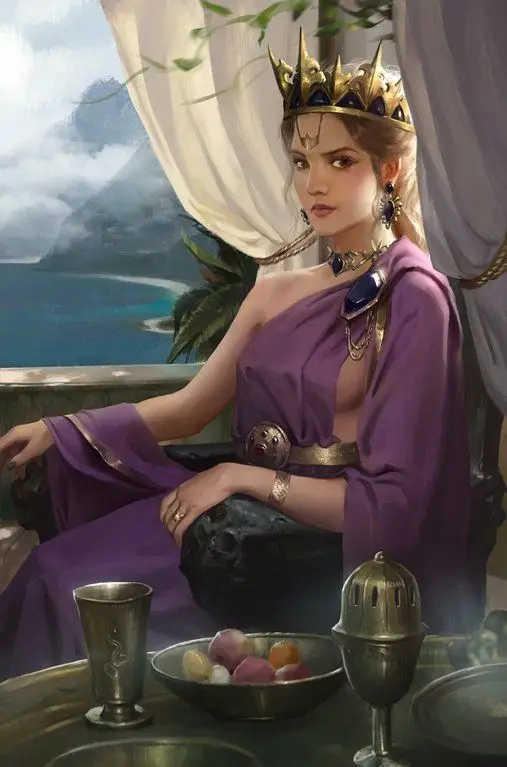
Martial Boon: 2 Ability Points
Age. Humans reach adulthood in their late teens and live less than a century.
Alignment. Humans tend toward no particular alignment. The best and the worst are found among them.
Size. Humans vary widely in height and build, from barely 5 feet to well over 6 feet tall.

In the reckonings of the world, Humans are the "Third People," born after the Äälar and Yrwin but before the awakening of the other races. They are the most numerous, the most ambitious, and the most divided of all races. While they share the same form—short-lived, adaptable, and fierce—they do not share the same soul.
Mankind is divided into two distinct lineages: the Blood-Born of Poseia, and the Godforged of the Naplica.

I. The Blood-Born (Poseians)
The Lineage of the Bear
The majority of mankind traces its roots to the frozen archipelago of Orkfjarr. They are not merely creations of the gods; they are the descendants of one.
The Divine Union Long ago, the god Ættǫrr (the Dreaming God) defied the laws of Clērātas to sail beyond the mists. Upon his return, filled with longing for a legacy, he copulated with his sister-wife Íækvins. From this union, the first mortals were born. These were the ancestors of the Poseian peoples.
The Departing of Children. For ages, Men dwelt in Orkfjarr. But as they multiplied, they turned their worship from the nature-gods (Varangr/Auðmaer) to Teiws, the god of Law. Ættǫrr, bitter at this betrayal, visited dreams upon the tribal leaders, whispering of golden lands across the sea to drive them away.
These "Departed" tribes spread their language and culture across the continent of Poseia. They are defined by their wanderlust, their feudal codes of law (inherited from Teiws), and their belief that they are the rightful heirs of the world.

II. The Godforged (The Men of Naplica)
The Lineage of the Forge
Far across the Thermare Sea, in the burning lands of Naplica, the race of Man has a different genesis. They do not claim descent from Ættǫrr, nor do they speak the tongues of their brethren in Poseia.
The Divine Experiment. During the Cataclysmic Wars against the dragon Hēiyào, the deities of Naplica looked west and saw the children of Ættǫrr. They saw a creature that was fragile yet possessed an infinite capacity for war and resilience. The Naplican gods did not breed; they built. Taking the red clay of the riverbanks and the fire of the desert, they crafted the Godforged. Modelled after the perfection of Ættǫrr’s children but unrelated by blood, these men were animated by divine will to serve as soldiers of deliverance.
Because they were crafted rather than born, the Men of Naplica possess a culture distinct from their western cousins. They are "Builders of Destiny," valuing monumental architecture, strict religious observance, and the mastery of the environment. Their languages are complex and unrelated to the tongues of Poseia, reflecting their separate creation.

III. Shared Nature: The Candle that Burns Twice as Bright
Despite their separate origins—one born of a God’s loins, the other of a God’s hands—the two lineages are indistinguishable to the eyes of the Elder Races.
The Curse of Time. Compared to the immortal Valäälar and the long-lived Yrwin, humans are mayflies. They rarely live a single century. Perhaps it is this brevity that drives them. A human knows they will not live to see the trees they plant, so they build empires of stone to grant them the immortality their bodies are denied.