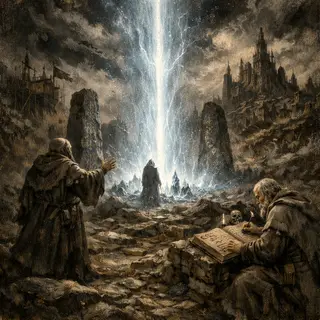
The Era of Creation began not with conquest, but with revelation. When King Locke Berathian forged alliance with the Wisp and founded Reach as a gesture of cooperation, the Wisp shared something that would change Llithe forever: the understanding that Mana was not confined to sacred groves or hidden sanctuaries, but present throughout the land itself. It flowed in soil, stone, wind, and tide. Though strongest within Wisp territory, it could be studied, guided, and shaped. That knowledge ignited a transformation unlike any Llithe had known.
Innovation surged across the kingdom. Artisans experimented with Mana infused tools that improved harvest yields and strengthened construction. Scholars began mapping subtle arcane currents. Blacksmiths explored ways to temper steel with Mana guided precision. Farmers learned to sense when soil was receptive to subtle enchantments that encouraged growth without exhausting the land. For the first time, craft and magic intertwined not as mystery, but as applied discipline.
Reach quickly emerged as the epicenter of structured advancement. Its proximity to The Wisp allowed deeper study of Mana theory and ritual containment. Advancing its economics with the creation of Hearth, expanding its goods and trades with other lands, and expanding relations with the Deso Sera, strengthening their numbers and people of interest. While Bera remained the agricultural heart of Llithe, Reach became the mind of its evolution. Workshops expanded into research halls. Early arcane academies formed. The foundation for institutions like the Sovereign Arcanum began during this period, though not yet fully formalized. The kingdom as a whole felt as though it had stepped into a brighter age.
The Highlands and Xemascus benefited in equal measure. Mining operations grew more efficient through Mana assisted surveying and reinforcement techniques. Trade routes strengthened under improved infrastructure. Maritime design advanced as shipbuilders experimented with arcane balance and sail optimization. For a time, prosperity seemed endless. The land was generous, and knowledge multiplied faster than resistance to it.
Yet beneath the glow of progress, tension stirred. The more Mana was harnessed, the more ambition grew. Innovation began to blur into competition. Philosophical divides widened between those who believed Mana should remain balanced and those who saw it as an instrument of sovereignty. Malek Berathian, observing Reach’s rising potential, began to view the capital not as a complement to Bera but as its future successor. The Era of Creation had given Llithe power. It had also given it rivalry.
By the time the Era of Creation reached its height, Llithe had transformed from a fertile kingdom into a realm of expanding capability. Cities grew, industries matured, and faith intertwined with progress. It was an age defined by optimism and possibility. Yet in its brilliance lay the seeds of fracture. The very knowledge that elevated Llithe would later sharpen its divisions, proving that creation and conflict are often born from the same spark.