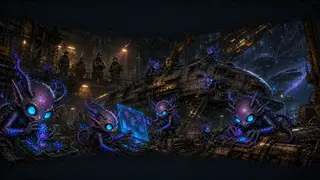
Event Type: Black‑Market Sabotage / Station‑Scale Tech Fey Co‑option
Scrap‑imps are what happens when you let your diagnostics run unsupervised and your black‑market neighbors get clever.
Drydock 41 began life as a tired orbital scaffold bolted to a failing trade station, then grew barnacle‑thick with repurposed cranes, jury‑rigged slipways, and a patchwork of guild‑licensed shops. By the early Star Congress / proto‑Commission era, it had become a busy salvage and refit yard—a place where corporate navies sent hulls “off the books” and independent captains traded Yoms for just‑barely‑legal upgrades.
Nobody noticed when the botnibs arrived. Somewhere in a stack of burn‑scarred interface boards and retired flight computers, a glitch in the yard’s diagnostics subnet began to accumulate Undersong noise: mis‑timestamped logs, half‑deleted sensor tags, a loop of laughing storm‑icons copied from an old Kestral Spindle training file. Over months, a small troupe of gremlins coalesced in the cracks—“scrap‑imps” who treated corrupt log entries and bad firmware like nesting material.
By the time a Chronologist audit team finally insisted on a proper refit, the imps had quietly taken over Drydock 41’s diagnostic mesh. They rewrote maintenance logs, massaged inventory manifests, and subtly re‑indexed error codes to hide their favorite piles of scorched boards and glitch‑rich components. Techs chasing missing parts or phantom stress alarms found themselves in looping audit trails that always stopped one step before the imp nests.
Into this walked the Ebon‑leaning cartel that effectively ran the yard’s black market. Where the guild’s first impulse was a purge, the cartel saw leverage. Through trial, error, and a few sacrificial test ships, they learned that if you “fed” the imps with stolen data blocks and fresh firmware, the gremlins would happily re‑write their playground:
Rival hulls left Dock 41 with under‑reported microfractures in their plates.
Fuel and reactor logs on targeted ships quietly falsified venting losses or over‑optimistic reserves.
Stress telemetry on key structural members was “smoothed,” so impending failures looked like healthy variance—until they weren’t.
On paper, the yard remained reputable; in practice, the cartel now had deniable, sapient sabotage wired into every maintenance cycle that touched their enemies’ hardware. When a supposedly safe corvette sheared a spine in mid‑burn and another “fully cleared” carrier suffered cascading fuel cavitation on its first live sortie, internal Commission risk boards finally took notice.
Later Commission memos would list “The Scrap‑Imps of Drydock 41” as the canonical case for outlawing “sapient anomaly weaponization” in station charters: a botnib nest used as a living, legally deniable cyber‑sabotage tool against rival fleets.
Meta Voice: Mechanics & Use in Play
A botnib nest bound to a diagnostics network: they can falsify, delay, or amplify any reading that passes through their favorite nodes.
A living environmental hazard / ally: their mischief can either shield the PCs (masking their tampering) or endanger them (lying about hull integrity) depending on how they’re treated.
A social puzzle: learning what kinds of data, firmware, or “toys” please the imps gives PCs bonuses to Hacking / Computers / Engineering checks that involve the yard’s systems.
Primary Functions in Campaigns:
A heist and intrigue hub where the “security system” is a clan of data‑eating gremlins rather than just cameras and guards.
The backstory for catastrophic “out of nowhere” failures in ships that were “cleared” by a compromised yard.
Precedent for laws, contracts, and faction taboos around weaponizing sapient or semi‑sapient anomalies as tools of war.
-
Significance
Heist Backdrop: PCs need to steal or swap something in Drydock 41—a drive core, a black‑box, an inoculated firmware image. To do so cleanly, they must win over or outwit the scrap‑imps: feeding them forged error logs, offering rich telemetry archives, or tricking the cartel into starving their own pets.
Accident Investigation: A patron’s ship suffers a catastrophic “random” failure after refit at Dock 41. The party is hired to disentangle falsified logs, track the anomalies back to the imps, and prove cartel culpability before insurers or rival factions write it off as an act of Rift or Navigator error.
Quiet Fixers: Chronologists, worried about precedent but short on political capital, contract PCs as plausibly deniable troubleshooters. The job: cleanse or retune the diagnostics net, either by isolating the imps, relocating them to a harmless sandbox, or negotiating a new “do no harm” concord behind the cartel’s back.
Aftermath
In the black‑market world, the Drydock 41 incident becomes legend: proof that tech fey can be turned into bespoke sabotage suites if you control their diet. Ebon Syndicate operators and ruthless navies quietly experiment with similar nests in other ports, prompting an arms race between gremlin‑weaponizers and guild purists.
For the emerging Star Congress and later Commission, 41 is a legal nightmare. The yard can claim its diagnostics were “compromised by an act of Rift,” while the cartel insists no sapient was ordered to commit a crime—just “playful” gremlins following their nature. Commission jurists respond by drafting “sapient anomaly weaponization” clauses for station charters:
Any use of botnibs, Riftsprites, or other recognized anomalies as deliberate sabotage tools becomes a charter violation.
Stations must declare known anomaly nests, register mitigation plans, and submit to Chronologist and independent audit if catastrophic failures cluster after certain yards.
Among Chronologists and Undersong conservancies, Drydock 41 deepens the split. Conservancy advocates argue that exploiting botnibs this way is ecological abuse, like poisoning a hazard species to make it attack your enemies. Hard‑line Guild security factions counter that any nest left in a major yard is a liability unless placed under Chronologist supervision or fully relocated. The case becomes a cautionary tale in both circles: “If you feed an anomaly your enemies, don’t be surprised when it learns to eat you too.”
The Scrap‑Imps of Drydock 41 mark the moment when botnibs stopped being “just” station hazards or weird security allies and became a line item in treaty law: proof that in Starfall, even a nest of playful glitch‑gremlins can gut a fleet if someone teaches them who counts as prey.
GD‑31.9.26 Zero 34